





































































































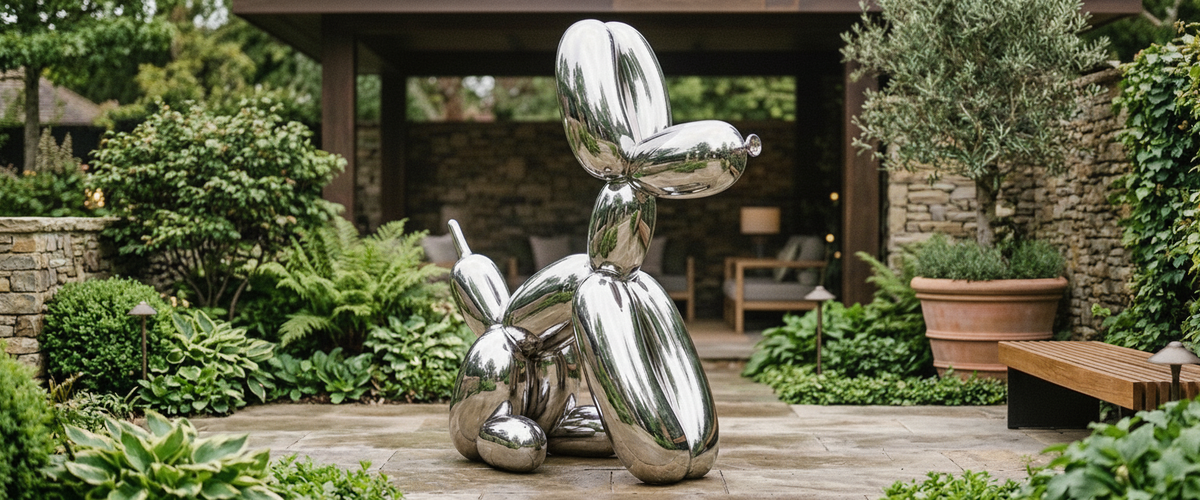

Most balloon dog sculptures fail in the same half inch of surface: the knot where the neck twists into the chest. Get that join right and the whole piece reads as taut, inflated, weirdly alive. Get it wrong and you have a cartoon dog with a seam in it. Buyers rarely articulate that when they call us, but it is what they are reacting to when they say a piece looks cheap in photos. Scale, gloss and material matter too, and we will get to all of them, though the twist is where your eye lands first.

Key Takeaways
The join is the tell. Crisp, slightly compressed twists where limbs meet the body separate a convincing balloon dog sculpture from a novelty casting.
Finish changes the meaning. Mirror chrome absorbs your room; candy gloss keeps the object playful and self-contained.
Material decides lifespan. Fiberglass and resin suit interiors and sheltered terraces; stainless steel is the choice for permanent outdoor installation.
Reflections are inherited. A glass lobby gives you a hundred versions of the sculpture, a walled courtyard gives you one.
Gloss needs a routine. Fingerprints, dust and UV are the three things that age a high-shine surface, not impact.
Bespoke is normal here. Color, scale and base engineering are all specifiable; budget follows material, size, complexity and installation, so ask for a tailored quote.
Who Made the Balloon Dog Sculpture, and Where Is the Blue One?
The balloon dog entered art history through Jeff Koons, whose Balloon Dog series of the 1990s produced five unique versions in mirror-polished stainless steel with transparent color coating, each standing over ten feet tall (about 3.1 m). If you are asking where the balloon dog sculpture is located, the answer depends on the color. Balloon Dog (Blue) sits in the collection of The Broad in Los Angeles. Others live in private hands and travel to exhibitions, which is why sightings pop up everywhere from museum roofs to art fair plazas.
That lineage matters commercially. Ask about a balloon dog sculpture artist and most people expect the pop-inflatable idiom: high gloss, no visible tooling, colors that belong on candy rather than on bronze. When we produce balloon-form work at Giant Sculptures, we are working within that visual language while making something original for the client, not copying a specific artwork. Good makers in this genre are judged on surface discipline and proportion, both of which are harder than they look.

Where the Twist Meets the Limb
Look at any balloon animal in the flesh. The rubber bulges either side of a twist and pinches tight at the center, and the pinch is never perfectly symmetrical. Cheap castings smooth that away because it is fussy to mold and even fussier to finish. Better pieces keep the asymmetry, keep the slight taper along each limb, and hold a clean specular highlight that runs uninterrupted down the length of a leg. Run your eye along that highlight. If it wobbles, the surface is not true.
The pinch at the twist should stay slightly asymmetrical, with the highlight running clean along each limb.
Smaller pieces are a fair way to audit a maker before committing to scale. At console or plinth height, something like the Bramhall Silver Balloon Dog Sculpture at 54cm (about 21 in) is inspected at arm's length, which is exactly the distance at which sloppy joins and a soft mirror finish give themselves away.
Mirror Polish, Candy Coat or Chrome
Three finishes dominate this genre and each tells a different joke. A true mirror finish, whether polished stainless or a chromed composite, hands the surrounding space back to the viewer; the dog becomes a distorting lens, and the wit comes from watching your own living room bend around a balloon. Candy gloss in a saturated color does the opposite. It keeps the object emphatically an object, and it photographs beautifully against planting or pale stone.
There is a middle option people forget: a deep, warm satin. In a paneled study or a Napa dining room where full chrome would fight the joinery, a lower-sheen color such as the Cranford Brown Balloon Dog Sculpture at 71cm (roughly 28 in) is closer to the right register. Satin also forgives fingerprints, which anyone who has owned a mirror-finish piece near a hallway will appreciate.

Fiberglass, Resin or Stainless Steel
Weight and weather are the two questions. Fiberglass and resin composites give you a hollow, relatively light form that can be moved by two people, wall-anchored or set on a plinth without structural work; they take automotive-grade paint superbly, which is why most pieces in this genre are built that way. They are best kept indoors or under real shelter, because UV and freeze-thaw cycles will eventually dull a clear coat.
For a permanent outdoor commission, fabricated stainless steel is the honest answer. It holds a polish, it welds cleanly at the twists, and in coastal air the grade choice becomes critical; 316 outperforms 304 near salt spray, as the Nickel Institute sets out in its guidance on stainless in aggressive environments. We have had this exact conversation with clients in Palm Beach and on Long Island, where an inland specification would have started tea-staining within two seasons. Where the setting is a bronze-and-stone garden rather than a gloss interior, a figurative counterweight like the Traditional Boy and Dog Bronze Sculpture - 150cm carries the dog theme in a material that patinates instead of polishing, and it asks nothing of you in maintenance.
A Giant Balloon Dog Sculpture in a Glass Lobby Versus a Walled Courtyard
Reflective sculpture inherits its surroundings, so choose surroundings you actually like. A giant balloon dog sculpture in a glass-walled Dallas or Manhattan lobby will multiply into curtain wall, elevator doors and polished floor, which is thrilling at 9am and chaotic if the space is already busy with signage. A walled courtyard, a hedge run or a single planted backdrop gives you one clean read and lets the silhouette do the work.
A single planted backdrop gives the silhouette one clean read instead of a hundred competing reflections.
Scale should be set against the tallest thing near it, not against the floor area. At around 7 ft (210cm) a balloon-form piece reads as an occupant of the space rather than a decoration in it, and that shift happens somewhere between chest height and head height. Below that, plinth it. Our giant balloon dog sculptures collection is worth browsing with a tape measure in hand, and the large balloon dog sculptures range covers the step below lobby height; the difference between 5 ft and 8 ft (1.5 m and 2.4 m) in a real courtyard is not subtle.

Keeping a High-Gloss Surface Honest After Year Two
Impact is rarely what ruins these pieces. Neglected gloss is. A short routine keeps a surface looking factory-fresh:
Dust weekly with a clean, dry microfiber cloth, folded and turned often so grit does not travel.
Wash with pH-neutral soap and warm water. No ammonia, no solvent wipes, no abrasive pads.
Dry immediately with a second cloth to stop water spotting, especially on chrome and mirror finishes.
Apply a non-abrasive wax or ceramic sealant annually on painted composite; it is your UV buffer.
Handle with cotton gloves when repositioning. Skin oils etch clear coat over years.
Check base fixings and anchor bolts each spring, plus after any storm event.
Rotate indoor pieces away from unfiltered south-facing glass, or film the glazing.
Commissioning a Balloon Dog Sculpture in Your Own Colorway
Bespoke work in this genre follows a predictable path. We agree the pose and proportion first, usually against reference images and a scale drawing set in your actual site. A maquette or digital model follows so you can approve the twist geometry before anything is built at size. Color is matched to a physical sample sprayed on the same substrate as the finished piece, because a chip on paper lies about gloss. Then engineering: base plate, internal armature, wind loading and anchoring for outdoor sites.
Two things clients underestimate. First, access. Measure gates, stair turns and elevator depths before you fall in love with a size. Second, finish sign-off. Approve the sample in the light the sculpture will live in, not in a studio bay. Cost depends on material, scale, complexity, structural engineering, installation and the finishing schedule, so we quote each commission individually rather than working from a list. If you want a starting point, the wider balloon dog sculptures range and our dog statues and sculptures collection show the tonal span from playful pop to serious garden bronze, and either can be the brief for something built to your own specification.
For wider placement ideas, How to Place a Large Bronze Mermaid Statue so It Reads Like Art is useful companion reading before finalising the setting and sightlines.