


















































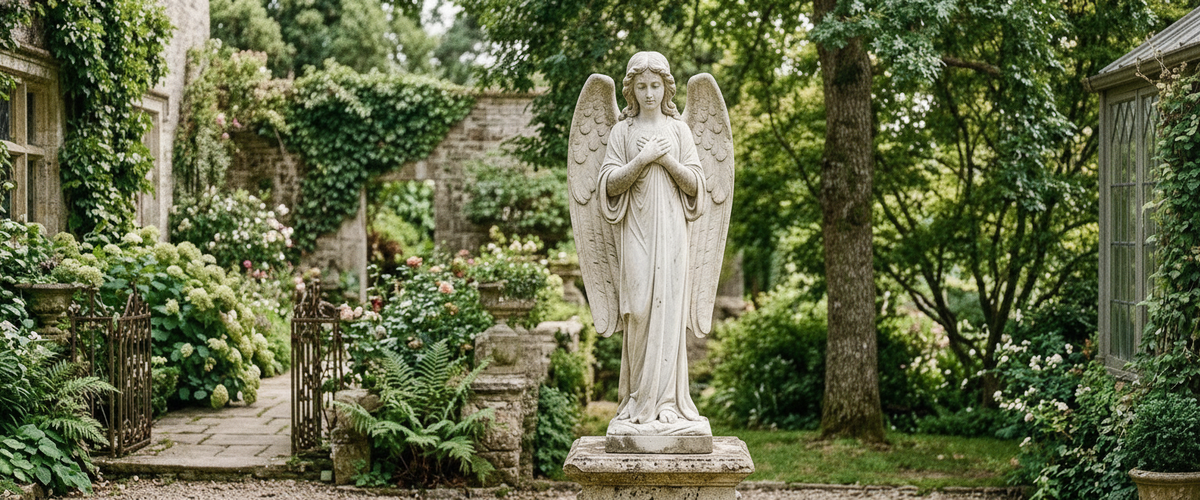

The first part of a garden angel to fail is almost never the face. It is the trailing edge of a wing, the feather tip that sits three quarters of an inch proud of everything around it, catching a wheelbarrow handle or a hard frost. If you are shopping for an angel statue for garden placement, that thin edge tells you more about the piece's future than the carving of the eyes ever will. Wings are the whole engineering problem of the subject, and most buyers only look at them last.
Angels have been in gardens for centuries because they do something no abstract form can: they suggest watchfulness. But a figure with two outstretched wings, fingers, drapery folds and a raised chin is a catalog of vulnerable geometry. Choose the material and the position with that in mind and the piece outlasts you.

Key Takeaways
Wing edges are the thinnest section in any mould or block, so folded or leaf-form wings survive knocks far better than fully spread ones.
Cast stone tends to show its first hairline within a few winters if water is allowed to sit in a fold or on a flat wing surface.
Resin chalks under UV long before it yellows. The surface goes dusty and matte, and no wax brings it back.
Bronze holds verdigris beautifully; the plinth below it does not. Copper salts streak stone and concrete.
North-facing borders keep figures permanently damp, which drives moss, biological staining and worse freeze damage.
Repairs to wingtips, hands and fingers almost always show. Prevention is the only clean answer.
Trailing Wing Edges: The First Thing to Chip
In marble carving and in casting alike, the trailing wing edge is where the material runs thinnest and where the maker has least room to build strength. On a spread-wing figure, that edge can be a fraction of an inch thick over a span of two feet. It survives the studio and the crate and then meets a strimmer line, a ladder, or an ice-loaded feather tip in February.
The design answer is geometry, not thickness alone. Wings that fold in toward the body, or that resolve into a stylized leaf form, keep their mass close to the core. In a working garden with mowers, dogs and narrow paths, a leaf-form wing of the kind carved on the Leaf-Winged Angel Marble Outdoor Sculpture, around 5 feet 7 inches (170 cm), is the safer geometry: it reads as delicate at distance while carrying far more section than its silhouette suggests.
Leaf-form wings keep mass close to the body, so the most exposed edge is never the thinnest one.

Cast Stone Through Frost-Thaw: The Hairline That Opens Where Water Sits
Cast stone is a cementitious composite, and its enemy is water held in the piece when temperatures cross freezing. Water expands roughly nine percent as it turns to ice, and each cycle widens whatever void it found. The US National Park Service guidance on cast stone is blunt about the pattern: deterioration usually starts where water collects or where a joint lets moisture in, then propagates.
Practically, that means the flat upper surface of a wing, the hollow of a cupped hand and the base seam are the danger zones. A client in the Hudson Valley sent us photographs of a cast stone angel statue for garden display, bought elsewhere, perfect after two winters and cracked along the left wing root in the third. Water had been sitting in a shallow drapery fold and running into a casting void. Nothing about the piece looked wrong until it did.
Resin Under UV Goes Chalky Long Before It Goes Yellow
Buyers worry about resin yellowing. The more common outcome is chalking: the binder at the surface degrades under ultraviolet light, pigment powders off, and the piece turns dusty and flat. Wipe a finger across it and you get a gray smear. That is not dirt, it is the sculpture leaving. In high-UV regions such as Arizona, Texas and Southern California, a resin angel can lose its surface character in a handful of seasons, and unlike stone it has no depth of material to weather into. Resin has a place indoors and in shaded courtyards. As a permanent angel statue for garden focal points, it is the wrong long-term bet.
Bronze Drapery Holds Verdigris and the Plinth Below Holds the Streaks
Bronze is the most forgiving material for a figure with wings, because you can cast a thin trailing edge that is still metal and still tough. The patina develops into the drapery folds and gives the piece the depth people associate with old European garden statuary. The trade-off sits underneath. Copper corrosion products wash down in rain and stain porous stone or concrete, and those green-brown runs are stubborn. Detail the plinth with a drip edge, use a dense stone with low absorption, or accept the streaking as part of the piece's age.
A drip edge on the plinth is what keeps copper run-off from writing green lines down the stone.
Water features magnify all of this. Once you move to a bronze at the scale of the Monumental Classical Winged Angel and Cherub Fountain Bronze Fountain - 320cm, the basin has to be designed for constant splash-back, and hard water needs a plan for mineral deposits before the pump is ever switched on. Ask about water chemistry at the design stage, not after your first summer of scale lines.

North-Facing Borders and the Figure That Never Fully Dries
Position changes lifespan more than most people expect. A north-facing border in a walled garden may never give a sculpture a full day of drying sun. Persistent damp brings algae, moss and lichen, and it keeps porous materials saturated going into a freeze. Marble handles this better than cast stone, and bronze better again, but any angel statue for garden shade needs airflow: lift it on a plinth, pull it eight to twelve inches (20 to 30 cm) clear of hedging, and keep irrigation heads pointed away from it.
If your only strong sightline is a shaded one, put the durability into the material and the height into the silhouette. Carved marble at the scale of the Blooming Guardian Angel, about 7 feet 3 inches (220 cm), will take that microclimate for decades, gathering the soft biological patina that many collectors actively want rather than fighting it.
Repairs That Always Show
Three repairs are visible forever under raking light: a filled wingtip, a re-pinned hand, and a replaced finger. Marble fills never match the translucency of the surrounding stone, which is why conservation practice leans hard on preventive care rather than restoration; the Getty Conservation Institute has published extensively on stone deterioration and the limits of intervention. Bronze is kinder, since a skilled foundry can weld, chase and re-patinate a break, though a new patina on old metal takes years to blend. Plan the piece so it never gets hit.
Choosing an Angel Statue for Garden Placement: Decision Criteria
For wider placement ideas, Guardian Angel Statues and Sculptures: Get the Gaze and the Scale Right is useful companion reading before finalising the setting and sightlines.
Traffic: within reach of paths, play or maintenance equipment? Choose folded wings and bronze or marble over cast stone.
Climate: hard freeze zones favor bronze and dense marble. High-UV zones rule out resin outdoors.
Aspect: north-facing or heavily shaded? Prioritize non-porous materials and raised, ventilated mounting.
Sightline distance: viewed from 60 feet (18 m) across a lawn, you need scale and silhouette. At 6 feet on a terrace, you need surface quality and finished detail.
Foundation: a tall figure needs a designed pad and dowel or pin fixing, sized to the piece and the ground conditions.
Budget: cost tracks material, scale, carving or casting complexity, engineering, finishing and installation. Ask for a tailored quote against your site rather than guessing from a category.

Ten Minutes Each Spring
Routine care on an angel statue for garden use is genuinely brief. Doing it prevents almost everything above.
Rinse with clean water and a soft brush, working from the top down. No pressure washer.
Clear standing water traps: wing tops, cupped hands, drapery hollows, the base seam.
Run a fingertip along every trailing wing edge and check for new chips or grittiness.
Inspect the plinth joint and the fixing for movement after winter heave.
Cut back planting that touches the figure, and re-aim any sprinkler hitting it.
On bronze, apply a fresh coat of a suitable microcrystalline wax while the metal is dry and above about 50°F (10°C).
Commissioning a Piece That Is Built for Your Site
Most of the failures we see arrive with pieces designed for a showroom rather than a specific garden. When we commission an angel statue for garden installation, we work backward from the site: prevailing weather, aspect, viewing distance, access for delivery and craning, and the fixing detail into the ground. Wing geometry gets adjusted for exposure. Plinth stone gets chosen against the metal above it. Wall thickness in a casting gets specified where the hazard is, not evenly across the piece.
The angel statues and sculptures collection is the place to compare poses and scales, while the bronze angel and cherub statues suit anyone who wants fine wing detail in a metal that can take a knock. For memorial gardens and chapel grounds, the wider religious statues collection covers related subjects at similar scale. Giant Sculptures works on bespoke commissions worldwide, and the conversation that saves you money is the one before the crate is built, not the one after the third winter.