





































































































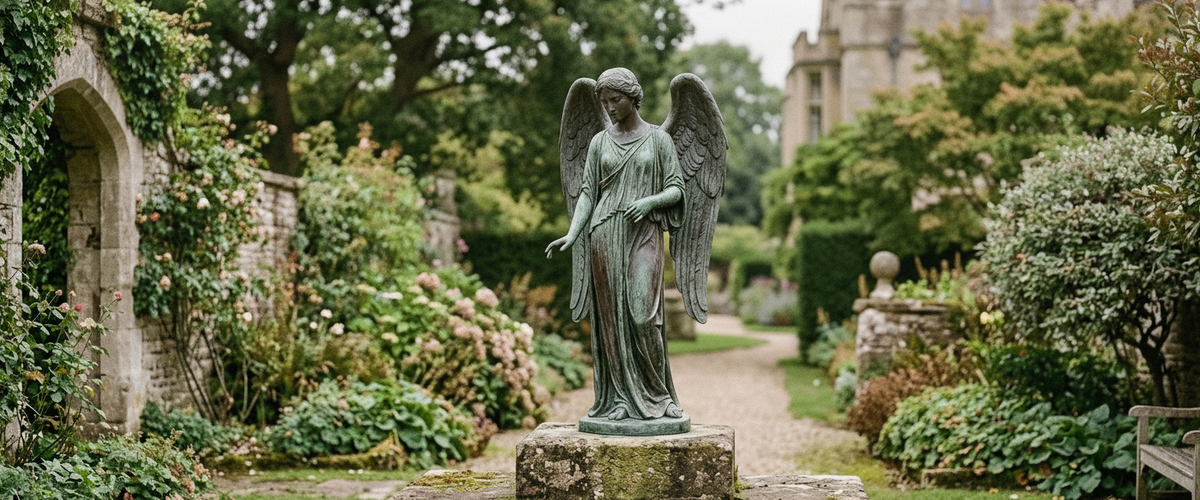

An angel with the wrong gaze will nag at you every time you walk past it, and it will never tell you why. Buyers shopping guardian angel statues and sculptures for gates, lawns and memorial gardens open the conversation with height, then find that the one specification settling everything is where the sculpted eyes land. This guide covers the five decisions that decide whether a figure holds its space: role, eye line, wingspan, material and inscription. Wingspan and plinth mass matter enormously on guardian angel statues and sculptures, and they are engineering problems with clean answers. The face is the part buyers get wrong, and it is the part you cannot fix once the piece is cast or carved.
What follows comes from pieces we have cast, carved and installed: how to tell a guardian figure from a memorial or devotional one, where to set the eyes, what a pair of raised wings does in coastal wind, and how marble, bronze and cast stone actually behave after five wet winters.

Quick Answer: Settle These Five Things First
Role: guardian, memorial or devotional. Guardian angel statues and sculptures split into three different figures, not three finishes of the same one.
Eye line: level gaze to greet visitors, downcast gaze to console. Plinth height then follows the gaze, not the other way around.
Wingspan: the widest point of the piece, the biggest wind load, and the number that decides your access route.
Material: bronze for exposure and longevity, marble for the classical carved face, cast stone only where shelter is genuine.
Inscription: decide before casting or carving begins. Retrofitted lettering rarely sits right.
Guardian, Memorial or Devotional: Three Angels Buyers Routinely Confuse
Guardian angel statues and sculptures built for the guarding role face outward. Feet planted, shoulders square, wings held high or half-furled, often with an open hand or a sword point resting on the ground. It is a threshold figure, and it works when it appears to be watching something beyond the property line.
A memorial angel does the opposite. It kneels, or leans, or drapes itself over a plinth, and its attention falls inward toward the person standing in front of it. Devotional figures are different again: hands together, chin lifted, gaze angled upward and away from the viewer entirely. Buyers browsing guardian angel statues and sculptures often shortlist all three, then wonder why the samples feel inconsistent. They are reading three separate emotional instructions.
Ask yourself what you want the piece to do at seven in the morning when nobody is looking at it. That answer picks the pose.

A Downcast Gaze Consoles, a Level Gaze Greets
Eye line is the most underrated specification across guardian angel statues and sculptures. For a standing guardian at an entrance, put the sculpted eyes somewhere near an adult's own eye line, roughly 5 ft to 5 ft 6 in (1.5 to 1.7 m) above the ground the viewer is standing on. Too low and the figure reads as decorative. Too high and it becomes remote, which is fine for a chapel niche and wrong for a front gate.
A downcast angel needs the opposite treatment. Raise it. If the eyes are angled 30 or 40 degrees below horizontal, a tall plinth brings that gaze down onto whoever is standing or sitting below, and the piece suddenly feels attentive rather than sleepy. We have adjusted plinth heights by as little as 4 in (10 cm) on site and watched a client's whole reaction change.
A level gaze greets; the plinth is sized to the eye line, not the other way around.
Do the test with a mock-up before you sign off on guardian angel statues and sculptures at any scale. A stack of concrete blocks and a cardboard silhouette at the real height will tell you more in ten minutes than a week of renders.
Wingspan Is a Structural Problem Long Before It Is a Beautiful One
Wings are cantilevers, and on guardian angel statues and sculptures they carry most of the risk. In marble they are the most vulnerable element on the piece, carved across the grain and reliant on internal stainless dowels at the shoulder joint. In bronze they are usually cast separately, welded, chased and blended, which is why the seam quality on a good bronze angel is invisible and on a poor one is a ridge you can feel with a thumb.
Then there is wind. A pair of raised wings behaves like a sail, and on an exposed coastal site the overturning moment at the base is real. We have shipped to enough oceanfront gardens to take it seriously. Foundation depth, anchor bolt pattern and plinth mass on guardian angel statues and sculptures all follow from wingspan.
Access is the other one. One client had a 1.9 m (6 ft 3 in) figure specified and a 32 in (81 cm) side gate. The wings were the problem, not the body, and we ended up craning over a hedge at dawn. Measure your narrowest pinch point before you fall in love with the wingspan on guardian angel statues and sculptures.

Marble, Bronze and Cast Stone After Five Wet Winters
Marble gives you the face, and with guardian angel statues and sculptures that is often the whole argument. Nothing else holds a soft cheekbone or a translucent edge of drapery quite like it. The trade-off is chemistry: rainfall is mildly acidic, and calcite dissolves slowly under it, blurring fine detail on exposed carving over decades. The US EPA's summary of acid rain effects explains the mechanism plainly. Under a portico, or in a dry inland garden, marble ages gracefully. On a rain-lashed elevation it wants inspection and gentle cleaning.
Bronze is the long-game choice for open ground. Properly patinated and waxed, bronze guardian angel statues and sculptures are still recognizably themselves after fifty winters, and maintenance amounts to washing and rewaxing on a sensible cycle; Historic England's guidance on metals is a good grounding for anyone specifying outdoor metalwork. Cast stone and composite sit lower down the list for exposed work: freeze-thaw cycling through a hard winter finds every void, and spalled wing tips are not repairable in any convincing way.
Garden Gate, Lawn Edge and Forecourt: Three Scales of One Figure
At a garden gate, think in pairs and think modest. Two guardian angel statues and sculptures at chest height frame an entrance better than one large one, and the same principle governs any paired threshold guardian: a matched pair such as the Large Traditional Chinese Guardian Lion Bronze Sculpture (Scalloped Plinth) - 140cm at 140cm (about 4 ft 7 in) holds a gateway through symmetry rather than sheer size. If your angel is going to stand alone, it has to work harder for the same effect.
At a lawn edge or the end of a walk, a single standing guardian angel sculpture wants roughly life size or a touch above, with clear sky behind it. Backdrop matters more than height here. A dark yew hedge will make a pale marble figure sing; a busy mixed border will swallow it.
Raised on a taller plinth, a downcast figure reads as attentive rather than sleepy.
Commercial forecourts, hotel arrival courts and memorial gardens are where the largest guardian angel statues and sculptures, at ten feet and beyond, earn their keep, especially with water. Where an arrival court needs an axis and a sound as well as a silhouette, a piece on the scale of the Monumental Classical Winged Angel and Cherub Fountain in bronze at 320cm (around 10 ft 6 in) sets the geometry of the whole space, and moving water changes how people use it. Plan drainage, pump access and winter shutdown at design stage, not after installation.

Plaques and Inscriptions: Where an Angel Stops Being Decoration
An inscription turns guardian angel statues and sculptures into markers, and that is a serious change. Keep the text short. A name, two dates, one line at most. V-cut incised lettering carved into the plinth stone ages far better than an applied plate, though a cast bronze plaque with raised letters and a recessed field is an excellent second option and can be patinated to match the figure.
Specify letter height against viewing distance, and leave generous margins. The most common regret we see is lettering crammed edge to edge on a plinth face that was never sized for it. Decide on the wording before the plinth is cut.
Buyer's Checklist for Guardian Angel Statues and Sculptures
Confirmed role: guardian, memorial or devotional
Sculpted eye line height agreed and mocked up on site
Full wingspan measured against every gate, path and doorway on the delivery route
Foundation, anchor detail and plinth mass sized for wind exposure
Material matched to exposure: bronze for open sites, marble where shelter or climate allows
Patina or stone finish sampled in daylight, not under studio lights
Inscription wording, letter height and plinth face dimensions locked before fabrication
Care cycle understood: washing, waxing for bronze, gentle cleaning for stone
Commissioning a Bespoke Angel Through Giant Sculptures
Most of the guardian angel statues, sculptures and cherub fountains we deliver start as a catalogue piece and end up modified: a different wing position, a taller plinth, a hand opened rather than closed, a patina shifted from green toward warm brown. That is normal, and it is where our studio adds the most value. Bespoke work runs from maquette to clay to mold to cast or carve, with client sign-off at each stage.
Budget for guardian angel statues and sculptures depends on material, finished scale, pose complexity, structural engineering, installation access and finishing, so there is no honest shelf price for this kind of work. Send us the site photos, the exposure conditions and the intended role, and we will come back with a tailored quote. If you are still comparing directions, the bronze angel and cherub statues and marble sculptures collections are the fastest way to see how the same figure reads in two very different materials.
For wider placement ideas, Chinese Guardian Lion Statues: Getting the Sides, Scale and Setback Right is useful companion reading before you finalize the setting and sightlines for your guardian angel statues and sculptures.