



































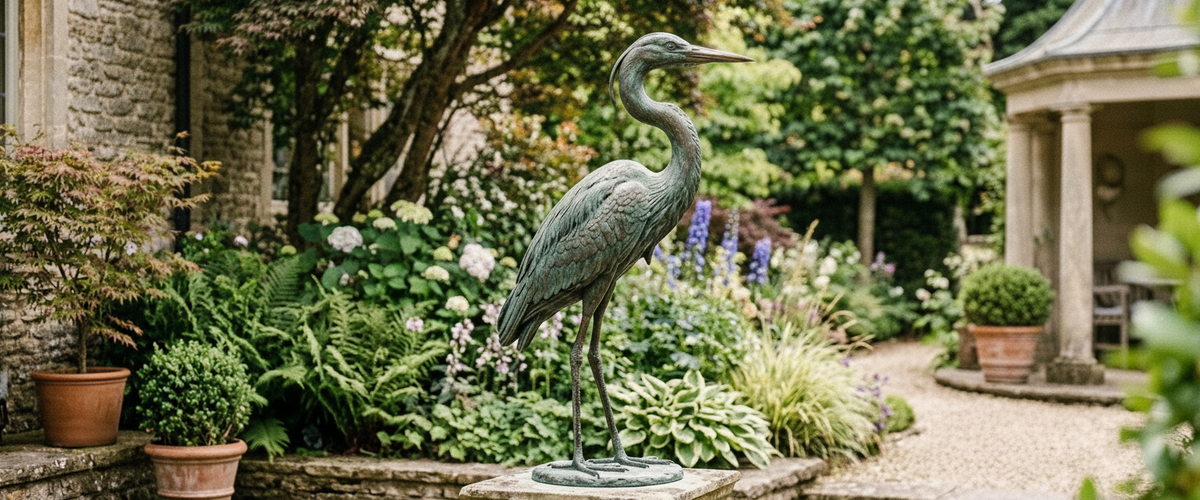

The heron is the hardest animal our studio makes, and the reason sits under the feathers: two legs that look as if they should snap. A large bird sculpture puts a full body, a long neck and a pointed beak on supports far slimmer than a deer's or a horse's. Get the engineering right and the bird looks weightless. Get it wrong and you notice the wobble on the first windy afternoon.
At a glance
Wading birds such as herons, cranes and flamingos push all their weight and wind load through two slim legs, so the hidden steel matters more than feather detail.
Bronze has a little give; stainless steel holds its line. Both work when the armature is designed for the site.
The footing under the lawn, gravel or pond edge takes more strain than the sculpture itself.
Flocks need deliberate spacing so the legs read as birds, not a fence.
Unusual stances and exposed sites usually mean a bespoke commission.

Why Herons, Cranes and Flamingos Are an Engineering Problem
A wading bird is top-heavy by design. In life, the body rides high on legs built for standing in water. Cast that proportion in metal and the center of gravity sits far above the base, while the body and neck catch every gust like a sail on a mast. Scale it up for a large bird garden sculpture, say a crane standing around 5 to 6 feet (1.5 to 1.8 m), and the use at the ankles grows faster than the legs can thicken without looking wrong.
That is the whole design tension in any large bird sculpture. Thicken the legs and the bird reads clumsy. Keep them true to life and something hidden has to do the work.
The Hidden Steel Armature Inside Large Metal Bird Sculptures
Nearly all large metal bird sculptures that stand on two legs carry a steel core. In a cast bronze heron, a solid stainless rod typically runs from the base plate up through each leg and into the hollow body, where it ties into an internal frame. The bronze you see is the skin; the rod is the skeleton. In fabricated stainless pieces, the legs are often solid bar or thick-walled tube rather than formed sheet.
One lesson we learned the slow way: on a large bird sculpture, the leg itself rarely fails. The weak point is the knee or ankle, where the rod changes direction. Early on we joined two straight sections at the bend, and later inspections showed that joint doing all the flexing. Today we run a single continuous rod through those angles wherever the pose allows.

Bronze Flexes, Stainless Resists: How Each Metal Handles Wind Through the Legs
Bronze is a copper alloy with useful ductility, which the Copper Development Association documents in detail. Under a strong gust, a bronze bird with a steel core flexes a fraction and returns. That small give is forgiving, but repeated over decades it is also why a bronze wader on an open site deserves a periodic check at the base fixings.
Stainless steel is stiffer. It barely bends, so wind load passes straight down into the bolts and footing. That suits exposed positions such as a Malibu bluff or a Texas Hill Country ranch, provided the fixings are sized for it. Near salt air, grade 316 is the standard choice because of its molybdenum content, a point the Nickel Institute covers well. Corten works beautifully for flat, stylized bird silhouettes cut from plate, but we steer clients away from it for slender round legs, where the rust layer can hold moisture at the foot.
Lawn, Gravel or Pond Margin: Where the Footing Takes the Strain
A lawn looks like stable ground for a large bird sculpture, and it is not. Soil shifts with rain and drought, and mowers clip anything at ground level. We set a concrete pad below the turf with threaded fixings, then let the grass grow back to the base plate.
Gravel is a finish, never a foundation. The pad still goes underneath; the gravel simply hides it and gives a crisp edge that suits contemporary Napa and Austin gardens.
The pond margin is where a heron or crane looks most at home and where footings work hardest. Saturated soil and freeze-thaw cycles in places like Aspen or upstate New York will heave a shallow pad, so the footing needs to go below the local frost line. Clients often want their cranes standing in the shallows. We usually set them instead on a stone ledge just above the waterline: the fixings stay dry, and the reflection still does its job.

One Bird Stands Tall, a Flock Needs Spacing
A single large bird sculpture has room to be a silhouette: one strong vertical against hedging or sky. A group behaves differently. Line up three flamingos at equal intervals and their legs become a row of uprights that reads, from the terrace, like fencing.
Break the rhythm. Vary the heights, mix poses (one preening, one head-up, one mid-stride) and stagger the birds in depth so the legs overlap irregularly from the main viewpoint. Odd numbers help. Comparing poses side by side in our bird sculptures and statues collection is a useful way to test how different stances sit together before you commit to a group.
When Leg Span Forces a Large Bird Garden Sculpture Into a Bespoke Commission
A standard large bird sculpture works when its pose and size match a proven armature. Once you change the stance, the engineering changes with it. A flamingo resting on one leg carries its entire load through a single support. Spread wings add sail area. A wider stride, a coastal hilltop or a rock outcrop as a base all call for an armature designed around that exact site, which is the core of the bespoke work Giant Sculptures takes on.
Some clients sidestep the leg problem altogether. Where the brief is a tall vertical accent beside a terrace or entrance rather than a free-standing wader, birds worked in relief around a column, as on the Clear Guardian Lion on a Gilded Bird Relief Column - 168cm, carry no load through their legs at all, so the feet and feathers can stay as delicate as the design demands.
At interior scale the support can even become the design. On a console or library shelf, a piece such as the Amber Jade Effect Pierced Disc & Brass Birds lets the disc do the holding while the brass birds simply perch, a cleaner answer than shrinking a wading bird onto pencil-thin legs.

Buyer Checklist Before You Choose
Pose: two legs, one leg or wings spread? Each step adds engineering.
Exposure: open lawn, sheltered courtyard or coastal edge decides bronze versus 316 stainless.
Ground: confirm what sits under the lawn, gravel or pond edge, and plan a pad below the frost line.
Viewpoint: where will you see it most? Plan flock spacing from there.
Ownership: ask how the armature is joined at the knees and how the fixings can be inspected.
Budget for a large bird sculpture depends on material, scale, complexity, engineering, installation and finishing, so the honest answer is a tailored quote. Send us your site photos and rough dimensions, and look through our bronze animal sculptures for a sense of finish and patina before we talk.
For wider placement ideas, Large Eagle Statue in the Garden: Why the Perch Matters More Than the Bird is useful companion reading before finalising the setting and sightlines.