
























































































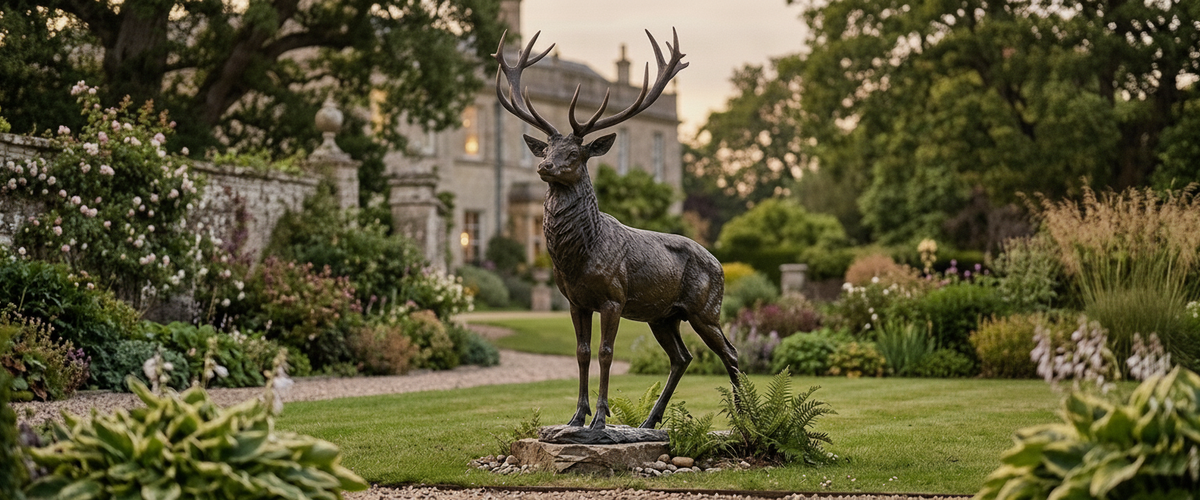

Most bronze deer end up marooned. Dead center of a lawn, squared up to the house, staring at the front door like a pet that lost its way home. The casting is often excellent; the placement kills it. A bronze deer statue works on the same instinct that makes a real deer stop your car: the animal appears at an edge, half-committed, ready to move. Put that same figure on open turf with nothing behind it and the illusion collapses into ornament.

Key Takeaways Before You Choose a Bronze Deer Statue
Place at edges, not centers. Tree lines, hedge breaks, the shoulder of a drive, the far bank of a pond.
Match the pose to the approach. A standing stag reads best in three-quarter view from where people actually walk.
Measure the antlers, not just the height. Antler spread governs path clearance and mower routes.
Ground cover changes the silhouette. Long grass hides slim legs; gravel and mown lawn expose them.
Foundations matter more than weight. A fine-legged bronze deer statue tilts over years if the base sits on soft, freezing ground.
Test the dusk sightline. Backlight is what sells antlers to the eye.
The Tree Line Trick: Why a Bronze Deer Garden Statue Belongs at the Edge
Deer live in transition zones. Woodland edge, hedgerow, the ragged line where mown grass gives up and meadow begins. Site a bronze deer garden statue three or four feet (about 0.9 to 1.2 m) inside that boundary and two things happen. The trees or shrubs behind it give the antlers something to read against, and the eye assumes the animal has just stepped out. Push the same bronze deer statue thirty feet onto open lawn and it loses its backdrop, its scale reference and its story all at once.
Set just inside the tree line, the antlers gain a backdrop and the animal reads as arriving.
A client in the Hudson Valley moved a life-size stag three times before it settled. On the lawn it looked like a trophy. Beside the pool it looked like a mistake. Tucked at the mouth of a birch stand, visible on the walk up from the barn, it finally became the thing guests stopped mid-sentence to look at. Same casting. Different edge.
Standing Stag, Grazing Doe or Leaping Buck
Pose should answer a question: where will people be standing when they first see the bronze deer statue? A standing, alert stag holds a long sightline and rewards a three-quarter view, so it suits the end of a drive or the far side of a lawn. A grazing doe is quieter and lower, and it works close to a path where you catch it in passing. A leaping buck needs air and a clean run of space behind it; crowd it against a wall and the movement stops dead.
Narrative pieces behave differently again. A figure group is a composition rather than a wildlife moment, so it wants an architectural setting: a terrace terminus, a formal axis, a clipped hedge apse. Where the garden is formal and the deer is really there to complete a classical arrangement, something like the Life-Size Classical Goddess and Deer Bronze Sculpture - 250cm at 250cm belongs on an axis rather than at a hedgerow. For a still corner near water or gravel, where the point is to slow a viewer down instead of startling them, a low, settled form such as the Large Traditional Recumbent Deer and Dharma Wheel Bronze Sculpture is closer to the right design language. The rest of the range in our bronze deer statues collection splits along the same lines, and knowing which side you are shopping on saves a lot of circling.

Antler Spans and Path Clearance
Everyone measures height. Almost nobody measures the turning circle. Antlers project forward and sideways, and on a mature stag that spread can sit at shoulder or head height for an adult walking past. Two rules we give clients siting any bronze deer statue: keep antler tips at least 24 inches (about 60 cm) clear of any path or door swing, and check the mower line before the crate leaves the studio. Ride-on decks and string trimmers have chipped more patina than weather ever will.
Delivery access counts too. Antlers are the widest, most vulnerable part of the piece, so crating, gate widths and the final carry route should be discussed before you commit to a location. We would rather redesign the mounting plate than watch a tine catch a gatepost.
Ground Cover and What It Does to a Slim Silhouette
Deer bronzes have thin legs. That is the whole appeal, and it is also the placement risk. Mown lawn shows every inch of leg, which flatters a tall stag and can make a fawn look stilted. Gravel does something better: it reads as a dry riverbed or trail, holds the color of the patina, and drains away from the base. Long meadow grass hides the lower legs entirely, which is why a bronze deer statue outdoors in a naturalized area often looks the most convincing, though you lose the piece for part of the season.
Scale follows the same logic. A courtyard, a planted bed or a covered terrace has no tree line to work against, and a life-size bronze deer statue in that space simply looks confined; a smaller figure at knee height, such as the 62cm Bramwick Bronze & Brown Deer Sculpture, sits among planting rather than fighting it, and at that size the footing work stays simple. Above roughly a metre, you are back to needing depth behind the animal.
One practical trade-off on surfaces. Grass and meadow mean string trimmers and moisture at the base; gravel means splash-back staining if the surrounding drainage is poor. Neither is wrong. Just choose knowing which maintenance job you have signed up for.

Grouping a Doe and Fawn So It Reads as a Herd
Two deer facing each other at equal spacing look like a shop display. Real groups are uneven. Set the doe forward and slightly angled away, then place the fawn behind and off to one side, roughly a body length back, partially screened by planting. Vary the direction of gaze so they are not both fixed on the same point. If you are adding a stag later, keep it well apart, ideally on the other side of a path or at a different elevation, watching over rather than joining in.
Scale discipline helps. A fawn that is simply a shrunken adult breaks the spell instantly, so proportion is worth specifying in a bespoke commission rather than assumed.
Pins, Pads and Winter Heave
A fine-legged bronze deer statue concentrates its whole weight into a few small contact points. On clay or poorly drained soil, freeze-thaw cycles lift and drop the ground repeatedly, and the piece slowly leans. Frost can penetrate several feet in northern states, which is why footings need to reach below the local frost depth rather than just sit on a paver; the University of Minnesota Extension publishes useful background on how deep that goes in cold regions.
A gravel collar drains the base and keeps string trimmers away from the legs.
Our standard advice for a bronze deer yard statue: a poured concrete pad with stainless anchor pins set into the base plate, sized to the piece and the soil, with a compacted gravel bed for drainage. In milder coastal gardens a bedded stone plinth may be enough. Patina care is separate work; a hot wax or cold wax regime once or twice a year keeps the surface stable, and the Getty Conservation Institute is a good starting point on how outdoor bronze surfaces behave over decades.

Backlighting at Dusk: The Sightline That Decides Everything
Walk the site at last light before you pour anything. Antlers only really register when there is light behind them, so a bronze deer statue set against a bright western sky, a lit pool surface or a low uplit hedge gains a second life at dusk. Front-lit from a spike light, the same piece goes flat and shows every shadow in the wrong place. Grazing light from low and behind, plus one soft cross-light, is usually all it takes.
Commissioning Checklist
Photograph the site from every direction people approach, morning and dusk.
Mark the footprint with stakes and string, including antler spread.
Confirm mower routes, path clearance and gate widths for delivery.
Decide the surface: mown lawn, gravel or meadow, and plan drainage accordingly.
Specify patina tone against your backdrop; dark browns vanish into evergreens, warmer tones hold up better.
Agree footing type and anchoring for your soil and climate.
Ask for a tailored quote. Budget depends on material, scale, complexity of the antlers and pose, engineering, finishing and installation, so a real figure needs real drawings.
Giant Sculptures builds pieces at this scale for private gardens, estates, hotels and resorts, and a bespoke bronze deer statue lets you fix pose, antler span, patina and mounting to one specific edge of one specific site. Browse the wider bronze garden statues range for context, then send site photographs. Placement conversations are always shorter when we can see the tree line.
For wider placement ideas, A Large Bronze Horse Sculpture Needs Room to Move is useful companion reading before finalising the setting and sightlines.