




























































































A sculpture in a private garden gets looked at. A sculpture at a music venue gets leaned on, sat on, vaulted over, photographed at 1am by someone holding a plastic pint, and hosed down before the gates open again. Outdoor sculptures for music venues are public furniture as much as public art, and the outdoor sculptures music venues still rate in their fifth season were designed around that fact from the first sketch.

At a Glance: What Changes When the Audience Arrives
The brief for the outdoor sculptures music venues buy shifts the moment a crowd is added to it:
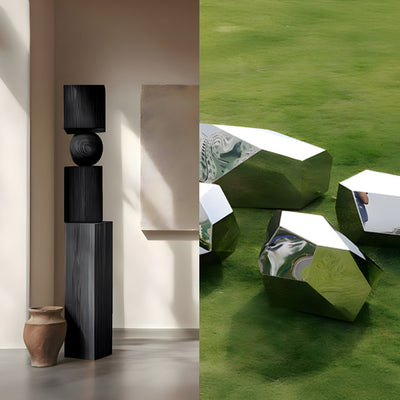
Geometry first, subject second. Any horizontal surface between knee and hip height will be used as a seat or a launch pad.
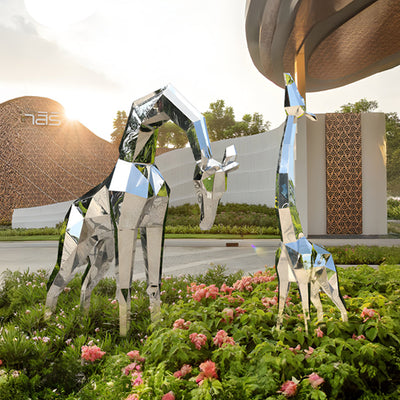
Finish beats form under moving light. Satin and brushed surfaces read cleanly under stage wash; mirror polish throws hotspots and shows every fingerprint.
Open ground means real wind load. Amphitheater sites and field stages have no shelter, so base engineering for the outdoor sculptures music venues put on open ground is a design input, not an afterthought.
Temporary sites need heavier feet. If you cannot core into a foundation, you ballast, and that mass has to be planned into the piece.
Cleanability is a purchase decision. Bronze, stainless and Corten tolerate a Monday wash cycle far better than painted or composite surfaces.
Outdoor Sculptures for Music Venues Take a Different Kind of Punishment
Five thousand people apply loads to the outdoor sculptures music venues install that a private commission never sees. Not dramatic loads, mostly. It is the accumulation: hands on the same shoulder every night, shoes on the same plinth edge, a bike lock cinched around an ankle, someone's rucksack dragging across a patinated flank for six months. Abrasion at shoulder and hip height is the first thing we see come back in condition photos, and it is almost always in the same two spots.
Then there is the crowd-flow question, which your safety officer will raise before your designer does. A piece sitting in an egress route narrows it. A piece near a bar terrace creates a dwell zone, which is often exactly what you want, as long as the dwell is planned rather than accidental. Outdoor sculptures music venues place near gates and bars belong on the same drawing as barrier lines and fire routes from the start, because moving a multi-ton base after the fact is expensive and slow.
Grounded figurative groups give a crowd somewhere to stand without giving them anywhere to climb.

Climb-Proof Geometry: Round Every Ledge Someone Will Vault
Assume climbing. Draw the outdoor sculptures music venues order on the basis that somebody will get on top of them. Most venue clients open by telling us their audience will not climb it, and then a photograph arrives with a person standing on the shoulders. The design response is not signage, it is geometry.
Kill step-like transitions. Two flat surfaces stacked at stair spacing read as an invitation.
Round or rake plinth edges so there is no comfortable sitting lip and no toe purchase.
Remove finger holds under overhangs, where a hand naturally hooks.
Close pinch points that could trap a wrist or a lanyard.
Use tamper-resistant fixings, and hide them where a screwdriver cannot sit square.
Specify full-penetration welds on anything at kick height, ground and blended, not just tacked and filled.
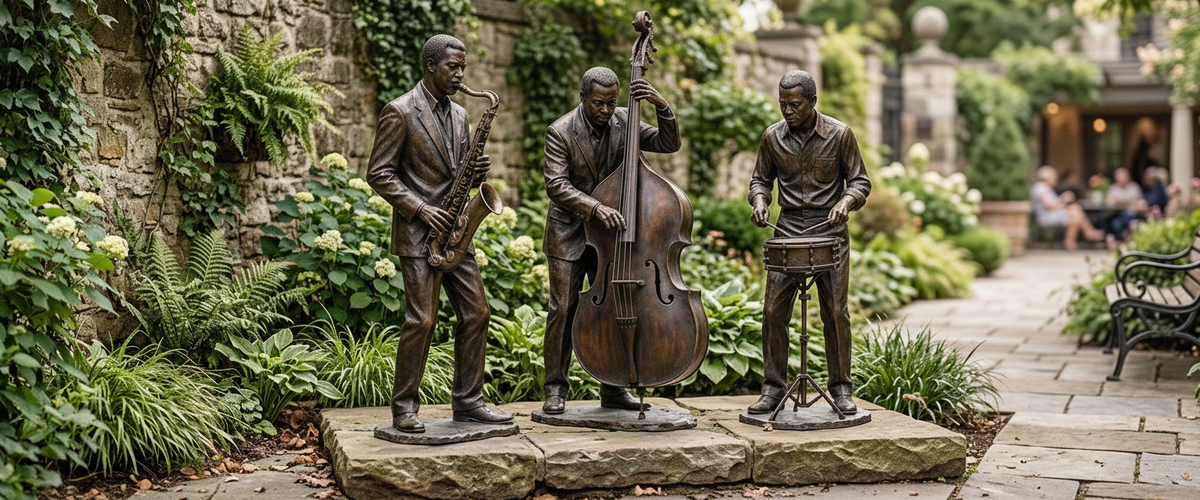
Figurative work needs particular care. A standing figure with an extended arm is a pull-up bar. Grouped figures with gaps between them create ladders. Where musicians are the subject, the safer composition for the outdoor sculptures music venues choose is planted and grounded rather than gestural: a grouping in the manner of Life-Size Jazz Band Musician Figures Bronze Sculpture - 200cm keeps instruments held close to the body, so there is very little for a hand or a foot to catch on.
Stainless, Corten and Cast Resin Under Moving Stage Light
Material choice for the outdoor sculptures music venues specify changes the moment the lighting rig fires up. Mirror-polished stainless steel is spectacular in daylight and slightly chaotic under moving heads, since it returns every beam as a hard specular point. Brushed or satin stainless gives you the same corrosion resistance with a softer return, and it hides handprints between cleans. Grade matters too: coastal and heavily gritted sites need a higher-alloy grade, and the British Stainless Steel Association publishes clear guidance on grade selection for exterior exposure.
Brushed and satin finishes scatter stage wash instead of firing it straight back at the audience.
Corten reads matte and warm on the outdoor sculptures music venues leave outside year-round, which is forgiving under colored wash light, and it needs no coating once the patina stabilizes. Its one catch is runoff staining on pale paving during the first few weathering cycles, which is why American Institute of Steel Construction guidance on weathering steel stresses detailing that sheds water cleanly. Put it on dark asphalt, gravel or planting and the issue disappears.
Bronze remains our default recommendation for the permanent figurative outdoor sculptures music venues commission. It takes hand contact well, and a rubbed patina at shoulder height eventually looks intentional rather than damaged. Cast resin has a place on touring and temporary builds where craneage and truck weight decide everything, but it is a compromise piece: lighter to move, easier to chip, and more vulnerable to long-term UV exposure. Where the brief is actually an indoor foyer or a covered bar, a lightweight wall-mounted piece such as Holoira Music Note Iridescent Ripple Acrylic 3D Wall Art is closer to the right design language, and it does the decorative job without carrying the cost of an exterior specification it will never need.

Wind Load, Ballast and Why Temporary Sites Need Heavier Feet
For wider placement ideas, Why a Life Size Outdoor Sculpture Looks Smaller the Moment It Leaves the Workshop is useful companion reading before finalizing the setting and sightlines.
Open amphitheater ground offers no shelter, so the outdoor sculptures music venues put out there behave like sails. A tall piece with a broad profile catches everything, and uplift at the leeward edge of the base is what actually lifts sculptures, not sideways push. For permanent installations, the answer is a properly sized reinforced concrete pad with cast-in anchor bolts, sized by an engineer working from your site's exposure category and soil data. Ask for a stamped drawing. Venue insurers increasingly do.
Temporary and seasonal sites are harder. With no ability to excavate, you carry the resistance in mass: a weighted steel base plate, ballast pockets filled on site, or a low plinth designed to take water or aggregate. Plan that weight into the brief for outdoor sculptures music venues run on temporary ground, because retro-fitting ballast almost always looks bolted-on. Also check what is under the grass. More than one festival site has cable ducts and drainage runs exactly where the sculpture wants to sit.
Queue Line, Bar Terrace or Main Gate: Where the Photographs Get Taken
Photographs decide where the outdoor sculptures music venues buy end up far more than sightlines do. The three highest-yield positions are the queue line, where people stand bored for twenty minutes with a phone in hand; the bar terrace, where they linger between sets; and the main gate, where the arrival shot gets taken. A gate piece needs to read from 100 feet (30 m) away and still hold up at arm's length. A terrace piece can be more detailed, because the viewing distance is intimate.
Leave a clear stand-back zone. If people need 10 to 12 feet (3 to 3.7 m) to frame the whole piece, and your walkway is 8 feet wide, you have created a bottleneck every evening. Light the outdoor sculptures music venues place along a queue on their own circuit rather than relying on the show rig, so they still work on a quiet weekday. For a terrace or courtyard, a multi-figure group such as Life-Size Contemporary Musician Trio Bronze Sculpture earns its footprint more convincingly than a single figure on a plinth, because the gaps between the figures give people somewhere to stand, and that is what turns a sculpture into a photo spot.

Fingerprints, Cider and Confetti: The Monday Morning Routine
Rinse with clean water first; the outdoor sculptures music venues hose down after a show need the grit carried away before anything touches the surface.
Use a wide fan tip and keep the pressure washer well back from patinated bronze; concentrate on the plinth, not the modelling.
Clear spilled drinks within a day or two, since sugars and acids mark wax and patina.
Pick confetti and cable ties out of undercuts by hand; blown debris packs into tight joints and holds moisture.
Check fixings and base bolts at the end of each season, along with drainage at the base.
Re-wax bronze annually, and more often at coastal or high-traffic sites.
Commissioning Outdoor Sculptures for Music Venues
Bring your structural engineer, safety officer and lighting designer into the conversation before the maquette is approved, not after. At Giant Sculptures we work through scale drawings, material samples, base engineering and fixing details as a single package, because a commission for outdoor sculptures music venues keep in place for decades is a build as much as an artwork. Come with site photos, crowd-flow drawings, prevailing wind direction and a note on whether the position is permanent or seasonal. Budgets for the outdoor sculptures music venues sign off turn on material, scale, engineering, installation and finish, so ask for a quote against your actual site rather than a headline figure. Our bronze sculptures and stainless steel sculptures give a sense of the range, then tell us what the crowd will do to it.