





































































































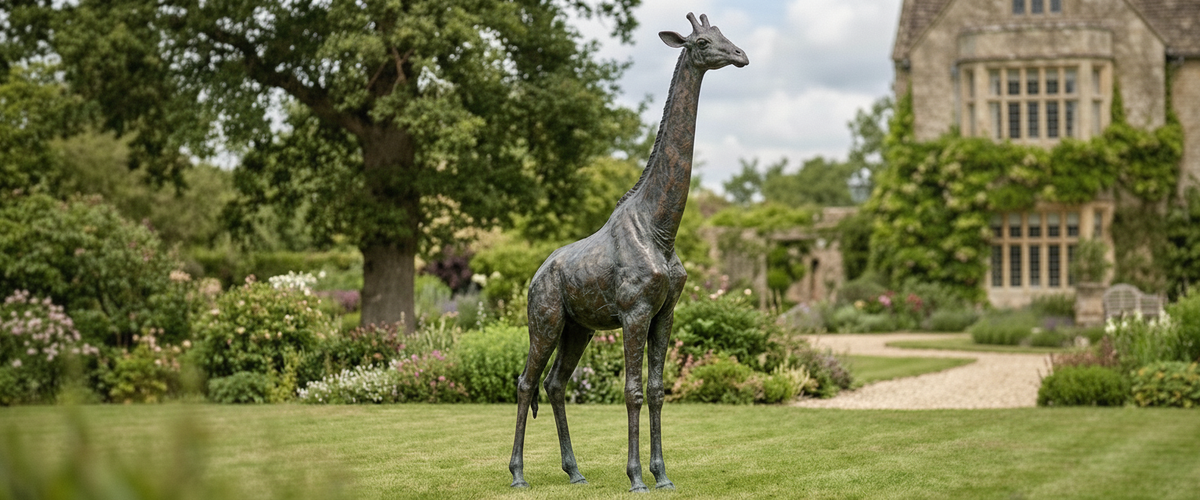

A 6 ft (1.8 m) bronze figure that fills a workshop bay can look almost apologetic once it stands on open lawn. Nothing about the casting changed; the space around it did. That single effect causes most of the buyer regret we see with a life size outdoor sculpture: the piece gets judged indoors, against walls and roof trusses, then installed somewhere with half a mile of sky behind it.

Quick Answer: What Really Controls Perceived Scale
Five things decide whether a life size outdoor sculpture keeps its presence once it is on site:
Backdrop beats height. A hedge, wall or tree canopy behind the piece does more for presence than adding a foot of bronze.
Viewing distance sets the minimum size. Doubling the distance roughly doubles the height you need for the same impact.
Plinths change the encounter. Around 8 in (200 mm) is the difference between meeting a figure and looking down on it.
Access decides everything early. Gate widths, gravel drives and crane or lift access should be measured before you sign anything.
Material changes the moving problem, not just the look. Bronze, stainless steel and resin at the same height behave completely differently on site and in wind.
Backdrop, Not Height, Makes a Life Size Outdoor Sculpture Hold Its Scale
Perceived size is relative. Put a life size stag against a yew hedge 12 ft (3.7 m) tall and it reads as substantial, because the eye has something to measure it against. Put the same stag in the middle of a two-acre paddock and it becomes a detail. Open sky is the worst backdrop for anything under about 10 ft (3 m), which is why so many estate commissions end up taller than the client first imagined.
A life size outdoor sculpture holds its scale when something solid sits behind it.
Before choosing a height, stand where people will actually stand and look at the spot. Then ask what sits behind it. Solid green, a stone wall, a pool house facade or mature trees all give the piece a frame; a hollow view does the opposite. A tall, narrow subject also survives open sites better than a broad low one. Where there is no hedge or wall to borrow scale from, a life size outdoor sculpture has to bring its own vertical reference, as the Life-Size Standing Giraffe Bronze Sculpture - 400cm (about 13 ft) does.
Gate Widths, Gravel Drives and the Lift Nobody Put in the Budget
Every life size outdoor sculpture has to reach the spot before it can be judged there. We once had a client in the Hamptons whose only route to the rear garden was a 42 in (1.07 m) side gate with a brick pier on each side. The piece was fine. The pier was not. Removing and rebuilding it cost more than the crating.
Measure the tightest point on the route, not the driveway entrance. Note overhead cables, low branches, arches and turning radii. Long gravel drives are a specific problem: a loaded truck or pallet truck will sink, and spreader boards or plate matting need arranging in advance. If a crane or telehandler is needed, that lands on the quote too. Installation planning starts weeks before the piece is finished; on larger commissions we would rather discuss the route while the armature is still being built.

Resin, Bronze and Stainless at Identical Height: Three Different Problems
Specify the same 8 ft (2.4 m) figure in three materials and you get three different site problems. Cast bronze can run to several hundred pounds and needs lifting gear plus a properly engineered base. Fabricated stainless steel is lighter and often hollow, but the polished surface marks easily and every sling point needs padding. A life size resin outdoor sculpture is light enough for two people to walk into position, which is exactly why it can be the riskiest of the three on an exposed site.
Resin outdoor sculpture also ages differently. Pigmented, UV-stabilized composites hold up well in shaded courtyards and covered loggias, and outdoor resin animal sculpture pieces suit temporary displays, retail installations and seasonal event work. For a permanent piece facing Aspen winters or Gulf Coast humidity for thirty years, bronze, Corten or marine-grade stainless is the honest recommendation. Bronze develops a protective patina that conservators actively maintain rather than strip, which is why the American Institute for Conservation treats waxing and washing as routine upkeep rather than restoration.
The same logic applies to fantasy and figurative subjects. An outdoor resin dragon sculpture works beautifully for a themed venue that repositions displays every season; where the piece is meant to still be there when the planting has matured, the Life-Size Traditional Chinese Dragon Bronze Sculpture at 220 cm is the version worth the foundry time.
The 8 Inches That Decide Whether You Meet the Piece
Plinth height is the most underrated decision in specifying a life size outdoor sculpture. A figure set flat on turf gets read as an object. Lift it 8 in (200 mm) and the eyeline shifts; you approach it rather than look down on it. Go to 24 in (600 mm) or more and it becomes monumental and slightly formal, which suits entrances and civic settings.
Plinth height decides whether a life size outdoor sculpture reads as wild or as a trophy.
Animal subjects are the exception worth noting. A crouching cougar or a grazing doe usually wants to be at ground level, because the pose depends on the animal belonging to the terrain. Set the Life-Size Contemporary Bugling Elk Bronze Sculpture - 290cm on a low natural stone slab and it reads as wild; put the same elk on a formal pedestal and it reads as a trophy. Decide which you want before the base is engineered.

Sightlines: Terrace, Drive and the Upstairs Landing Window
Most life size outdoor sculpture gets specified from a single ground-level view, then lived with from three or four. Walk the property properly. The approach along the drive gives you the first reveal. The terrace or kitchen window gives you the everyday view, often at 40 to 60 ft (12 to 18 m). The upstairs landing window gives a plan view that will expose an awkward back or a flat top to the composition.
Rotate the piece on paper before you rotate it on site. Which face carries the strongest silhouette? Where does the morning sun sit? A polished stainless form that dazzles at 8 a.m. from the breakfast room is a design decision, not an accident. Working through a range like our life size bronze statues with those three viewpoints in mind changes which subject you shortlist.
Ballast and Ground Anchors on Exposed Sites
For wider placement ideas, Bird Statues for Garden Spaces: Why Height Beats Size Every Time is useful companion reading before finalising the setting and sightlines.
A hollow life size outdoor sculpture catches wind like a sail. Outdoor resin sculptures of giraffes are the classic example: tall, broad-flanked, and light enough to move in a gust that would not trouble a bronze of the same size. Any hollow piece on a ridge, a coastal plot or an open lawn needs sand or aggregate ballast in the base cavity, a bolted steel foot plate, or ground anchors into a concrete pad sized for the piece. Fixings should be stainless to avoid rust staining down the base.
Life Size Outdoor Sculpture Site Checklist
Photograph the spot from every viewpoint the piece will be seen from, including upstairs windows.
Measure the narrowest point on the delivery route, plus overhead clearance.
Confirm ground conditions: turf, gravel, paving, slope and drainage.
Mock the height with a stake and tape, then look at it from 50 ft (15 m).
Decide plinth height and material before the base is cast or fabricated.
Check exposure to wind, salt air and irrigation spray.
Agree who supplies lifting gear, matting and labor on installation day.
Commissioning With Scale in Mind
Bespoke work lets you solve the scale problem at the design stage rather than apologizing for it afterwards. We regularly adjust a maquette's height, stance or base after seeing site photographs, because a pose that reads well at eye level in the studio can lose its line from a raised terrace. Budget for a life size outdoor sculpture depends on material, height, modeling complexity, engineering, finishing and installation, so the sensible route is a tailored quote against your actual site rather than a guess from a catalog page. Start with the view, then the subject, then the metal. Our bronze garden statues are a useful place to test which subjects hold their scale in your setting.