






































































































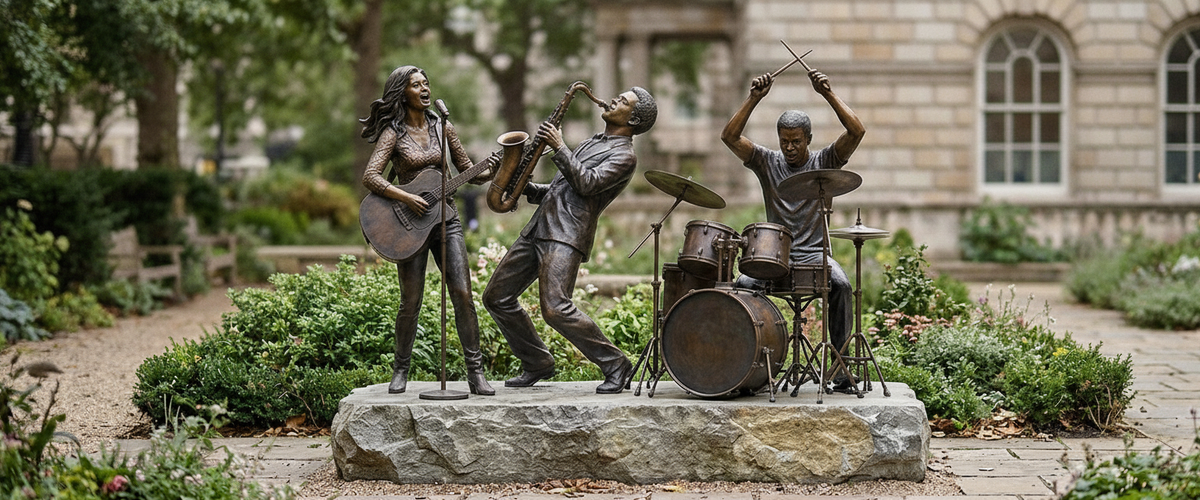

Most people will see your sculpture at 10:40 at night, holding a drink, while a lighting rig paints it magenta. That single fact rewrites the brief for outdoor sculptures for music venues. A piece that looks composed on a sunny site visit can turn into a muddy silhouette once the headliner starts. At Giant Sculptures we treat venue commissions as a separate discipline from gardens or hotel forecourts, because the audience, the light and the physical abuse are all different.

At a glance:
Design for night viewing first; daylight is the bonus.
Bold, deeply modeled forms read under uplight. Fine detail disappears.
Assume people will climb it, and engineer the base and fixings accordingly.
Bronze and stainless steel tolerate sustained low-frequency vibration far better than lightweight materials.
Decide early whether the piece is permanent or touring. The engineering is opposite.
Most of the Audience Meets the Piece Under Stage Spill, Not Daylight
Stage lighting, the real backdrop for outdoor sculptures at music venues, is saturated, moving and rarely white. Deep blues swallow dark patinas; reds flatten mid-tones. A traditional brown bronze can vanish against a night sky unless it has dedicated lighting or a lighter, warmer patina on the high points. Polished stainless steel behaves the other way: it borrows every color in the rig and throws it back, which suits some venues and overwhelms others.
Ask the production team which colors dominate their typical shows. It is a five-minute conversation that saves a great deal of regret.
Uplight from Below Flatters Bold Forms and Flattens Delicate Ones
Most venues light sculpture with ground-mounted fixtures because they are cheap to run and hard to vandalize. Uplight rewards strong silhouettes, deep undercuts and big gestures. It punishes shallow relief, fine fingers and subtle facial expression, which go flat or turn sinister.
In the studio we check poses with a lamp on the floor before signing off a model. Where a venue relies on ground-mounted fixtures, a group with instruments held clear of the body, such as the Life-Size Jazz Band Musician Figures Bronze Sculpture at roughly 6 ft 7 in (200 cm), will hold its shape far better than a single figure in a quiet, closed pose, because raised arms, horns and tilted heads throw clear shadow shapes. Keep any delicate detail at eye level, where front-of-house light can reach it.
Raised horns and open arms keep a clear silhouette under ground-mounted uplight.

Ten Thousand People Lean, Climb and Pose: Designing for the Crowd's Weight
All outdoor sculptures for music venues end up as photo spots, meeting points and, after midnight, climbing frames. Specify for that reality rather than hoping signage will stop it. Internal armatures should be sized for several adults hanging off an arm at once, and thin cantilevered elements need either reinforcement or redesign.
Group compositions help here. For a high-traffic plaza where the piece will be leaned on all night, a trio on a shared base such as the Life-Size Contemporary Musician Trio Bronze Sculpture, around 6 ft 11 in (210 cm), is a sounder choice than a lone figure on a slim plinth: the mass is spread across three bodies, so a fan leaning on one is not loading a single slender ankle. Rounded edges and no sharp protrusions at head height also matter once crowds are involved.
A shared base spreads crowd loading across three figures instead of one slender ankle.
Bass That Shakes Fixings Loose, and Why Stainless and Bronze Shrug It Off
Sub-bass arrays push sustained low-frequency energy through the ground for hours at a time. The casting itself rarely suffers; the hardware is the weak point. Anchor nuts and bolted joints can gradually back off over a season of heavy shows, which is why we specify locking fixings and an inspection after the first season as standard on venue work.
That is also why we steer outdoor sculptures for music venues toward dense cast bronze and heavy-gauge stainless steel, which have the mass and fatigue resistance to absorb that vibration without cracking welds or loosening panels. The Copper Development Association publishes useful background on how copper alloys weather outdoors, and the British Stainless Steel Association covers grade selection for exposed sites. Grade 316 stainless is the safer choice where spilled drinks, cleaning chemicals or coastal air are part of the picture.
Queue, Bar and Exit Gate: The Three Sightlines a Venue Piece Must Win
Fans spend most of their non-show time in three places. The entry queue is where anticipation builds, so a piece visible from the line becomes part of the arrival ritual. At the bar, sightlines are short and slow, which suits detail and texture. The exit gate is where the last photos get taken, so a sculpture lit and framed there earns its keep on social media long after the night ends.
A piece that wins only one of these is a decoration. A piece that wins two or more becomes the venue's landmark. When siting outdoor sculptures for music venues, walk all three routes with a site plan before choosing a location, and check that queue barriers and bar canopies will not block the view on busy nights.

A Permanent Landmark and a Touring Festival Piece Are Opposite Engineering Jobs
For wider placement ideas, Your Outdoor Wall Art Decor Needs a Lighting Plan Before It Goes Up is useful companion reading before finalising the setting and sightlines.
A permanent installation wants mass, concealed foundations and a finish that improves with age. A touring festival piece wants modular sections, lifting points, ballasted bases that need no ground penetration, and joints that survive repeated assembly. Trying to make one object do both usually produces something too heavy to tour and too compromised to stay.
For festivals, ask how the piece breaks down, how many crew it takes to erect and what it weighs per section in pounds and kilograms. For permanent sites, ask about foundation design, drainage and how the patina or polish will be maintained.
Choosing Outdoor Sculptures for Music Venues: A Buyer's Checklist
Viewing conditions: confirm typical show lighting and whether the piece will get its own fixtures.
Form: favor bold silhouettes and deep modeling over fine surface detail.
Crowd loading: get written confirmation the armature and base are engineered for climbing and leaning.
Fixings: specify locking hardware and a post-season inspection.
Material: bronze or heavy-gauge stainless steel for permanent sites; check grade against your climate.
Sightlines: test queue, bar and exit views on a site plan.
Use case: permanent or touring, decided before design starts.
Budget depends on material, scale, complexity, engineering, installation and finishing, so the useful next step is a tailored quote built around your site. Giant Sculptures handles bespoke commissions and ships worldwide, and our team can adapt an existing figurative design or develop a new piece around your venue's identity. If you are weighing finishes, our stainless steel sculptures are a good place to see how polished metal handles colored light.