






































































































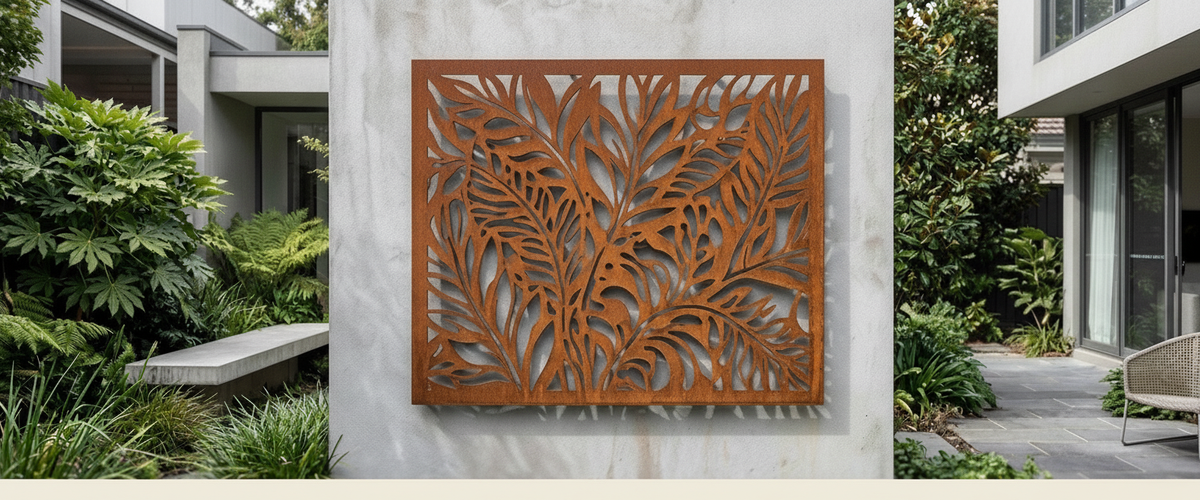

Most outdoor wall art decor is chosen at the worst possible hour. Buyers judge it at midday, in flat sun, and then mostly look at it after 7 p.m. with a drink in hand. Under noon light a Corten panel reads rich and rusty and a bronze relief looks crisp. By dusk the same pieces can go flat, muddy or disappear into the wall. Lighting is the half of the commission most buyers forget, and it decides whether the piece earns its place.
Key Takeaways
Judge the piece at the hour you use the space, not the hour you buy it.
Relief work wants grazing light; flat cut-steel panels usually want an even wash or a backlight.
Warm 2700K to 3000K suits Corten and bronze. Stainless can take slightly cooler light, but it rarely needs it.
The wall material decides where fixings and cable can go, so plan both before anyone drills.
Integrated backlighting changes the fabrication, so it has to be designed in from the start.

Chosen at Noon, Dead by Dusk: Why Daylight Is the Wrong Test
Daylight is generous. It wraps around a piece, fills every recess and flatters a weak patina. After sunset you lose all of that, and the wall becomes whatever your fixtures make of it. A common failure looks like this: a deep bronze relief is approved from photos taken at 1 p.m., then installed in a courtyard where existing soffit downlights hit it from almost straight above at a cold 4000K. The faces in the relief sink into gray. Swapping two fixtures and moving them lower can fix it in an afternoon, but it should have been on the drawing from day one.
A Corten panel under warm 2700K light at dusk.
The test is simple. Before you buy outdoor wall art and decor for a terrace, pool wall or entrance court, stand there at the time you actually use the space and look at the light that is already there. Porch lamps, pool lighting, neighbors' windows and soffit spots all land on that wall whether you plan for them or not.
Grazing Light for Relief Work, Wash Light for Flat Cut Steel
Most outdoor wall art decor falls into one of two lighting camps: relief or flat. Grazing means setting the fixture close to the wall and aiming it almost parallel to the surface, so every raised edge throws a long shadow. Cast bronze reliefs and the deeper pieces in our 3D wall art collection need this to get their depth back. A sensible starting point is 6 to 12 inches (15 to 30 cm) out from the wall, at the base or head of the piece. The closer you go, the more dramatic the texture becomes. You will also see every lump in the render behind it.
Grazing light from below brings back the depth of a bronze relief.
Flat laser-cut or water-jet steel is a different animal. A pierced Corten or stainless panel is mostly about silhouette, so grazing light only picks out the edge of the plate. A wash works better here. Use wider-beam fixtures set further back, often 2 to 3 feet (60 to 90 cm), so the panel and the wall behind it light evenly. If the panel stands off the wall on spacers, light the wall behind it and let the cut pattern cast its shadow forward.

2700K Versus Cool White: What Each Does to Corten, Bronze and Stainless
Color temperature is where good outdoor wall art decor quietly gets ruined. Corten's oxidized skin is full of orange and deep brown. Under cool white (4000K and up) it looks like dull chocolate, close to dried mud. At 2700K it glows. Bronze responds the same way: warm light lifts a brown or verdigris patina, while cool light makes green patinas look chalky. Brushed or polished stainless is the outlier because it mirrors its surroundings. It shifts with the source, and 3000K is usually the right balance between warmth and crispness.
Staying warm also keeps the neighbors happy. DarkSky International's lighting principles recommend warm color temperatures and shielded, downward-aimed fixtures to cut glare and skyglow. That matters in towns with dark-sky ordinances, such as Sedona or Flagstaff. A useful habit: check a finished patina under a 2700K lamp before signing it off, because that is how you will see it on a summer evening.

Brick, Render or Timber Cladding: Where Fixtures and Cable Runs Can Really Go
The wall limits how you light outdoor wall art decor far more than the artwork itself does. Brick is forgiving. Fix into mortar joints rather than brick faces where you can, so fixings can come out later and the joint can be repointed cleanly. Render punishes late decisions, because cable chased in after the render goes on leaves patch repairs that rarely match. On a freshly finished render wall, the usual workaround is to put uplights in the planting bed below. That works, but it is a compromise.
Timber cladding hides cable runs well behind the boards. It needs fixtures rated for wet locations and enough clearance that heat and moisture never sit against the wood. If you love the warmth of our wood wall art, keep those pieces under a covered porch or loggia, and save open walls for metal and stone. Whatever the substrate, have a licensed electrician run exterior circuits with GFCI protection.
British Winter Teatime Versus Long American Evenings: Light the Season You Use
British clients often light their outdoor wall art decor for a 4 p.m. December sunset, when a front-wall piece is mostly seen while arriving home in the dark. Clients in Texas, Arizona or Southern California usually do the opposite. They live outside in summer, the sun sets late, and the wall matters most from 8 p.m. to midnight beside a pool or outdoor kitchen. A winter piece wants a dusk timer and warm light to cut the gloom. A summer terrace piece wants dimmers, so the art sits alongside conversation and candlelight instead of competing with them.
Backlit and Integrated Lighting Belongs in the First Drawing
A backlit stainless or Corten panel that floats on a halo is one of the best effects in exterior work. It is also one of the hardest to add later. The panel needs:
standoffs deep enough to hide an LED channel
a folded return edge that conceals the light source
drainage, so water never pools on the strip
an access route to a driver that will one day need replacing
Integrated lighting behind pierced lettering or inside a relief niche can change the plate thickness, the fixing plan and sometimes the design itself. When it turns up as a change request after fabrication, the honest answer is often a remake. Raise it in the first conversation and we will engineer it in.

Outdoor Wall Art Decor Lighting Checklist
Run through these points before you commission or buy outdoor wall art decor for any exterior wall:
Have you seen the wall at the hour you will actually use it?
Is the piece relief (grazing light) or flat cut-out (wash or backlight)?
Does the color temperature suit the finish: 2700K for Corten and bronze, around 3000K for stainless?
Is the wall brick, render or timber, and has the electrician confirmed the cable route?
Do you need timers for winter arrivals or dimmers for summer evenings?
If you want backlighting, is it on the first drawing?
Are the fixtures shielded so they light the art and not the neighbors?
Budget depends on material, scale, complexity, engineering, installation and finishing, and lighting changes several of those. The most reliable route is a tailored quote that covers the piece and its light together. Browse our outdoor wall art collection for weather-ready starting points, or our wider wall art range if the wall sits under cover. Then talk to us about a bespoke piece designed for the way you live after dark.
For wider placement ideas, 3d Kitchen Wall Art That Survives Grease and Steam is useful companion reading before finalising the setting and sightlines.