





































































































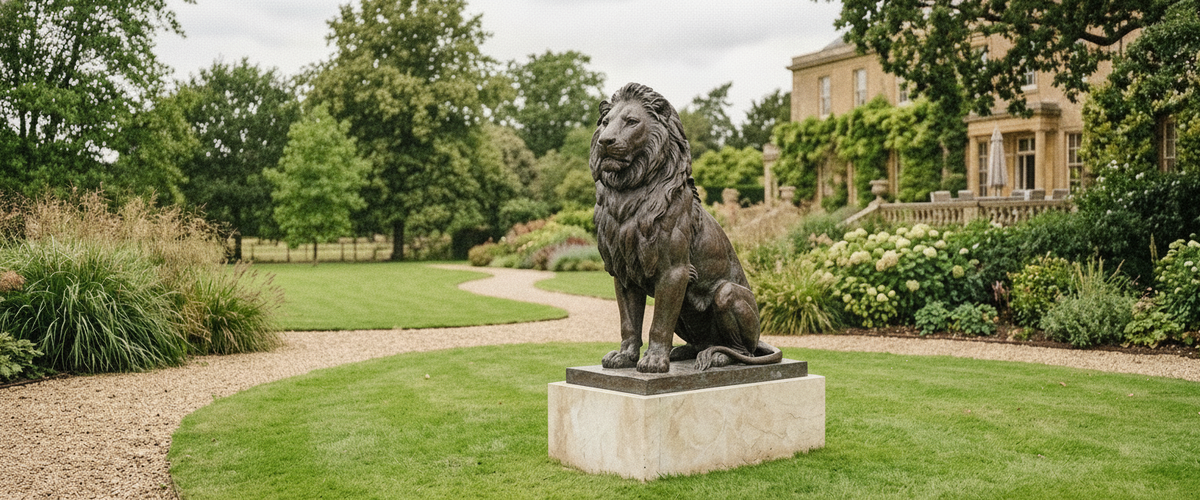

Open sky is the least forgiving light a sculpture will ever face. It floods a form from every angle at noon, flattens the modeling a sculptor spent weeks refining, and reduces a finely worked face to a pale smudge at twenty paces. That is the single biggest reason buyers are disappointed by outdoor sculptures and statues: they choose a piece for details they can see at arm's length in a showroom, then install it on a lawn where only the outline reads. Silhouette does the heavy lifting outdoors. Everything else is a bonus you get when you walk close.

At a Glance
Five things decide whether outdoor sculptures and statues earn their place on site:
Read the outline first. If the piece is unrecognizable as a black shape against the sky, it will underperform outdoors.
Match mass to position. A forecourt, a lawn edge and a terrace each want a different weight of object.
Test the backdrop before the sculpture. Hedge, stone wall and borrowed horizon change what you should buy.
Judge materials in weather, not light boxes. Bronze, stainless steel, granite and composite age in completely different directions.
Budget for what is under the ground. Footings, anchoring and frost movement decide whether a statue still stands straight in five winters.
Silhouette Does the Heavy Lifting
Squint at a photograph of any piece you are considering, or turn your phone screen brightness down until the image reduces to a shape. That shape is what a visitor sees from the driveway, the kitchen window, the far end of the pool. Strong outdoor sculptures and statues have gaps, cantilevers, raised limbs, negative space that lets light through and prints a clean profile against the sky.
Profile first: what the outline does against the sky decides how a piece performs from the drive.
Compact, closed-off forms need help. A crouched animal or a tightly folded abstract can be excellent, but it has to sit against something that gives it contrast, or be raised until it breaks the horizon line. Height helps, though not infinitely. A 4 ft (120 cm) piece on a 30 in (76 cm) plinth often reads better than a 6 ft (183 cm) piece sitting flat on turf, because the plinth lifts the outline clear of grass, planting and garden clutter.
Forecourt, Lawn Edge and Terrace Want Different Mass
A forecourt is an architectural space. It has hard edges, parked cars, a front elevation behind it, and people arriving at speed. Outdoor sculptures and statues placed here can absorb serious mass, and they usually need symmetry or a deliberate off-center anchor. Gate-flanking work is the classic answer; paired guardian figures or a pair of bronze garden statues on matched plinths give arrival a clear grammar. Scale is the trap. On a wide gravel court, a form with the bulk of the Indian Elephant in Pink Sandstone Statue - 220cm (around 7 ft 3 in) still registers as an event from the gate, where a 120 cm figure reads as something mislaid on the way to the door.
Lawn edges are different. The eye travels across open ground, so the sculpture becomes a destination, and it benefits from being seen in the round as you walk toward it. Terraces are the tightest brief of the three. You are close, often seated, often looking slightly down. Detail earns its keep here, scale must stay polite, and the piece competes with furniture and planters. Where a terrace boundary needs a sculptural face but cannot spare floor area, a vertical panel such as the Blessing Character Grey Granite Garden Screen - 200cm (about 6 ft 7 in) solves the problem more gracefully than a freestanding figure squeezed into a corner.

Test the Backdrop Before You Commit
Nothing changes how outdoor sculptures and statues read more than what sits behind them. We ask clients to do something low-tech: cut the profile out of plywood or cardboard at full size, stand it in position, and photograph it at 8am, midday and dusk. It takes an afternoon and it has saved more commissions than any rendering. A dark bronze against a mature yew hedge disappears. The same bronze against pale limestone paving or an open valley view sings.
Three backdrops, three rules. Dense green hedge wants light, reflective or pale work, or a piece with open structure so sky fills the gaps. Hard landscaping in stone or render wants tonal contrast and a form that will not compete with straight lines. A borrowed horizon, a Napa hillside, a Texas fence line, the dune grass beyond a Hamptons lawn, wants a clean profile and nothing fussy, because the sky behind it is doing all the contrast work for you.
How Materials for Outdoor Sculptures and Statues Behave in Real Weather
Cast bronze is the long game. It develops a patina that shifts with rain, sun and salt air, and with an annual wax it will outlive the house it stands beside. Coastal sites accelerate the change, which some owners love. The Getty Conservation Institute's work on outdoor sculpture conservation is a useful primer on why protective coatings and routine washing matter more than heroic restoration later.
Bronze patinates, stainless reflects, granite holds its surface. Choose the ageing you want to live with.
Stainless steel, especially marine grade, holds a mirror or satin finish and reflects its surroundings, which makes it a strong choice where you want the sculpture to borrow color from the garden. It shows water spotting and fingerprints, so it suits open positions over shaded ones. Granite and marble bring geological permanence and real weight; the black marble and grey granite pieces we ship are chosen as much for mass as for surface. Marble is more porous than granite and will soften in acidic rain over decades, which reads as age rather than damage to most owners.
Composite and fiberglass have a place: temporary installations, roof terraces with strict load limits, event work. They are light, which is the whole point and also the whole problem, because light objects need more anchoring, not less. For permanent outdoor sculptures and statues in a garden you intend to keep, metal and stone are the honest answer.
One Dominant Figure or a Group Across the Same Ground
A single dominant piece organizes a space. It sets a focal point, and everything else in the garden arranges itself in relation to it. It is also where the plinth argument pays off: a figure of moderate height carried on stone, as with the Bronze Lion on a Cream Marble Plinth - 120cm, breaks the horizon at the head of a lawn or the turn of a drive without needing the bulk of a monument. One object, one clear instruction to the eye.
A scattering of outdoor sculptures and statues does the opposite. It creates a route. Place smaller works at intervals along a path and you turn a walk into a sequence of discoveries, which suits larger acreage and estates where a single object would be lost. The trap is inconsistency. Groups need a shared logic, one material, one maker, one subject family, otherwise the effect is clutter. Path-side work at 60 to 90 cm, the sort of scale you will find across our garden statues, rewards the close look that a distant hero piece never gets.

Footings, Anchoring and the Frost That Moves a Statue by Spring
The failure we see most often with outdoor sculptures and statues is not corrosion. It is tilt. A heavy statue set on compacted gravel or a shallow pad in a freeze-thaw climate will move, because water in the soil expands as it freezes and lifts whatever sits above it. Frost heave is well documented in soils and extension literature, including guidance from University of Minnesota Extension, and the fix is boring and non-negotiable: take the footing below the local frost line, use a free-draining sub-base, and tie the plinth to the footing with stainless anchors rather than trusting weight alone.
One Aspen commission taught us this the expensive way. A stone-based piece went in during a warm September on a pad that looked more than adequate. By April it had rotated a few degrees and the joint had opened. We rebuilt the footing deeper, added a drainage layer, and it has not moved since. Engineered baseplates, wind loading calculations and lifting plans matter on anything above head height, and anchor design belongs in the specification from the start, not in a conversation on site with the crane already booked.
Buyer's Checklist
Photograph the site at three times of day before choosing anything.
Mock up the footprint at full scale, including plinth height.
Check the silhouette against the actual backdrop, not a studio image.
Confirm access: gate widths, ground protection, crane or hiab standing room.
Ask about frost depth and soil type at your address, then specify the footing to match.
Agree the finish schedule up front: waxing for bronze, cleaning for stainless, sealing for porous stone.
Plan for maintenance access. If you cannot reach all sides, you will not care for it properly.
Commissioning at Scale
Catalog pieces solve most briefs. When they do not, bespoke work lets you fix the exact height, pose, material and base detail for a specific sightline, which is often the difference between a good installation and a memorable one. Budget depends on material, finished size, complexity of the form, structural engineering, installation method and finishing, so we quote per project rather than by the foot. Work through the full range of outdoor sculptures and statues or the life size bronze statues to calibrate scale, then send us site photographs and we will tell you honestly what will read from your driveway and what will vanish.
For wider placement ideas, Granite Garden Sculptures and Statues: Buy the Silhouette First is useful companion reading before finalising the setting and sightlines.