





































































































A granite statue that looks superb at arm's length can go quietly flat the moment it sits 30 feet (9 m) away across a lawn. That gap between close inspection and real viewing distance is why buyers feel let down by granite garden sculptures statues, and the carving is rarely at fault. Five things decide whether granite garden sculptures statues hold their place outdoors: crystal grain, surface finish, siting by sightline, the base under the stone, and where you happen to be standing when you look.
Looking for the full range of granite garden sculptures statues in this category? Browse our Granite Headstones collection for every available finish, size, and configuration.

Key Takeaways Before You Buy
Silhouette outranks detail. At garden distances you read outline and mass, not eyelashes and fingernails.
Finish changes the stone. Flamed, honed and polished granite garden sculptures statues behave like three different materials once they are outside.
Grain size sets the limit. Coarse crystal granite softens fine facial modeling no matter how skilled the carver.
Light is local. Gray granite reads cool and silvery under overcast skies and considerably warmer under strong southern sun.
The base decides longevity of the view. A settled or tilted foundation ruins a sightline faster than 20 winters ever will.
Test before delivery. Photograph a scaled stand-in from your real viewing spot, not from the spot where the sculpture will sit.
The Showroom Con: Detail That Dazzles Up Close and Disappears Down the Lawn
Buyers inspect sculpture the way they inspect jewelry. Nose close, eyes on the fine work, fingers on the surface. That is the wrong test for granite garden sculptures statues headed into a border. Once the same statue is set in planting and viewed from a terrace or kitchen window, the eye stops registering incised feather lines or delicate drapery folds and starts reading one thing only: the shape against the sky or the hedge behind it.
One client outside Austin chose a heavily detailed figure after inspecting it up close, then set it at the end of a long gravel walk. From the house it read as a gray post. The replacement carried half the surface detail and twice the profile interest, and it held the view from 60 feet (18 m). When you shortlist granite garden sculptures statues or carved screens, squint at the product photo until the detail blurs. Whatever is left is what you are actually buying.
Silhouette first: at real viewing distance the outline of granite garden sculptures statues does the work, not the surface detail.

Flamed, Honed and Polished: Three Stones Wearing the Same Name
Finish on granite garden sculptures statues is no cosmetic footnote. It changes how the stone behaves in daylight and in rain.
Flamed
A thermal torch pass spalls the surface crystals and leaves a rough, matte, slightly lightened skin. Flamed granite scatters light, so form reads cleanly at distance and the piece never glares. It also hides water staining well. The trade-off is that fine detail gets rounded off during flaming, so it suits bold animal and abstract forms more than delicate portrait work.
Honed
Ground smooth but not reflective. Honed surfaces hold crisper edges than flamed, sit comfortably in planting, and go a shade darker when wet. Most of the gray granite garden sculptures statues we ship for planted borders end up honed, because it is the most forgiving finish across changeable weather.
Polished
Mirror bright, deeply saturated, and the most dramatic of the three, especially in black granite. Outdoors it becomes a reflector: on a bright day it throws hot spots that flatten the form, and on a gray day it acts almost like dark glass. Polished granite garden sculptures statues work best where there is something worth reflecting, such as water, a pale wall, or a clipped hedge. A polished piece against open sky often reads as a silhouette with a hole punched in it.
Crystal Grain Quietly Eats Facial Detail
Granite is an interlocking crystalline rock made largely of quartz, feldspar and mica, and those crystals are visible to the naked eye; the US Geological Survey describes it as a coarse-grained igneous stone. That grain is why faces on granite garden sculptures statues never reach the softness of a fine marble portrait. The carver is working across a mosaic of hard mineral crystals, and below a certain feature size the grain wins.
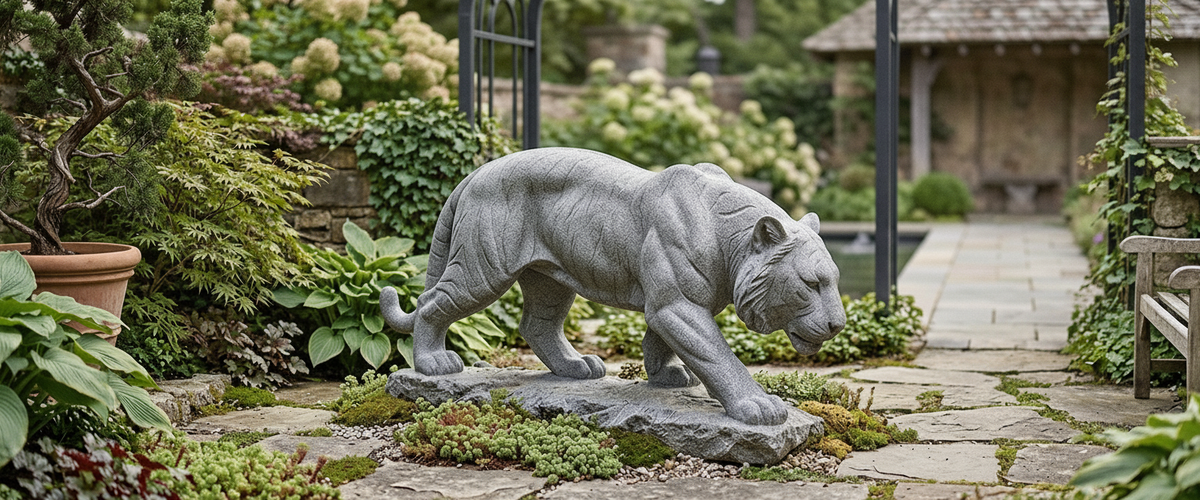
Treat that as a design constraint to buy into rather than a flaw to work around, because the granite garden sculptures statues that age best lean into it. Granite rewards mass, clean planes, strong curves and confident negative space. Where a lawn or driveway terminus needs an animal form that still carries at distance, a crouching piece such as the Descending Tiger Grey Granite Statue, 150cm (about 5 ft) is a safer choice in granite than a finely modeled portrait figure, because the power sits in the shoulder line and the stance rather than in whisker detail. The same logic applies to smaller pond-side animal pieces: a compact, slightly humorous outline will carry across water where fine surface work would vanish.

Gray Granite Reads Cold Under Cloud and Warm Under Southern Sun
The same block of gray granite is not the same color in Seattle and in Scottsdale, and neither is the granite garden statue cut from it. Under low, diffuse overcast light, gray granite pulls toward blue and silver, and the shadows are shallow, so pieces need stronger profiles to hold their shape. Under high desert or Mediterranean sun, feldspar warms noticeably, shadows deepen, and even modest surface texture starts to sparkle.
Buyers in the Pacific Northwest and the Northeast generally do better with bolder, more sculptural granite garden sculptures statues and panels, or with black granite that has enough tonal depth to hold against wet foliage. Clients in California, Texas and the Southwest can run lighter grays successfully, since the sun does the modeling for them. Anyone planting a piece against a dark evergreen backdrop should push toward flamed or lighter stone; against a pale stucco or limestone wall, a darker granite earns its keep.
Siting by Sightline: The Border, the Terrace and the Long Axis
Decide the viewing distance before you size granite garden sculptures statues for a spot. Three common positions, three different answers:
Close border, 6 to 12 ft (2 to 4 m): detail pays off. Honed finishes and mid-height pieces work. This is where carved screens and relief panels earn attention, since the surface is genuinely being read.
Terrace focal point, 20 to 40 ft (6 to 12 m): profile is everything. Go taller than instinct suggests and keep the outline uncluttered.
End of a long axis, 60 ft (18 m) and beyond: mass and height. A piece under 4 ft (1.2 m) will read as garden furniture rather than sculpture.
Screens and vertical panels are the most misjudged category within granite garden sculptures statues. Where the job is to divide space or provide a backdrop rather than to sit as a freestanding focal point, a carved screen such as the Peony and Fret Border Grey Granite Garden Screen, 200cm (about 6 ft 7 in) functions as architecture, not ornament. Set it as a partition, a backdrop, or a boundary marker, and view it from the side as well as head-on. Backlit against morning light, pierced granite gives you a second, entirely different piece.
A pierced screen works as architecture, and changes character entirely when it is backlit.
A Settled Base Ruins a Good Sightline Faster Than Weather Does
Granite is one of the most weather-stable materials we work with. What is not stable is the ground under it. A one-degree tilt is invisible on paper and glaringly obvious when a vertical figure leans away from a straight hedge line.
Large granite is heavy, and load has to be spread onto undisturbed subsoil or an engineered pad below the local frost line. Freeze-thaw movement in Colorado or upstate New York is a different problem from clay shrinkage in central Texas, and both will move an under-specified footing. We ask for site photographs and ground conditions before large granite garden sculptures statues go to production, because the plinth detail is part of the design, not an afterthought for the installation crew.
Maintenance is close to nothing by comparison. Rinse, keep organic debris off the horizontal surfaces, and avoid acidic or abrasive cleaners; the National Park Service's guidance on cleaning masonry makes the case for gentlest-means-possible on historic and monumental stone, and the same principle applies to a new granite piece you intend to keep for generations.
Test the Piece Before Delivery: A Six-Step Checklist
Mark the intended footprint on site with stakes or a cardboard cutout at the actual height.
Stand at your real viewing spot: the terrace chair, the kitchen sink, the top of the drive.
Photograph the mock-up from that spot at morning, midday and late afternoon.
Check the backdrop. Sky, hedge or wall changes the finish you should choose.
Blur the supplier's product photo on your phone and confirm the silhouette still reads.
Confirm access: gate widths, overhead cables, ground bearing for lifting equipment, and where the crane or gantry can stand.
That last point is the one people skip. Big granite garden sculptures statues arrive as serious weight in a single mass rather than in sections, and a stacked composition such as the Three Stacked Turtles Granite Statue, 150cm is a good example, so the route from the truck to the plinth needs planning before the order is placed. The difference between a smooth install and a bad day is usually a measurement someone did not take.

Commissioning Granite With Giant Sculptures
Bespoke granite garden sculptures statues let you fix the problems above at the design stage: adjust height for a specific sightline, simplify detail that will not survive distance, change finish for local light, or scale a piece up so it holds a long axis properly. As a bespoke sculpture supplier working in stone, bronze, stainless steel and Corten, Giant Sculptures builds each granite commission around the site rather than the catalog page. Budget depends on block size, stone type, carving complexity, finishing, engineering and installation, so the sensible next step is a tailored quote with your site photographs and viewing distances attached.
Get the silhouette and the sightline right, and granite garden sculptures statues give you the rarest thing in a garden: a piece that looks exactly as good in its thirtieth year as it did in its first.
For wider placement ideas, Why a Granite Buddha Garden Statue Beats Marble After Five Winters is useful companion reading before finalising the setting and sightlines.