

































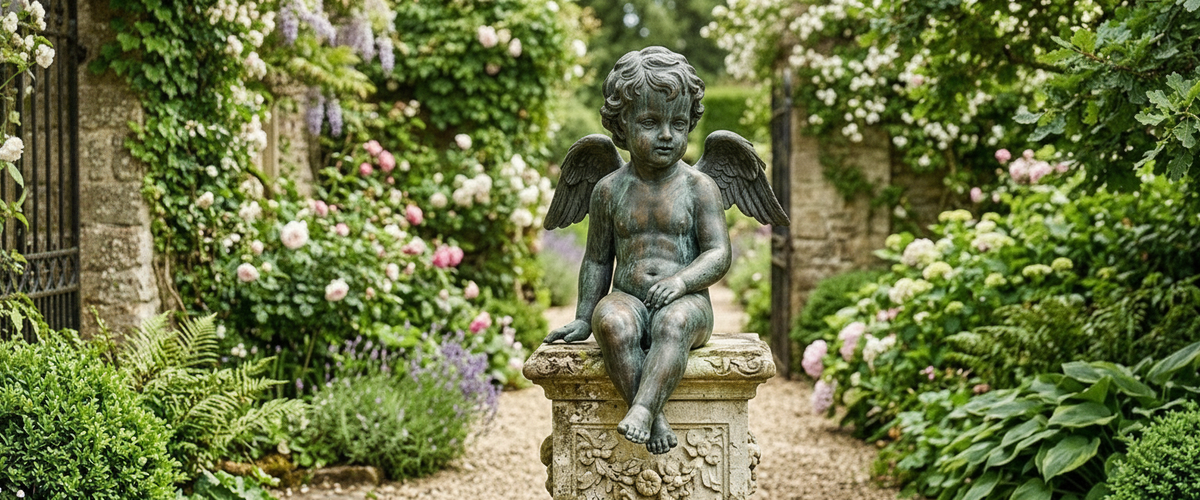

A cherub is the easiest figure in the garden to get wrong. Buy one two sizes too small and it disappears into the planting like a forgotten ornament; buy a life-size angel for a suburban patio and the whole space suddenly feels like a cemetery lawn. Angel cherub garden statues live or die on scale, plinth height and sightline, and almost none of that is decided by the sculpture itself. It is decided by where you stand when you look at it.

Key Takeaways Before You Buy
Putto (roughly 18 to 30 inches / 45 to 75 cm): playful, decorative, works close to seating and steps.
Cherub (around 3 to 4 feet / 90 to 120 cm): the warm middle ground; holds a border without dominating it.
Full-height angel (5 feet 6 inches and up / 170 cm+): formal, still, and emotionally serious. Use with intent.
Plinth height changes tone more than size does. Knee-high reads as mischief, chest-high reads as reverence.
Bronze outperforms cast stone outdoors over decades, especially for fine wings, fingers and drapery edges.
Budget depends on material, scale, casting complexity, finishing and installation. Ask for a tailored quote rather than guessing from a size chart.
Putto, Cherub, Full-Height Angel: Three Sizes That Say Three Different Things
Listings sell angel cherub garden statues under all three names interchangeably, but the sculptural traditions behind them are distinct. A putto is a chubby winged child from Renaissance and Baroque decoration, usually secular, usually busy doing something: holding a garland, wrestling a dolphin, blowing a horn. The Metropolitan Museum of Art collection is full of them precisely because they were the ornamental grammar of European gardens and interiors for three centuries. A cherub carries a faint devotional charge without committing to it. A full-height angel is unambiguous: it stands, it looks at you, and it changes the emotional temperature of the space.
Buyers often arrive asking for "an angel" when what they actually want is a putto. The tell is the intended mood. If you describe the piece as charming, sweet or a little bit fun, you want a putto or a small cherub. If you describe it as peaceful, watchful or commemorative, you want height and stillness.
Why a Three-Foot Cherub Warms a Border and a Life-Size Angel Cools It
Scale is read against the human body, and a figure well under your own height gets treated as a companion rather than a presence. Put a 3-foot (90 cm) cherub at the front of a perennial border in a Connecticut garden and it becomes part of the planting, half-hidden by nepeta in June and fully revealed in November. Guests smile at it. Nobody lowers their voice.
A cherub kept below eye level joins the planting instead of presiding over it.
Substitute a 6-foot (183 cm) standing angel into the same border and the effect flips. The figure now meets your eyeline, and eye contact at full height reads as ceremony. That is not a fault; it is a tool. Just be honest about whether you want a garden that greets people or a garden that asks them to pause. Among the angel cherub garden statues we ship, the pieces that disappoint are almost always the ones bought at a size chosen for the budget rather than for the mood.

Plinth Height as a Tone Dial
Once the figure is chosen, the plinth does the fine tuning. It is the cheapest tonal adjustment available on angel cherub garden statues, and the most often ignored. A cherub set almost at ground level, tucked among ferns, feels found. Raise the same piece 18 inches (45 cm) and it becomes a deliberate ornament. Raise it to chest height on a stone pedestal and it acquires gravity it never asked for.
The same figure reads as playful at knee height and ceremonial at chest height.
Fountains follow the same logic with water added, except that the basin fixes the viewing height for you. Something on the scale of the Monumental Classical Winged Angel and Cherub Fountain Bronze Fountain - 320cm, standing over 10 feet (320 cm) to the top of the figures, is never a border piece. It is a terminus: sited at the end of an axis, in a courtyard, or in a walled garden where the sound of water carries and there is enough distance to read the whole silhouette.
Where the garden has no room for that kind of set piece, an urn-based figure answers the plinth question inside a single object. A piece such as the Classical Bronze Cherub Urn Planter already lifts its cherubs to a natural viewing height, so a low stone pad is usually all the base it needs.
The Kitsch Line: Where Sweetness Tips Into Sentiment
Cherubs get mocked for a reason, and with angel cherub garden statues it is usually a materials problem rather than a subject problem. Thin, chalky cast stone with a sprayed antique finish loses its crisp detail within a few winters, and a cherub with softened features and green-streaked cheeks looks sad rather than classical. Bronze ages the other way. Statuary bronze develops a stable protective patina through controlled oxidation, which is why the Copper Development Association documents architectural copper alloys lasting for generations outdoors with modest care.
The other kitsch trigger is expression. Faces sculpted with wide grins and cartoon roundness read as ornament from a shopping mall. Look instead for downcast eyes, a turned head, or the figure absorbed in a task. Renaissance putti almost never make eye contact with the viewer, and that indifference is what keeps them dignified.
Pairing Two Cherubs Without Turning the Bed Into a Nativity Scene
Pairs are powerful and easy to overdo. The safe rule: pair identical pieces for symmetry, or pair different pieces for narrative, never both at once. Two matched cherubs flanking a stair, gate or pool entry is architecture and reads as intentional. Two different cherubs scattered through the same flower bed with a third figure nearby starts telling a story nobody asked for.
We shipped a matched pair of small bronze cherubs to a Napa Valley property last year, one on each side of a stone stair down to the lower terrace. The owner's original plan involved four figures around a fountain. Cutting it to two made the stair feel like a threshold instead of a display cabinet. In a smaller courtyard the same restraint applies at a smaller scale: one seated figure of the Classical Cherub Child and Urn type, at 55 cm on a low step or wall, usually does more work than three competing pieces spread around the paving.

Read the Piece at Fifty Feet, Not at Arm's Length
Most angel cherub garden statues are bought from a close-up photograph and then lived with from a kitchen window 50 feet (15 m) away. Those are two entirely different pieces of information. At close range you notice tooling, feather detail and patina depth. At distance you notice silhouette, mass and whether the figure separates from the hedge behind it.
Test it before you commit. Stand a cardboard cutout of the right height in the intended spot and go look at it from the sofa, the dining table and the driveway. If the outline vanishes against a dark yew hedge, you need either a lighter patina, a plinth, or a bigger figure. Silhouette beats surface detail every time at range, which is why full-height angels in the angel statues collection tend to be sculpted with open wing profiles rather than tightly folded ones.
When a Memorial Genuinely Calls for a Full-Height Angel
Memorial commissions are the one case where the largest option is usually the right one. A full-height figure holds its ground in an open lawn, survives being viewed from every angle, and does not need planting to give it context. Keep it dignified by resisting inscription clutter, keeping the base simple, and siting the figure so it faces a view rather than the house. Bronze is the sensible choice here for its longevity and repairability; a bronze memorial can be re-waxed and, if needed, re-patinated decades later without losing the original modeling.
Bespoke work matters most in this category. Our studio regularly adapts wing span, drapery, height and base detail on angel cherub garden statues so the finished piece suits one specific site, and we cast to commission when nothing in the bronze angel and cherub statues collection is quite right.
A Short Checklist for Buying Angel Cherub Garden Statues
Decide the mood first: playful, decorative or commemorative.
Match the figure height to that mood, then adjust with the plinth.
Mock up the height on site and view it from your three most-used sightlines.
Check the backdrop. Dark hedges swallow dark patinas.
Choose bronze or carved stone for anything you expect to keep for decades.
Limit yourself to one figure per view unless you are building deliberate symmetry.
Confirm foundation and drainage requirements before delivery, especially for fountains.
Ask for a quote based on your final size, material, finish and installation access.
Get the scale right and a cherub stops being an ornament and starts being the reason people walk down to that end of the garden. Get it wrong and no amount of beautiful casting will save it.
For wider placement ideas, How a Bronze Garden Statue Ages, Year by Year is useful companion reading before finalising the setting and sightlines.