






































































































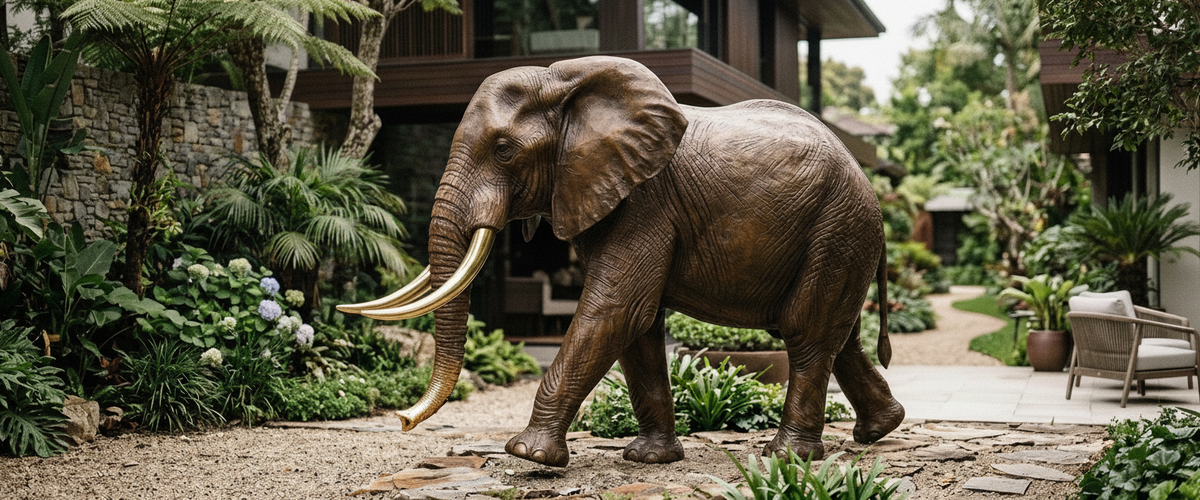

One elephant in a plaza is a photo opportunity. A hundred of them is an argument, and only as a herd spread across Boston will elephant sculptures make that argument land. Reports that Boston will display one hundred elephant sculptures for wildlife conservation have prompted a sharper question from the collectors and designers who write to us. Few of them are asking where to find the herd. They want to know why it works, and what it says about choosing a wildlife sculpture that has to perform for decades rather than for a single season.

Key Takeaways
Repetition is the message. The elephant sculptures Boston will install turn a city into a single, walkable campaign.
Public trails favor painted fiberglass because it is light, colorful and built for a defined run.
Permanent outdoor pieces favor bronze, which ages into its patina rather than wearing out.
Crowds change the brief. Sightlines, foot traffic and touch matter as much as the pose.
Private settings should cluster animals. Three animals in a loose triangle read as a family.
Why Boston Will Fill Its Streets with Elephant Sculptures
Conservation herds of this kind, including the elephant sculptures Boston will place across its neighborhoods, follow a familiar model. Each elephant is sponsored or decorated, the herd is spread out, and people go looking for the next one. That search is the point. A visitor who finds six elephants on a Saturday has spent an afternoon thinking about a species, which is more than most fundraising letters achieve.
The cause is real. Both African elephant species are assessed as threatened, with the forest elephant listed as Critically Endangered and the savanna elephant as Endangered on the IUCN Red List. The hundred elephant sculptures Boston will display make that status physical. You cannot scroll past a hundred elephants.
Why One Message Repeated a Hundred Times Lands Harder Than a Single Bronze
A single monumental bronze asks you to stop. A herd, like the elephant sculptures Boston will scatter through its streets, asks you to keep moving, and every new encounter reinforces the last. Campaign designers rely on that rhythm; sculptors rarely get to use it, because most commissions are for one site and one sightline.
For private buyers, the lesson is about scale. Repetition carries meaning, but each piece still has to earn its place. Spread a hundred across the city, and the elephant sculptures Boston will show read as one city-wide herd. On a private estate the principle shrinks rather than disappears: three elephants on a two-acre lawn can carry the same sense of a herd, provided they are sized and spaced as a family and not as stock.

Painted Fiberglass for a Season Versus Wildlife Bronze for a Century
Trail elephants, including most of the elephant sculptures Boston will put on its sidewalks, are almost always fiberglass, for good reasons. The material is light enough to move with a small crew, takes paint beautifully and suits a run that ends with an auction. For an event space or a lobby that is restyled every few years, a painted piece such as the Hazeham Blue Elephant Sculpture (205cm), about 6 feet 9 inches (205 cm) tall, brings bold color and a friendly scale without the footings and lifting plan a bronze of similar size would need.
Permanent outdoor work is a different commitment. Wildlife bronze sculptures are cast by the lost-wax process, chased by hand and patinated, and they carry their weight in the ground rather than on a trailer. Bronze does not chip the way a painted shell can; it darkens over time, greens at the edges if left alone, and regular washing and waxing keep it at a warm brown. At the scale of a Monumental Life-Size Walking Elephant, roughly 11 feet 10 inches (360 cm), that difference is the entire reason to buy: nothing that size should be planned around repainting.
Our advice is blunt. If the sculpture will stay where you put it, choose bronze. If it will move, rotate or be repainted, fiberglass is the honest choice. When an older bronze needs more than a wash and wax, a qualified conservator, such as those listed by the American Institute for Conservation, is the right call.

Life-Size Elephants Among Crowds: Sightlines, Flow and Touch
Watch the elephant sculptures Boston will set among shoppers and commuters, and you will see what happens when a life-size animal meets a crowd. People slow down around it, children want to climb it, and every hand reaches for the trunk. On public bronzes, the trunk tip and tusks are often rubbed bright gold while the flanks stay dark. That polish is a record of affection, and it should be planned for rather than fought.
For hotels, resorts and venues, think in terms of approach. The animal should be readable from the entrance and have a clear walking loop around it, so guests do not bunch against a doorway. Footings deserve as much attention as the sculpture. On a large bronze installation, the concrete pad and anchoring should be poured weeks ahead, and the crane route walked before delivery day. None of it should be improvised.
What Estates and Hotels Can Borrow: Three Animals as a Group, Never a Row
The elephant sculptures Boston will display can stand one after another along a street, because the trail itself is the group. A garden has no such excuse. The most common mistake we see with African wildlife sculptures is the parade line: three animals evenly spaced along a drive, facing the same way. It looks like a showroom. Elephants live in family groups, and the sculptures should too.
Place them in a loose triangle, with the largest slightly behind and the smallest closest to the viewer. Vary the direction of each head. If you would rather start with the relationship already built in, a single casting such as the Large Traditional Adult and Baby Elephant, about 8 feet 6 inches (260 cm), holds mother and calf in one piece, and a third figure set apart on a lawn in Napa or the Hamptons completes the herd.

Buyer Checklist Before You Commission
Permanence: Will the piece stay in place for decades? Choose bronze. Will it move? Consider fiberglass.
Scale: Mock up the height with poles or a cardboard silhouette from the main viewing point.
Ground: Confirm footings, drainage and anchoring with your landscape designer or engineer.
Access: Check gates, slopes and crane reach before you finalize size.
Touch: Accept that public pieces will be handled, and specify a patina that wears gracefully.
Budget: Cost depends on material, scale, complexity, engineering, installation and finishing, so request a tailored quote rather than comparing listings.
Giant Sculptures casts and ships bespoke wildlife sculpture worldwide, from single statement pieces to grouped commissions planned around a specific site. Our bronze elephant statues cover permanent outdoor work, while the wider elephant statues and sculptures collection is the place to weigh painted pieces for an event. The elephant sculptures Boston will display are built for a season. A well-placed bronze will still be standing when the next herd comes through.
If the elephant sculptures Boston will show have you rethinking your own grounds, Garden Wood Sculptures for Sale: How to Spot One That Will Last Outdoors is useful companion reading before finalizing the setting and sightlines.