





































































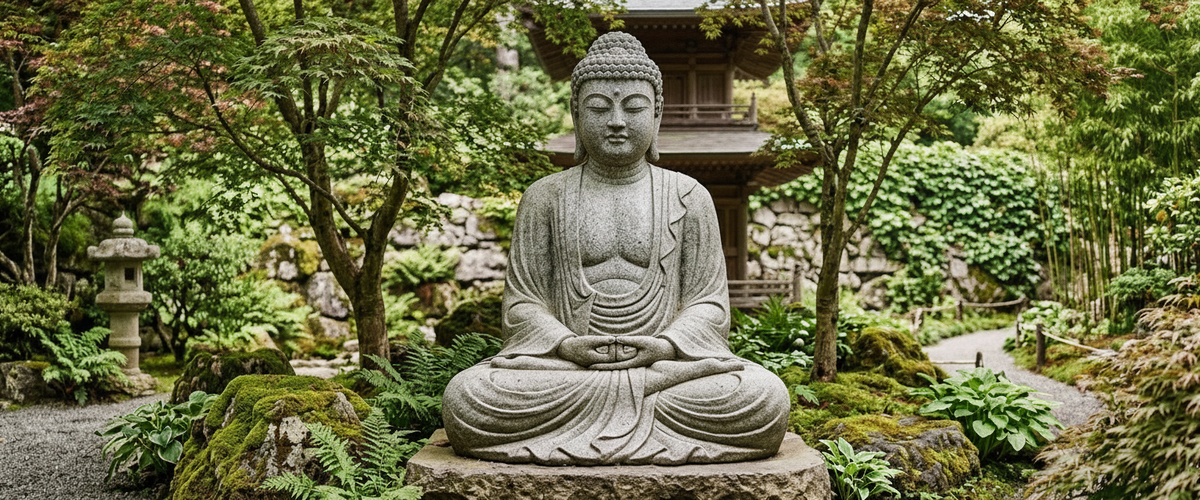

Set a white marble figure in an Aspen garden and by the fifth spring you can feel the difference with your thumb. The surface has gone faintly sugary, the carved edges have softened, and the folds of the robe have lost their crispness. Put a granite buddha garden statue in the same position and it looks the way it did the day the crane set it down. That gap has nothing to do with carving skill. It comes down to grain size, porosity, and what happens when water freezes inside stone.

Quick Answer for Buyers
Frost: granite's tight interlocking grain absorbs very little water, so freeze-thaw cycling does almost nothing to it. Marble and limestone pit and spall.
Pollution and rain: mildly acidic rainfall dissolves calcite in marble. Granite's quartz and feldspar are effectively immune at garden timescales.
Finish: gray granite reads best under flat light; black polished granite needs sun or water nearby; flamed finishes hold detail.
Weight: granite runs around 165 to 170 lb per cubic foot (roughly 2,650 to 2,750 kg/m³). Plan the route and the base before you plan the view.
Upkeep: water, a soft brush and patience. No acids, no bleach.
Frost Cycles Are the Real Test, and Granite Passes
Damage in cold climates rarely arrives as one dramatic crack. It arrives as thousands of small freeze-thaw cycles, each one expanding trapped moisture by about nine percent inside the stone's pore network. Marble typically carries enough porosity for that to matter, and its calcite crystals loosen at the grain boundaries. Ten Chicago winters will tell you everything.
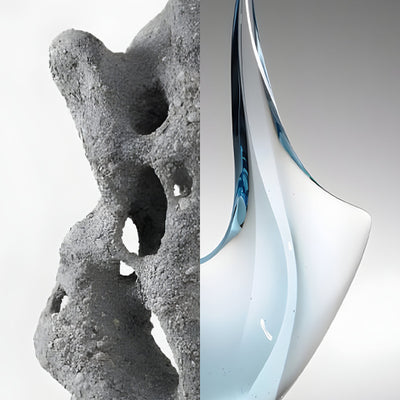
Granite is an igneous rock with grains locked together under enormous pressure, and its water absorption is a fraction of a percent by weight. There is almost nothing for ice to push against. That is why a granite buddha garden statue works equally well in Vermont and in Napa, while a marble one really only belongs in a mild, sheltered climate or under a loggia. We have shipped granite pieces into properties where snow sits banked against the plinth for four months, and the client's only job in April is to sweep it off.
Flamed grey stone holds its modelling through repeated freeze-thaw cycles.
Acid Rain, and Why Granite Never Dulls the Way Marble Does
Rainwater is naturally slightly acidic, and in areas with sulfur and nitrogen emissions it gets more so. Calcite-based stones dissolve in it. The USGS has documented this on marble and limestone monuments, where sharp carved detail turns soft and inscriptions become unreadable over decades of exposure (USGS, Acid Rain and Our Nation's Capital). Quartz and feldspar, the bulk of granite, simply do not react on that timescale.
The practical result for a buyer is that a granite buddha garden statue keeps its face. Eyelids, lips, the ridge of a robe hem, the fingertips in a mudra: these are the first details to disappear on softer stone, and they are exactly the details that make a buddha figure worth owning. Granite garden statues carved with fine relief are still legible generations later, which is why granite has been the working material for memorial and temple carving across Asia for centuries.

Gray, Black or Flamed: Picking a Finish That Reads in Real Light
Most buyers choose a finish from a photo shot in bright studio light and then install the piece under a gray November sky. The two do not match. Polished black granite is dramatic in direct sun or beside reflective water, but on an overcast day it can read as a flat dark shape with no modeling. Mid-gray stone is far more forgiving; the surface scatters light and the carving stays visible in almost any weather.
Flamed (thermal) finishes are the quiet favorite for outdoor work. The torch spalls the surface to a matte, slightly textured skin that holds shadow, hides water marks, and resists the greasy look that polished stone can develop under trees. A common approach on a granite buddha garden statue is a flamed body with polished detail on the face and hands, so the eye lands where you want it.
If you are building a whole composition rather than dropping in a single figure, matching stone across pieces matters more than people expect. Where a seated figure needs a defined wall behind it rather than open planting, a mid-gray carved screen such as the Blessing Character Grey Granite Garden Screen - 200cm keeps the whole group in one tonal family and stops the sculpture dissolving into the border.
Weight Is the Price of Survival
Granite's density is exactly why it lasts, and exactly why the delivery needs thought. A life-size seated granite buddha garden statue is not a two-person carry. Before you commit, walk the route: gate width, overhead branches, gradient, soft lawn that a forklift will sink into, and whether a truck can actually reach the property. One California courtyard commission came down to a side gate the client had never measured; the piece went in over the wall by crane, booked a week ahead.
Ground bearing matters just as much. Set heavy stone directly on topsoil and it will settle unevenly within a season, tilting the figure. A compacted sub-base with a reinforced concrete pad, sized to spread the load, is the standard answer. The taller and more vertical the composition, the harder that foundation works: a stacked form like the Three Stacked Turtles Granite Statue - 150cm concentrates a great deal of mass over a small footprint and is far less forgiving of a base that moves.
Seated, Reclining or Standing: Scaling a Figure for a Small Garden
Pose changes the footprint of a granite buddha garden statue more than height does. A seated figure is wide and low, which suits a courtyard, a terrace corner or the end of a gravel path where you want mass without blocking sightlines. A reclining figure demands real horizontal room and reads badly if planting crowds it; give it a clear bed of gravel or moss. A standing figure buys presence in a narrow space, and it is the right call when the sculpture needs to be visible from an upstairs window.
A low seated pose gives mass in a courtyard without blocking sightlines.
For gardens under about 40 feet (12 m) across, a seated figure between roughly three and five feet tall usually sits comfortably without dominating. Go larger only if you have a long approach view. Where the plan calls for secondary markers along the path, something in the 120cm range such as the Sitting Frog Grey Granite Statue - 120cm holds a corner without competing for attention. If you are weighing stone against metal, our bronze buddha statues and heads offer a different route: lighter for the same visual mass, with a patina that shifts over time.

Ten Years of Upkeep, and Two Things to Keep Well Away
A granite buddha garden statue asks for very little outdoors. An annual rinse and a soft-bristle brush handles most of it. Lichen and algae respond to water, time and gentle mechanical removal; the National Park Service's guidance on masonry cleaning consistently favors the gentlest effective method over aggressive chemistry (NPS Preservation Briefs).
Avoid acidic cleaners including vinegar, citrus formulas and any masonry acid wash. They will not dissolve the quartz, but they can attack iron-bearing minerals and leave permanent rust-colored bleeding.
Avoid chlorine bleach. It streaks, it kills surrounding planting when it runs off, and on flamed surfaces it can leave a chalky residue.
Skip high-pressure washing on carved detail. Low pressure and a brush, always.
Check the plinth and bedding joints each spring for movement or open mortar.
Clear leaf litter from the base in fall; standing organic matter feeds biological growth.
Sealing is generally unnecessary outdoors and can trap moisture. Ask before applying anything.
Commissioning a Granite Buddha Garden Statue
Most of our stone work at Giant Sculptures is bespoke, and the useful conversations start with site rather than style. Bring photos of the position, the approach route, the light at different times of day, and any existing hard landscaping you want the stone to relate to. From there we can advise on pose, granite color, finish combination, plinth design and installation method.
Budget depends on scale, the stone selected, carving complexity, base engineering, transport and installation, so the honest answer is a tailored quote rather than a headline figure. What we can say is that a well-founded granite buddha garden statue is a one-time decision. The wider religious statues range is a useful reference for form and pose while you work that out, then tell us what the garden actually needs.
For wider placement ideas, Shade Is Why Your Marble Buddha Statue Turns Green in the Garden is useful companion reading before finalising the setting and sightlines.