





































































































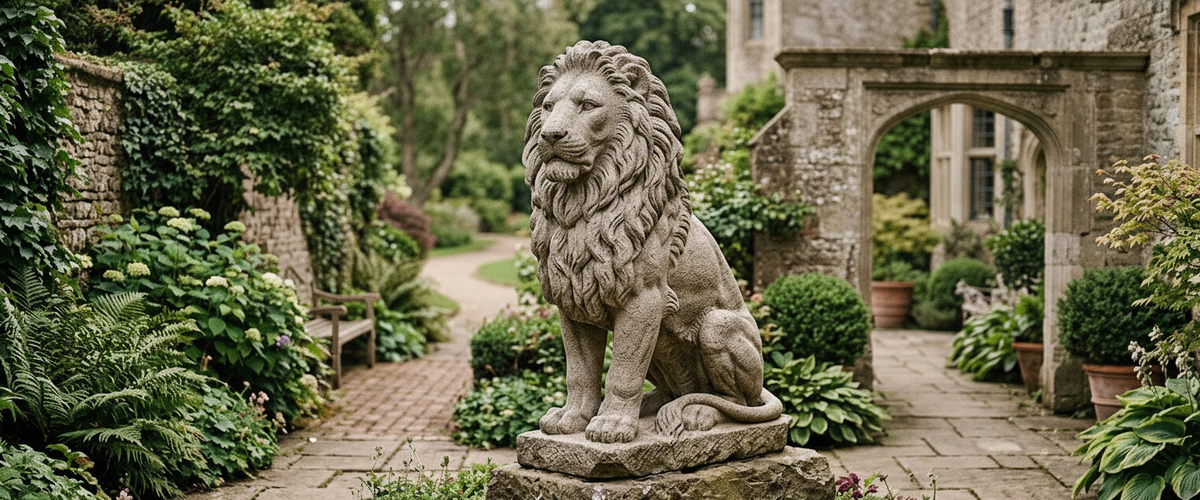

Turn a stone lion around and look under its jaw. That is where hand carved animal statues either prove themselves or fall apart. The showroom-facing three-quarter view is the one the factory optimized; the underside of the chin, the inner ear, the web between the toes are the areas nobody photographs and nobody polishes twice. We have inspected pieces where the front was crisp and the back of the mane was a smooth gray blur, softened by a sanding pad to hide the fact that no chisel ever reached it.

Key Takeaways Before You Buy
The short version, if you are shortlisting hand carved animal statues this week:
Tool evidence beats sales copy. Look for point and claw chisel tracks in recessed areas, not a uniformly abraded surface.
Ears, tails, paws and undercuts are where machine roughing reveals itself first.
"Machine roughed, hand finished" is a legitimate process, but it is a different product from a piece cut by hand throughout. Ask which you are buying.
Granite grain size caps detail. Coarse-grained stone will not hold a whisker, no matter who is holding the chisel.
Placement makes or breaks the carving. Give an animal an approach path and a turning circle, not a shrub collar.
Budget depends on stone, scale, undercutting, engineering and installation. Ask for a tailored quote rather than trusting a headline figure.
Claw Tracks, Point Work and the Surface a Router Never Produces
Hand carving leaves a legible sequence. A point chisel bruises the stone in short percussive bites, a claw chisel drags parallel ridges across the form, and a flat chisel or rasp cleans it up. In recesses the carver could not comfortably reach, that sequence survives, and genuine hand carved animal statues keep that record in every spot the polisher skipped. You will see faint claw striations running with the muscle direction under a horse's belly, or point pitting deep inside a lion's mouth. Those marks are not sloppiness. They are the visible record of a subtractive process, which is the distinction Tate draws between carving and cast or modeled sculpture: material removed decision by decision, with no way to put it back.
A three-axis or five-axis router produces the opposite: a field of consistent scallops at a fixed step-over, all running the same direction regardless of anatomy, because the toolpath does not care where the muscle goes. Sanding removes the scallops but leaves a curiously even, slightly waxy uniformity. Run your palm across a hand-cut flank and you feel small changes in plane. Run it across a machined one and it feels like a countertop.
Ears, Tails and Paws: The Four Places Machine Roughing Gives Itself Away
For wider placement ideas, What Nobody Tells You About Commissioning Custom Bronze Animal Sculptures is useful companion reading before finalising the setting and sightlines.
Four zones fail first. Inner ears: a cutter cannot easily reach into a deep concave cone, so machined ears end up shallow, with a rounded floor instead of a sharp fold. Tails: any tail that lifts away from the body needs undercutting, which a router avoids; machined tails tend to lie flat against the haunch like they were glued there. Paws and claws: the crevice between toes should be a genuine slot with a dark shadow line, not a shallow groove. Where limbs meet ground: hand carvers cut a crisp intersection; machine work leaves a soft fillet, because tooling geometry hates inside corners.
Detail like this is exactly what you are paying for at scale. On a piece such as the Elephant With a Carved Roundel Marble Statue - 210cm (roughly 6 ft 11 in), the ear edges and the relief roundel are the two areas a viewer will study from three feet away. If those read soft, the whole animal reads soft.

What "Machine Roughed, Hand Finished" Actually Means
Plenty of good studios rough out a block on a router or a pointing machine and then finish by hand. For large architectural work it saves weeks of blocking-out labor and reduces the risk of a catastrophic misjudgment in expensive stone. That is honest practice. The problem starts when the result is sold and priced as fully hand carved animal statues.
Ask directly what percentage of the form was cut by hand, and which passes the carver performed. A studio that machines to within an inch and then spends three weeks on anatomy is offering something genuinely different from one that machines to within a quarter inch and then sands. The second version is a machined statue wearing a hand-finished coat.
Identical Flaws Across a Batch Tell You a Template Did the Thinking
Ask for photos of three examples of the same model. Real hand carved animal statues drift: one lion's brow sits a fraction higher, one tail curls tighter, one muzzle carries slightly more weight. When every unit shares the same small blemish in the same place, the same shallow spot behind the left shoulder, the same odd flattening on the right ear, a template did the thinking. Natural stone variation also matters here. Blocks differ in vein, tone and hardness, and a hand carver adapts the cut to what the block gives. A file does not adapt.
One client set two pairs of guardian lions from different suppliers side by side in a driveway court before deciding. The hand-cut pair were not mirror-identical, and that asymmetry is what made them read as sculpture rather than merchandise. The traditional guardian lion form lives on exactly that character: the twist of the mane, the tension in the raised paw, the small departures a template flattens out.
Granite Grain Size Sets the Finest Detail a Chisel Can Hold
Buyers asking about hand carved granite animal statues often want marble-level crispness in a stone that will shrug off Chicago winters and Texas sun. Granite will outlast marble outdoors with far less surface loss, but there is a trade. Granite is an igneous rock made of interlocked quartz, feldspar and mica crystals, and the size of those crystals sets the minimum feature the stone can hold. A coarse-grained granite with quarter-inch crystals cannot carry a fine whisker or a thin eyelid; the detail simply crumbles along crystal boundaries. Fine-grained granite holds far more. This is the point where hand carved animal statues meet a hard material limit rather than a skill limit. The Natural Stone Institute publishes useful technical guidance on selecting dimension stone for exterior work.
Practical rule: choose granite for bold, planar animal forms with strong silhouettes, and marble for pieces that live on fine feathering, drapery or facial nuance. Where the subject depends on thin edges and feather detail, as it does on the Swan on Carved Water White Marble Statue - 150cm (about 4 ft 11 in), marble carries the carving in a way a coarse gray granite never will.

Give a Carved Stone Animal an Approach Path, Not a Border Planting
The most common placement mistake we see is treating a carved animal as a plant. It gets tucked into a border, ringed with boxwood, and viewed only from one angle at fifteen feet. Hand carved animal statues are directional. They have a head, a gaze, a stride, and they need room for those to register.
Set a sightline. Place the piece at the end of a walk, a lawn axis or a drive, so visitors approach it head-on and then pass it.
Keep a turning circle. Leave enough clear ground to walk fully around it; undercut carving is wasted if half of it faces a hedge.
Respect the horizon. A striding animal reads best when its back sits above or below eye level, not exactly on it.
Plan the base first. Multi-ton stone needs a compacted, reinforced foundation below the frost line and a rigid path for a crane or gantry.
Watch the light. Carved fur and feather detail comes alive in raking morning or late afternoon light and flattens at noon.
Plinth choice belongs in this conversation too. On an open lawn where the ground offers no framing, a bronze animal raised on a granite base gains height and visual weight without competing for texture, which is how a piece like the Life-Size Traditional Trotting Horse Bronze Sculpture (Granite Plinth) - 190cm keeps its stride legible from fifty feet away.
Questions That Make a Studio Name the Carver
Serious suppliers answer these without hesitation. Vague answers are their own answer.
Who carved this piece, and can I see other work by that carver?
Was the block roughed by machine? To what tolerance, and what happened after?
Which quarry and which grade of stone, and what is the grain size?
Can you send in-progress photos at blocking-out, modeling and finishing stages?
How are undercuts, tails and raised limbs supported for shipping and installation?
What anchoring, doweling or pinning is specified for my site conditions?
What does long-term care look like in my climate, including freeze-thaw exposure?
At Giant Sculptures we work in marble, granite, bronze, stone and engineered metalwork, and bespoke commissions start with the same conversation: subject, stone, scale, site and sightline. Cost follows material, size, complexity of undercutting, structural engineering, finishing and installation, so we quote per project rather than from a list. Browse the animal sculptures collection to see hand carved animal statues at working scale, or the bronze animal sculptures if you want fine detail with a lighter installed weight. Then ask us who would cut it. We will tell you.