






































































































Most disappointing animal commissions are lost at the photograph stage, not at the foundry. By the time bronze is poured, the gesture, the muscle line and the weight distribution have already been decided three times over. Custom bronze animal sculptures reward clients who engage early and punish clients who wait until the crate arrives to have opinions. We have sent commissioned animals to ranch entrances, terraced gardens and tight city courtyards, and the pressure points sit in the same places every time.

Key Takeaways Before You Commission
Reference photography matters more than a written brief. Shoot the animal in flat light from all four sides, plus above.
The maquette is your last comfortable chance to change pose, attitude and head angle.
Leg and armature engineering is the invisible cost line in any serious foundry quote for a standing animal.
Chasing (the hand finishing after casting) decides whether fur and feather read from 20 feet away.
Patina is planned with the sculptor before wax work, not chosen from a swatch card at the end.
Approach line, plinth height and eye level should be agreed on paper before anything ships.
The Reference Photographs We Ask for, and the Ones We Set Aside
Clients usually send us their favorite photograph first. It is almost always the wrong one: a long lens portrait, warm evening light, the horse's head turned toward the camera, everything foreshortened. Beautiful image, useless geometry. What a modeler needs is unromantic. Flat overcast light, the animal square to the camera from both sides, front, rear and, where possible, from slightly above. Add close-ups of the head, hooves or paws, and any marking that matters to you. Those plain, unflattering frames are what custom bronze animal sculptures are actually built from.
For a wild subject, or any animal you cannot photograph yourself, we ask for skeletal and museum references too, because photographs flatten the ribcage in ways that show up badly at scale. When we work up a boar, the shoulder mass and the drop of the head come from anatomical references, not from a trail camera shot. At any size above waist height, the whole silhouette depends on the forequarters reading heavier than the rear, and only anatomical reference gets you there reliably.

Maquette Sign-Off Is the Last Honest Moment to Change the Gesture
A maquette is a small clay or wax study, usually a fraction of final height. It exists so that everyone argues in cheap material rather than expensive metal. Sculptors have used them this way for centuries; the Henry Moore Foundation documents the small studies that preceded almost every one of his monumental works.
The maquette stage: cheap clay, expensive decisions.
Look at the maquette for attitude, not detail. Is the animal alert, resting, threatening, playful? Is the head turned toward the path people will walk, or away from it? A pair of sparring rabbits works because the two bodies lean into each other with real tension; slacken that lean by a few degrees and the piece goes flat. Change the gesture at maquette stage and it costs a conversation. Change it after the full-size clay is built and it costs weeks.
Leg Engineering and Armature: The Hidden Line in Every Foundry Quote
Here is the part nobody enjoys explaining. A standing quadruped is a heavy mass balanced on four thin columns, and the wind does not care about your artistic intent. Inside the clay sits a steel armature; inside the finished bronze sit stainless steel armatures, thickened wall sections and threaded rod running from the hoof or paw down into the base.
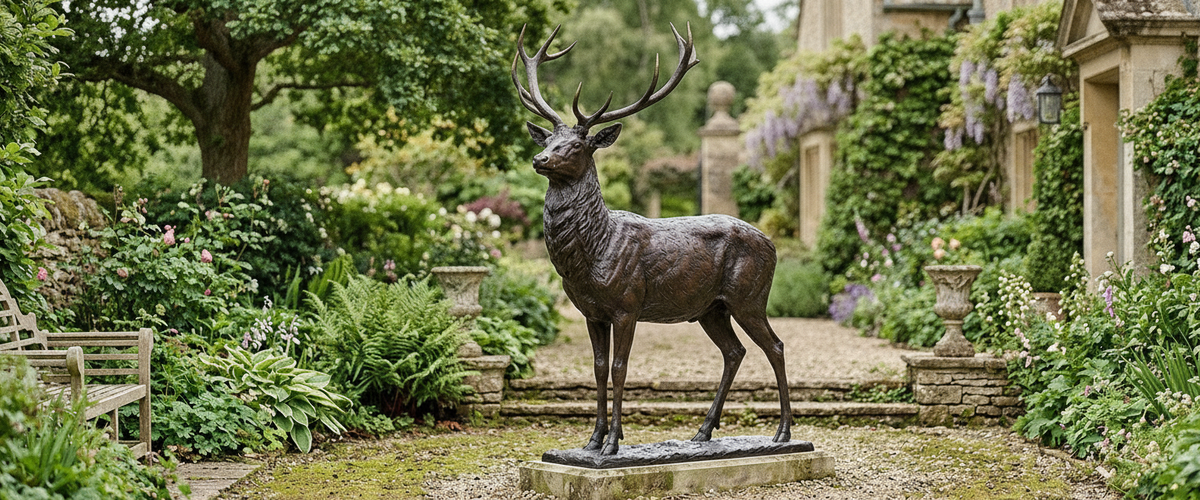
A leaping or rearing pose can concentrate the whole load onto one or two contact points, which means heavier internal steel, thicker bronze at the ankle, and a base plate engineered to a real wind load rather than a guess. That work is why two custom bronze animal sculptures of identical height can be quoted very differently. Compact, grounded subjects behave better: a low, broad-footprint form such as the Large Traditional Giant Tortoise Bronze Sculpture - 200cm needs far less hidden engineering than a striding deer of the same length. Ask your supplier what is inside the legs. If nobody can answer, that is your answer.

Chasing Is Where Fur, Feather and Muscle Either Read or Turn to Mush
After casting, the bronze arrives in sections covered in gates, seams and flash. Chasing is the hand work that welds those sections, removes the evidence, and re-cuts surface texture across the joins so the coat, hide or plumage runs unbroken. It is slow, and it is where cheap castings betray themselves. Look closely at a poorly chased animal and you will find fur that stops dead at a shoulder seam.
Chasing across a shoulder seam, before any patina goes near the metal.
Scale changes the texture strategy on custom bronze animal sculptures. On a piece viewed from arm's length, individual hairs matter. At the scale of the Life-Size Contemporary Knuckle-Walking Gorilla Bronze Sculpture - 200cm, texture has to be cut deeper and broader so it still reads as fur from across a lawn. Tell your sculptor the primary viewing distance. It genuinely changes the tooling.
Patina Is Chosen Before the Wax, Not After the Bronze Cools
Patina is a chemical reaction on the metal surface, usually worked with heat. It is not paint. Deep browns, liver reds, black, verdigris green and warm gold ranges all behave differently over a textured surface, and some finishes need the surface prepared in a particular way while the wax is still being worked. Bring the color conversation forward.
Outdoors, patina keeps moving. Rain, salt air and sprinkler water all push it along, which is why coastal and poolside placements should be planned with maintenance in mind. The American Institute for Conservation publishes sober guidance on protective coatings and wax cycles for outdoor bronze. Our practical advice: wash with clean water, dry, and re-apply a microcrystalline wax once or twice a year depending on climate. A desert garden and a salt-air garden are not the same job.
Honest Lead Times for Custom Bronze Animal Sculptures
A life-size stag is not a six-week job. Custom bronze animal sculptures move through reference work, maquette, full-size clay, mold making, wax, casting in sections, welding, chasing, patina, sealing, crating and freight. Each stage has drying, curing or cooling time that cannot be compressed by asking nicely.
Where time is genuinely saved: approving references quickly, giving consolidated feedback rather than daily notes, and confirming patina early. Where time is lost: pose changes after the full-size clay, and site details that arrive after the base plate has been drilled. If you have a fixed show date, tell us at the enquiry stage so the schedule is built backward from it.

Approach Line, Plinth Height and Eye Level
Decide how people meet the piece. Walk your site and mark the path visitors actually take, then set the head angle to greet that approach. A charging pose facing a blank wall wastes the drama; the same figure angled across a driveway turn does real work.
Plinth height is the other lever, and it changes how custom bronze animal sculptures behave in a space more than most clients expect. Lift a crouching predator too high and it loses its menace, because a crouching animal only threatens when it meets you at your own level. We usually keep low, coiled subjects near ground level and reserve taller plinths for upright or heraldic subjects. For a terrace-side placement, a low-slung form like the Large Traditional Crouching Leopard Bronze Sculpture - 110cm set on a stone slab beside the step is far more unsettling than the same cat on a waist-high pedestal. Confirm the finished eye level in a drawing before the crate leaves, along with fixing method, access route and lifting plan.
Your Pre-Commission Checklist
Reference set: four sides, flat light, head and foot close-ups, any anatomical references.
Pose brief: one sentence on attitude, plus the viewing direction that matters most.
Scale: confirmed height and the primary viewing distance, in feet and meters.
Engineering: internal armature, base plate spec, fixing method, wind exposure.
Finish: patina family agreed before wax work, plus a stated maintenance plan.
Site: approach line, plinth height, ground conditions, crane or forklift access.
Schedule: any fixed date, shared at enquiry rather than halfway through.
Budget depends on scale, alloy volume, pose complexity, engineering, chasing hours, patina, crating and installation, so the only useful number is a tailored quote. Browse the bronze animal sculptures already in our catalog to test your reaction to scale and finish, look at how pieces sit outdoors across our bronze garden statues, then talk to us about a commission. Custom bronze animal sculptures from Giant Sculptures run from tabletop studies to monumental installations, and the conversations that start with photographs and a site plan almost always end well.
For wider placement ideas, A Bronze Animal Sculpture Lives or Dies by the Approach is useful companion reading before finalizing the setting and sightlines.