

























































































A gold bear sculpture goes wrong in one of two ways. Either it glares like a trophy and flattens into a bright blob, or it disappears into a beige wall and looks smaller than the invoice suggested. Both problems are fixable, and neither has much to do with the bear. They come down to finish, backdrop and height, which are the three decisions most buyers make last and should be making first.

At a Glance
Gilt leaf reads warm and slightly textured; polished or electroplated gold reads sharp and reflective, with real glare in direct sun.
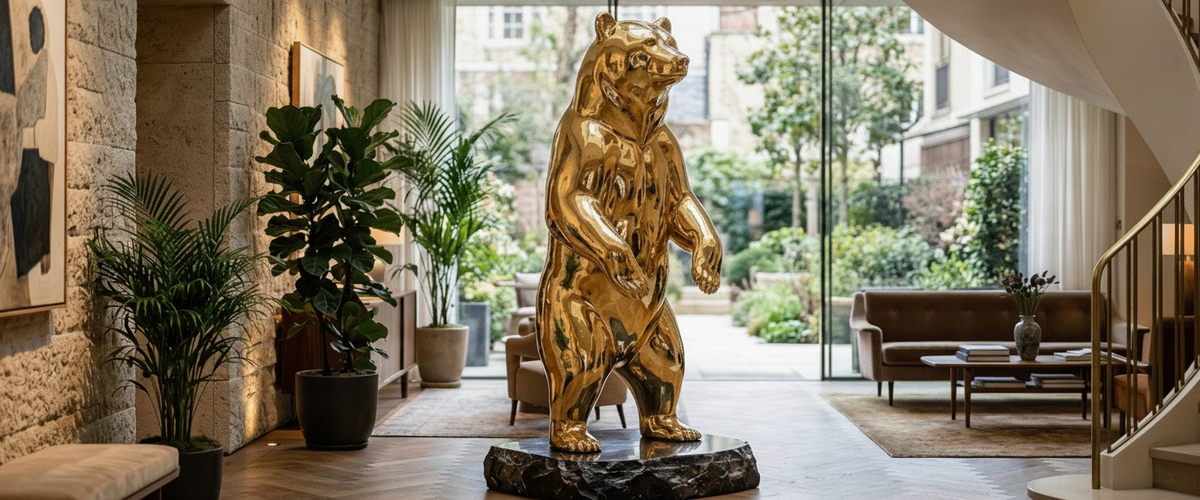
Dark backdrops win. Charcoal plaster, deep green, walnut and bronze-tinted glass give a gold bear sculpture its edges back.
Pose sets loudness. A standing or boxing bear pushes gold surface upward; a seated bear compresses it.
Pedestal height matters more than pedestal design. Aim the head or chest, not the plinth, at the viewer's eye-line.
Outdoors, decide early: maintain the gilding, or let a brass piece dull into a brown patina on purpose.
Gilt Leaf or Polished Brass: What Changes at Ten Paces
Stand two finishes side by side at thirty feet (9 m) and the difference is obvious. Gilt leaf, laid in overlapping squares over a prepared substrate, scatters light. You get warmth, a faint grain where the leaves meet, and a surface that keeps some of the sculpture's modeling visible. It looks like an object with a skin.
A golden brass bear sculpture, or an electroplated gold finish over metal, behaves differently. It reflects rather than scatters, so it throws hard specular highlights and picks up the color of whatever is nearby. In a room with warm timber and low lamps, that is gorgeous. Under a Scottsdale skylight, it can turn into a mirror that erases the animal's anatomy between about eleven and three.
Neither is better. But if the gold bear sculpture will sit in strong daylight, we usually steer clients toward a satin or brushed finish rather than a mirror polish, because the form survives the sun.
Why a Pale Wall Flattens a Gold Bear Sculpture
Gold has a narrow value range. On off-white plaster or pale limestone, the gold bear sculpture and the wall sit at similar brightness, so the silhouette blurs and the piece looks lightweight. We shipped a boxing bear to a corporate lobby in Dallas where exactly this happened. The bear sat against travertine and read as decor. The client had a joiner clad one bay in fumed oak, moved the bear four feet (1.2 m) forward, and it became the anchor of the room without changing a thing about the sculpture.
A dark, matte backdrop hands the silhouette back to a reflective finish.
Dark green, ink blue, charcoal micro-cement, blackened steel, dense planting: all of these give gold something to push against. Outdoors, a clipped yew hedge or a mature evergreen mass does the same job for free. Avoid mirrors directly behind a reflective bear unless you want a doubling effect that confuses the outline.

Lacquer, Wax or Bare Metal: Fingerprints, Dust and Reality
Interior gold pieces are usually lacquered. A clear coat keeps brass from tarnishing and makes dusting a dry-cloth job, but lacquer is a sacrificial layer; it will eventually craze or wear at high-touch points such as a bear's muzzle or paws. Wax gives a softer, more forgiving look and can be refreshed at home, though it needs doing once or twice a year. Bare brass tarnishes, and the Copper Development Association is clear that copper alloys will keep reacting with air and skin oils unless they are coated or regularly polished.
The practical rule: high-traffic locations want lacquer, collector interiors can carry wax, and no gold bear sculpture anywhere should be cleaned with an abrasive cream. One pass with the wrong product removes plating you cannot buy back.
Standing, Seated or Walking: How Pose Sets the Volume of the Gold
A gold bear sculpture reads louder or quieter depending on how much surface faces the light. An upright, squared-up bear presents chest, shoulders and forearms to the room at once, which is why something built like the Gacko Electroplated Gold LV Boxer Bear Sculpture - 200cm (about 6 ft 7 in) belongs in a lobby or courtyard rather than a living room. Seated and crouching poses fold the reflective surface inward and read calmer, which suits studies and dining rooms.
Walking bears sit between the two. The stride creates shadow under the belly, which breaks up the gold and helps the eye find the volume. For a garden run or a long hallway, that shadow line does a lot of work.

One Bear, Three Settings: Lobby, Study and Terrace
Scale changes the argument entirely. In a double-height lobby, anything under about four feet (1.2 m) becomes furniture. In a study or a bookcase bay the logic reverses, and a tabletop piece such as the Golden Luster Bear Sculpture - 50cm (Ex-Display, Near Flawless) (roughly 20 inches) holds a shelf far better than a scaled-down floor piece, because you view it from six feet away rather than sixty.
On a terrace, gold competes with sky. A Napa client placed a mid-size gold bear sculpture at the end of an olive-lined gravel walk, with a dry-stone wall behind it, and the piece held because the backdrop was dark and matte. The same bear on an open pool deck would have vanished into glare. Where a hallway or den needs presence without lobby-scale mass, the Gacko Electroplated Gold LV Boxer Bear Sculpture - 80cm is closer to the right proportion, and the steps in between are easiest to judge across our bear statues and sculptures collection.
Pedestal Height and the Eye-Line Test Most Buyers Skip
Buyers obsess over plinth material and skip the height test. Do this instead: stack boxes to your proposed plinth height, put a broom or a chair on top to mimic the bear's mass, and stand where guests will actually stand. If the gold bear sculpture's head sits well above eye-line, the piece reads like a monument and you lose the face. If the plinth dominates, the bear looks like a specimen.
Head or upper chest near 60 inches keeps the face in the conversation.
For most interiors, we aim to bring the animal's head or upper chest to somewhere near 60 inches (152 cm) off the floor. Outdoors, drop it slightly, because people approach from further away and often from below. And check the plinth footprint against the base plate before you order stone; retrofitting a fixing into finished granite is a bad afternoon.

Keeping Gilding Alive Outdoors, and When Brass Is Better Left to Dull
Exterior gilding on a gold bear sculpture is a maintenance commitment, not a one-off. Water, UV and airborne grit attack the size and the leaf edges first, and conservation bodies including the American Institute for Conservation treat gilded exterior surfaces as periodic-renewal finishes rather than permanent ones. Expect inspection, spot repair and eventual re-gilding on exposed pieces, especially in coastal salt air.
The alternative is honest and often better. Specify solid brass or bronze, let it darken into a brown-olive patina, and keep only a light wax regime. A bronze bear ages into the garden instead of fighting it, which is why a good number of clients who start out asking for gold finish with a warm bronze. Our bronze bear statues show how that reads over time.
Buyer Checklist Before You Commit
Photograph the spot intended for your gold bear sculpture at three times of day. Note direct sun hours.
Choose the backdrop value first: is it darker than the sculpture, or lighter?
Decide satin versus mirror finish based on that light, not on a showroom photo.
Mock the pedestal height with boxes and run the eye-line test.
Confirm indoor or outdoor use, and agree the care regime in writing.
Check access: doorway widths, elevator depth, crane or stair-crawler needs for larger pieces.
Ask about base plates, fixings and wind loading for anything over about four feet (1.2 m) outdoors.
Commissioning a Gold Bear at Your Own Scale
If nothing in the catalog fits the site, a bespoke gold bear sculpture solves it. At Giant Sculptures we regularly scale a pose up or down, change the finish from mirror to brushed, adapt the base for a specific plinth, or move the whole thing into bronze or stainless steel for a coastal position. Lead time depends on the build, and cost depends on material, scale, complexity, engineering, installation and finishing, so the honest answer is to send us site photos and dimensions and ask for a tailored quote. Smaller interior pieces are worth reviewing in our small bear sculptures range while you settle on scale.
For wider placement ideas, A Large Bronze Horse Sculpture Needs Room to Move is useful companion reading before finalising the setting and sightlines.