





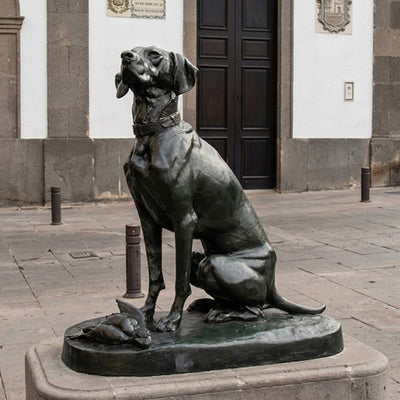























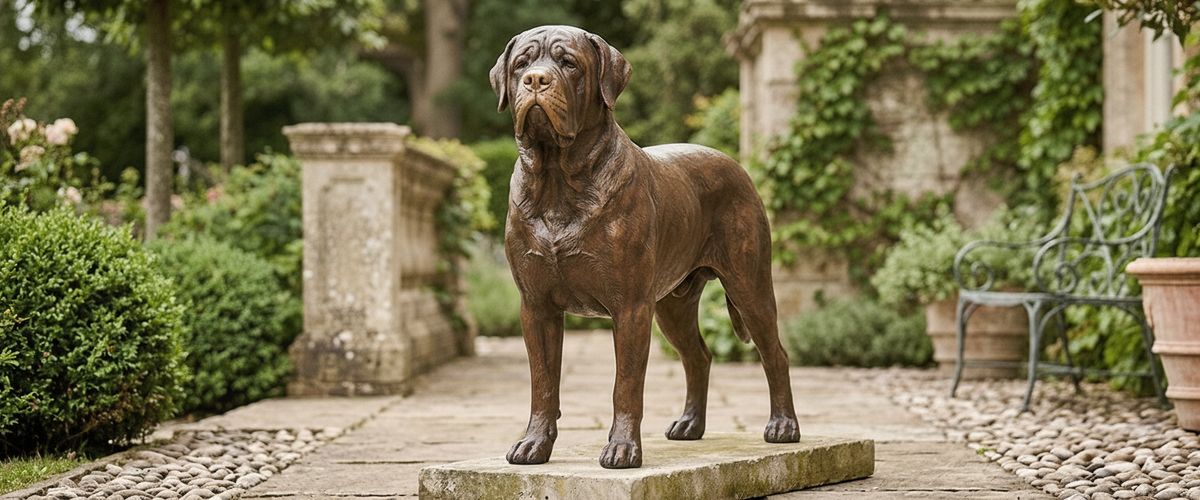

A bronze dog in the wrong spot looks abandoned. Move the same casting beside a front door, to the top of terrace steps or to the bend where the drive turns in, and it suddenly looks like it has a job. Nothing about the sculpture changed, only its placement. That is the first thing we talk through with anyone buying a large bronze dog sculpture, whether it is a stock piece or a portrait of a much-loved animal.

Quick Answer
Plinth height follows pose: seated dogs usually want more lift than standing breeds. Aim to meet a visitor's sightline, not tower over it.
Give the dog a post: doorways, gates and steps read as duty. Open lawns need an anchor such as a path, hedge line or bench.
Plan the approach: ear set and coat texture on a large bronze dog sculpture read best from roughly 10 to 20 feet (3 to 6 m). Beyond that, silhouette does the work.
Expect touch: noses and heads will polish where people pat them. Put the dog where that wear looks earned.
Portraits belong where the real dog waited.
Seated Hound or Standing Mastiff: Getting the Plinth Height Right
A seated hound is a compact, vertical shape. Lift it too high and it becomes a trophy on a shelf. Leave it on the gravel and it disappears into the planting by midsummer. For most seated breeds, we suggest a plinth that lifts the head toward a standing visitor's chest height, or a touch higher at a formal entrance, so the dog meets the eye without looming over it.
A seated hound on a raised plinth meets a visitor's sightline at the door.
A standing mastiff behaves differently. The body is long and horizontal, the weight drops through four legs, and the chest does the talking. It usually looks better on a low, broad base that reads as ground rather than pedestal; raise it too far and the belly becomes the main view. In our studio we mock this up with cardboard silhouettes at full scale before anyone signs off a plinth drawing. It takes an afternoon and saves a crane visit later.
Engineering follows the decision. Bronze is dense, so for every large bronze dog sculpture the footing, fixings and plinth material are specified for each piece and each site rather than guessed.

Doorway, Terrace or Lawn: Where a Large Bronze Dog Sculpture Reads as on Duty
The doorway is the classic post for good reason. A single seated dog beside a front door in Westchester, or a matched pair flanking the gates of a Napa estate, borrows meaning from the architecture: someone is watching who comes in. Keep it clear of the swing of the door and leave enough room for people to pass without brushing it.
Terraces suit dogs that look outward. Set at the top of steps and turned toward the garden, a pointer or retriever reads as alert rather than ornamental. This is where many large outdoor bronze sculptures earn their keep, because the terrace is the spot people actually stand and look from.
The lawn is the hardest. A large bronze dog sculpture alone in the middle of open grass looks lost, however good the modeling. Tie it to something: the end of a path, the corner of a yew hedge, the foot of a tree. Where there is no hedge or tree to borrow, a low bronze-toned seat such as the Bronze Swept Leg Cast Resin Low Bench, 185cm gives a lying or seated dog a reason to be there, as if it has settled at someone's feet. On a larger lawn that needs height rather than a resting place, a tall vertical group like the Quoin Bronze Reeds Sculpture, 400cm can set the backdrop, with the dog placed low in front of it so the two read as one composition. Browsing our bronze garden statues with a site plan in hand helps, because you start choosing poses for specific spots instead of falling for a piece and hunting for somewhere to put it.
Ears, Coat and Stance: Details That Need the Right Viewing Distance
Breed character lives in small things: the fold of a Labrador's ear, the feathering on a spaniel's legs, the tight skin over a Weimaraner's shoulder. Those details only register at conversational distance, roughly where a guest pauses on the path. Place a finely chased spaniel 60 feet (18 m) away across a lawn and the texture flattens into a brown lump.
For long sightlines, choose stance over surface. Pricked ears, a raised head and a clear gap between legs carry from the far end of a garden in Aspen or the Texas Hill Country. On any bronze sculpture large enough to be seen from the drive, silhouette does more work than coat texture. Our bronze dog statues cover both approaches, and we will tell you honestly which suits your site.

Patting Hands and Polished Noses: How a Bronze Dog Wears Its Patina
People pat bronze dogs. They cannot help it. Within a year or two the nose, crown and sometimes the back turn bright gold against the darker patina. Edinburgh's Greyfriars Bobby has had its nose rubbed so heavily by visitors that the city has repeatedly asked people to stop.
Touch wear on the nose and crown shows up within a year or two.
We see this as part of ownership, not damage, but it is worth deciding where you want it. A large bronze dog sculpture by a front door will be touched daily; one on a far terrace barely at all. Annual cleaning and a fresh coat of microcrystalline wax, the approach outlined in outdoor bronze care guidance from the Getty Conservation Institute, softens the contrast and protects the surrounding surface. Coastal homes in the Hamptons need that wax more often, because salt air speeds up green corrosion.
Portrait Commissions: Placing a Likeness Where the Real Dog Used to Wait
The most moving placements we handle are portraits. One client outside Austin asked us to cast her late Labrador at the kitchen garden gate, facing the drive, because that is where he sat every evening waiting for the car. The bronze is in exactly the same spot. Visitors who never met the dog still understand it.
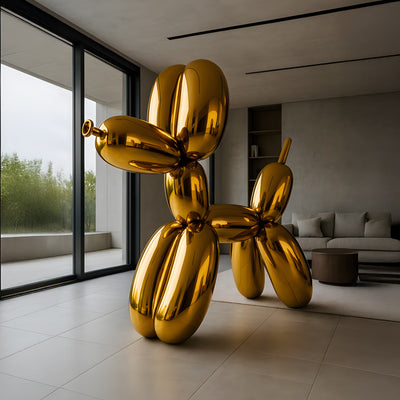
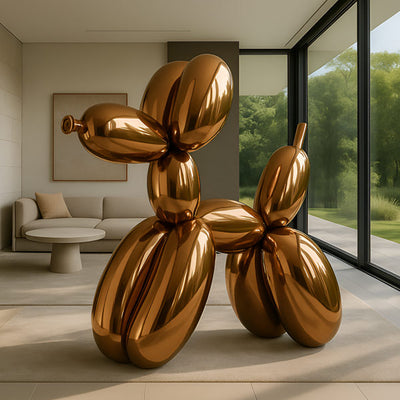
A portrait starts with photographs from every angle, measurements if they exist, and the details owners care about, like a collar tag or a crooked ear. We approve a clay model with you before it moves to lost-wax casting. If a lighter mood suits the space better, our large balloon dog sculptures in polished stainless steel take the idea somewhere playful.

Placement Checklist Before You Commission
For wider placement ideas, Why Large Resin Garden Sculptures Blow Over, and How to Anchor Them is useful companion reading before finalising the setting and sightlines.
Run through these points before any large bronze dog sculpture goes to the foundry.
Pose against location: seated for doorways, standing or pointing for terraces and long views.
Viewing distance: walk the route a guest takes and mark where they pause.
Plinth: height, material and footing agreed before casting.
Access: gate widths, slopes and lifting equipment for delivery day.
Touch zones: accept polishing, or place the dog out of reach.
Climate: salt, desert sun and freeze cycles all affect how often you wax.
Stock or bespoke: budget depends on scale, complexity, finishing, engineering and installation, so ask for a tailored quote.
Whether you want a large bronze garden sculpture of a favorite breed or a full portrait commission, Giant Sculptures can help you choose the pose, plinth and spot before anything is poured. Start with our large bronze sculptures collection, then send us your site photos.