

































It is easy to buy a vessel and never really look inside it, and that is the first placement mistake. An abstract vessel sculpture is built around a hollow, and the hollow is where the maker put most of the thinking. Set it too low, light it from above, or leave rainwater pooling in it, and you have paid for half a sculpture. This piece covers what to look for before you buy and how to place the work so the interior earns its keep.

Quick Answer
The void is the subject. Judge the interior with the same care as the outside.
Wall and lip tell the truth. They show how the piece was made and how it will age.
Side light beats downlight. Raking light gives the hollow depth; a ceiling spot flattens it.
Plinth height is a decision. With the rim below eye level, the interior joins the work. Above it, the profile takes over.
Outdoors, plan drainage first. Standing water causes more long-term trouble for outdoor vessels than almost anything else.
A Vessel That Holds Nothing: Where Sculpture Leaves Pottery Behind
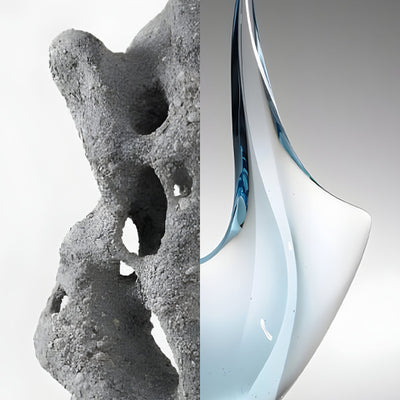
A pot is defined by use. A sculptural vessel borrows the form and drops the job. Once nobody needs to pour from it, the maker is free to tilt the opening, pinch the walls, split the rim or stretch the body into a hull. The Jōmon flame-rimmed vessels at the Metropolitan Museum are a useful reminder that this tension is ancient: those rims went far beyond anything cooking required.
For a buyer, the line matters because it changes what you are paying for. A good abstract vessel sculpture is designed to be walked around and looked into, so its value sits in proportion, opening and interior surface rather than capacity. Look through our abstract sculptures with that lens and the strongest pieces separate themselves quickly.
Read the Wall and the Lip Before You Buy
Start by running your eye along the edge of the opening. A crisp, even lip usually means a controlled mold or careful hand finishing. A lip that thickens and thins can be deliberate (hand-built ceramic often shows this) or a sign of a rushed cast with uneven wall thickness. Ask the maker which it is.
Wall thickness also predicts behavior over decades. Thin bronze walls ring when tapped and move slightly with heat; thick stone walls feel monumental but add serious weight, which affects floor loading and delivery access. Run a fingertip around the inside of the rim before you sign off on any piece. Rough casting seams hide there more often than anywhere else.

Ceramic, Bronze, Resin or Stone: How Material Shapes the Hollow
Each material handles the void of an abstract vessel sculpture differently.
Ceramic gives the most intimate interiors, with glaze pooling at the base. It is fragile at scale and best kept indoors.
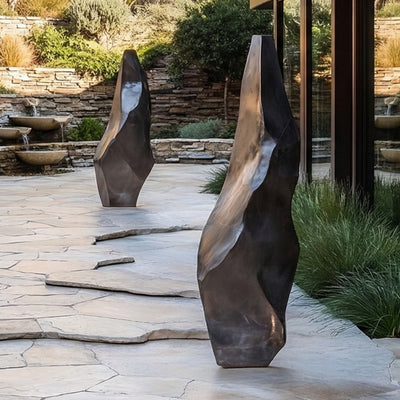
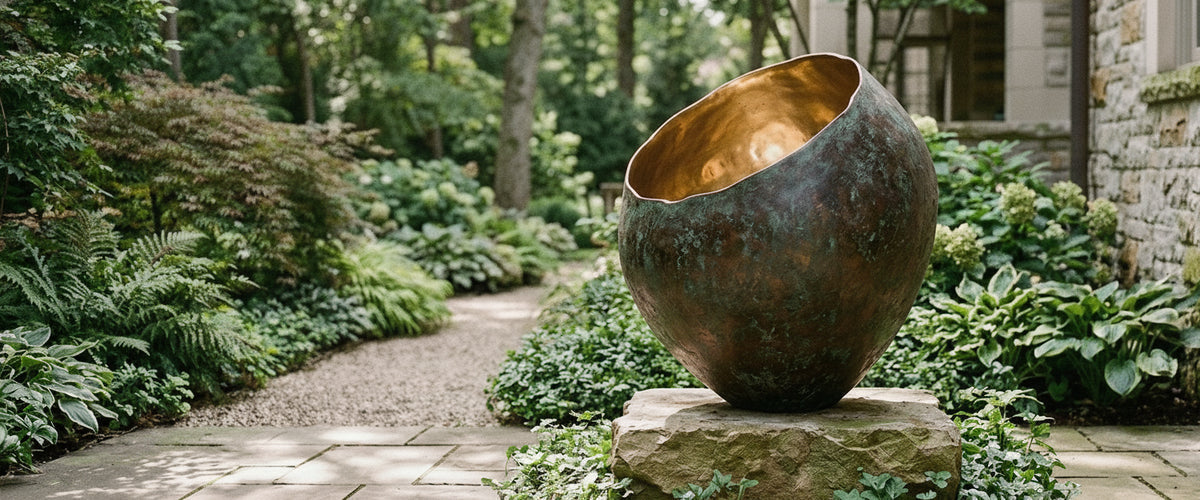
Bronze lets you push walls thin and openings wide. A patinated exterior against a polished interior is one of the most effective contrasts a vessel can carry; our bronze abstract sculptures show the range of finishes.
Resin takes color and high polish well, so the surface itself becomes part of how the form reads. A tinted fluted piece such as the Azure & Lime Polished Fluted Vessel Resin Sculpture - 88cm, at 88cm (about 35 inches), lets the fluting read as bands of color as well as shadow. Resin suits interiors and covered spaces.
Stone and marble make the hollow feel carved out of something solid. Expect heavy pieces and narrower openings, because the carver is removing material rather than building it.
Lighting an Abstract Vessel Sculpture: Side Light Over Downlight
A recessed ceiling spot aimed straight down fills the opening with a flat disc of light and turns the interior into a black hole beneath it. Light from the side, ideally at a low angle from a window or a floor-mounted uplight, rakes across the inner wall and shows its curve. One edge glows, the other falls into shadow, and the depth becomes legible.
Low side light reveals the curve of the inner wall.
A simple test before you commit to a spot: put the abstract vessel sculpture under a single side lamp and rotate it until the interior catches. In apartments with deep window reveals, the best position is often beside the glass rather than in the middle of the room under track lighting.
Plinth Height Decides Whether the Interior Counts
If the rim sits below eye level, typically on a plinth around 30 to 36 inches (76 to 91 cm), the viewer looks down into the work and the interior becomes part of it. Raise the rim above eye level and you lose the inside entirely; the piece reads as a silhouette.
A rim below eye level brings the interior into the work.
Neither option is wrong when placing an abstract vessel sculpture, but choose on purpose. If the profile is the point, a hull form raised on its own stand, such as the Amber Crackled Boat Vessel on a Metal Stand Resin Sculpture - 160cm at 160cm (about 63 inches), makes more sense than a bowl lifted onto a tall plinth: the stretched hull and stand make the side elevation the main event. A shallow bowl form, by contrast, wants to be low.

Outdoor Vessels and the Drainage Detail Most Makers Forget
An abstract vessel sculpture outdoors is a rain gauge. Water collects, freezes in winter, grows algae in summer and leaves mineral rings on bronze and stone. A bronze bowl on an open terrace without a drain can need bailing after every storm, and retrofitting a concealed weep hole later is far harder than planning one at the design stage.
Ask for a discreet drain at the lowest interior point, routed through the plinth, or a tilted base that sheds water. Conservators, including the Getty Conservation Institute, identify moisture as a major driver of outdoor deterioration, and vessels concentrate it by design. Bronze, Corten-detailed bases and dense stone handle exposure well; resin and ceramic should stay under cover.
Buyer Checklist Before You Buy or Commission
Where will the light come from, and at what angle?
Will the rim sit above or below eye level, and which view do you want?
Is the wall thickness consistent, and is the lip finished inside as well as out?
Indoors or outdoors? If outdoors, where does the water go?
Can the floor, terrace or plinth carry the weight, and can the piece get through the door?
Does the material match the setting: bronze or stone for gardens, resin or ceramic for interiors?
Budget depends on material, scale, complexity, engineering, installation and finishing, so the most useful next step is a tailored quote. Giant Sculptures makes bespoke vessels in bronze, stone and engineered metalwork, sized for Hamptons gardens and Texas lobbies alike. Send us the space, the light and the view you want, and we will design the hollow around it. For more directions, explore our contemporary and modern sculptures.
For wider placement ideas, How to Judge an Abstract Bronze Sculpture Before You Buy It is useful companion reading before finalising the setting and sightlines.