

























































































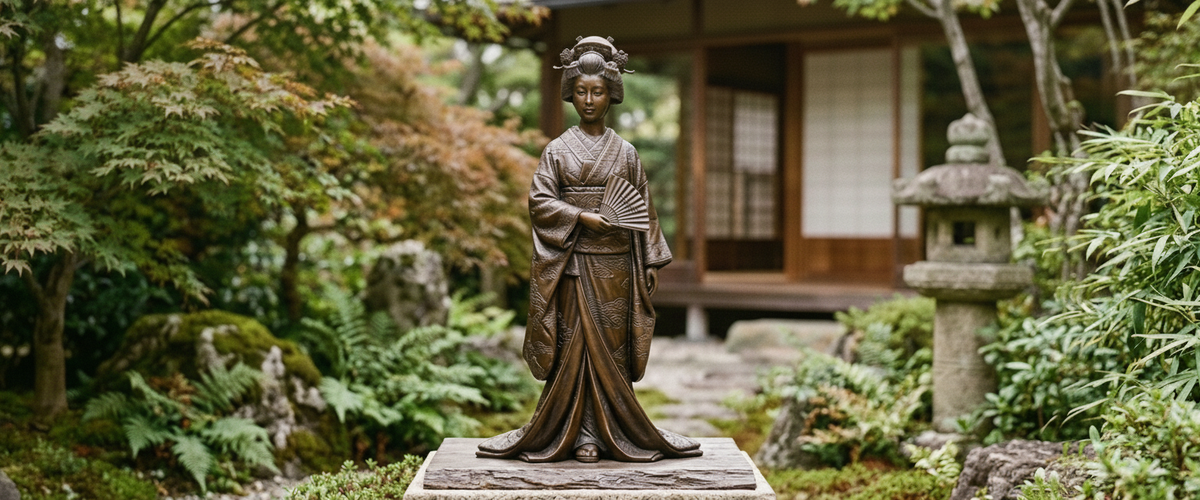

Most Japanese bronze figures fail in the home for one reason: they get pushed against something. A Japanese bronze figural statue with bell shaped dress and headpiece reads almost entirely through outline. The flare of the robe and the rise of the crown or hair ornament carry it. Crowd that outline with a lamp or a fern and the figure turns into a dark lump on a shelf.
We see this more than anything else in the photos clients send back from Dallas lofts and Napa guest houses. The fix is rarely a different statue. It is a different spot, a different height and a different light. Here is how we advise placing these figures, from compact antique-style casts to bespoke pieces made through our foundry partners.
At a glance
Leave clear air on both sides of the robe, at least half its widest measurement.
Set the headpiece around 60 to 64 inches (152 to 163 cm) for standing viewers, or about 44 to 48 inches (112 to 122 cm) where people mostly sit.
Alcoves, consoles and hallway niches suit these figures best.
Put pale plaster, limewash or linen behind the figure and avoid busy pattern.
Light from the side, not straight down.

Why a Japanese Bronze Figural Statue Needs Empty Air
The bell-shaped robe is the silhouette. On most Japanese figural bronzes the body barely exists under the garment. The sculptor put the drama into the flare of the hem and the column of fabric rising to the shoulders, so side clearance matters more than depth. As a working rule, leave at least half the robe's widest measurement as clear air on each side, and more if the wall is dark. A hem spanning 12 inches (30 cm) wants 6 inches (15 cm) of nothing to its left and right before a vase, frame edge or door casing intrudes.
Clear air on either side lets the flare of the robe read as a clean outline.
Depth is more forgiving. A few inches off the back wall is enough, provided the headpiece does not throw a shadow that doubles its outline. If your Japanese bronze figural statue will mostly be seen in profile, as in a corridor, flip the rule and give the front and back the air instead.
Plinth Height: Put the Headpiece Where Eyes Land
The headpiece carries most of the chased detail. When we check castings before they leave the studio, that is where the finisher has spent the longest: combs, pins, folded crowns, the fine lines of the hair. If a Japanese bronze figural statue sits with its headpiece below chest height, nobody sees that work. For a standing audience, aim for the top of the headpiece at roughly 60 to 64 inches (152 to 163 cm) from the floor. In a living room or library where people take the figure in from a sofa, drop that to about 44 to 48 inches (112 to 122 cm).
The arithmetic is simple. Subtract the statue's height from your target eye line and the remainder is your plinth or furniture height. A 24-inch (61 cm) figure on a 36-inch (91 cm) console lands its crown at 60 inches, right where a standing guest looks. Keep the plinth top slightly wider than the hem so the flare never appears to hang over the edge, and choose plain stone, oak or matte lacquer so the base stays quiet.

Alcove, Console or Hallway Niche: Three Spots That Work
The Alcove
A shallow wall recess frames the silhouette on three sides and does the clearance work for you. Measure the alcove width against the hem. If the robe fills more than about half of it, the figure looks trapped rather than housed.
The Console
A hall or sofa-back console gives natural height and a clean horizontal to read against. Keep the other end nearly empty. One low bowl is fine; a table lamp at the same height is not.
The Hallway Niche
Corridors are places people pass rather than stop, so the three-quarter view matters. We shipped a pair of figures to a client in the Hamptons who first set them square to the hallway. Turned about 30 degrees toward the approach, the robes suddenly had depth and the headpieces caught the window light. Nothing else in the hallway changed.
Walls That Let a Dark Patina Read
Most Japanese bronzes carry a warm, dark patina, anywhere from chocolate brown to near-black with a reddish undertone, a surface tradition with long roots in Japanese metalwork (the Smithsonian's National Museum of Asian Art holds good historical examples). That surface needs contrast, and the wall behind a Japanese bronze figural statue is where it comes from. Pale plaster, limewash, warm white paint or natural linen let the patina read as color rather than shadow. Busy wallpaper, dense grasscloth and glossy dark paint swallow it. A client in Austin once sent us a photo of her figure against charcoal lacquer, and we had to ask which side of the frame the statue was on.
Side Light for the Robe, Soft Fill for the Face
A beam raking in from 30 to 45 degrees off one side picks up every fold of the garment and puts a highlight on the headpiece. A recessed downlight directly overhead does the opposite: it bleaches the crown, drops the face into shadow and flattens the fall of the robe. If you are stuck with ceiling cans, use an adjustable gimbal and angle it off-axis, or add a small uplighter to one side. Then soften the other side: a low fill lamp or simply a pale wall bouncing light back keeps the face from disappearing. Warm light around 2700 to 3000K flatters bronze; cool white can make a brown patina look gray. If you are working with a lighting designer, the Illuminating Engineering Society publishes sound guidance on accent lighting.
A side beam at around 40 degrees picks out the folds of the robe and the chased headpiece.

Habits That Smother the Figure
Grouping is the most common mistake. Three figures on one shelf become a chorus line; one figure with room reads as a presence. If you want a companion, pick a different shape with a lower profile. A bronze bell seems a natural partner, but two flared bronze silhouettes side by side argue, so give the bell its own wall or garden spot. At 160 cm (63 inches), a temple form such as the Large Traditional Chinese Temple Bell Bronze Sculpture - 160cm has the height to hold a separate corner of the room on its own, while a smaller cast like the Large Traditional Bronze Bell Sculpture, 90cm sits more comfortably on a terrace or in a garden bed, well out of the figure's sightline.
Plants are the second offender. A trailing pothos at the hem blurs the exact line the sculptor worked hardest on, so keep foliage at least an arm's length away, or place it behind and above the figure. Three smaller habits are worth breaking too: stacking books to fake plinth height, dusting with furniture polish (a soft dry brush and occasional microcrystalline wax is all indoor patinated bronze needs), and parking the figure in a sunny window where one hot glare becomes the only thing you notice.
Choosing a Figure for the Space You Have
Before you buy a Japanese bronze figural statue, run through this list:
Hem width, not just height. Clearance works off the widest point of the robe.
Viewing position. Standing, seated or passing decides plinth height and orientation.
Wall finish. Plan any repaint before delivery, not after.
Light source. Know whether you can add side lighting.
Weight. Solid bronze is heavier than it looks; confirm your console or plinth can carry it.
Indoors or out. Outdoor figures need a patina and fixing plan for weather, and a garden setting usually calls for more scale than a console figure offers.
If nothing in stock fits your niche, a commissioned Japanese bronze figural statue is often simpler than buyers expect. Giant Sculptures can adjust scale, patina depth and headpiece detail to the room, and we quote each piece on material, size, casting complexity, finishing and delivery. Start with our bronze figures and statues, explore the wider bronze sculptures collection, or look at bronze garden statues if the figure is heading outside.
For wider placement ideas, Why Bronze Garden Statues Vanish by July, and How to Place Them Right is useful companion reading before finalising the setting and sightlines.