





































































































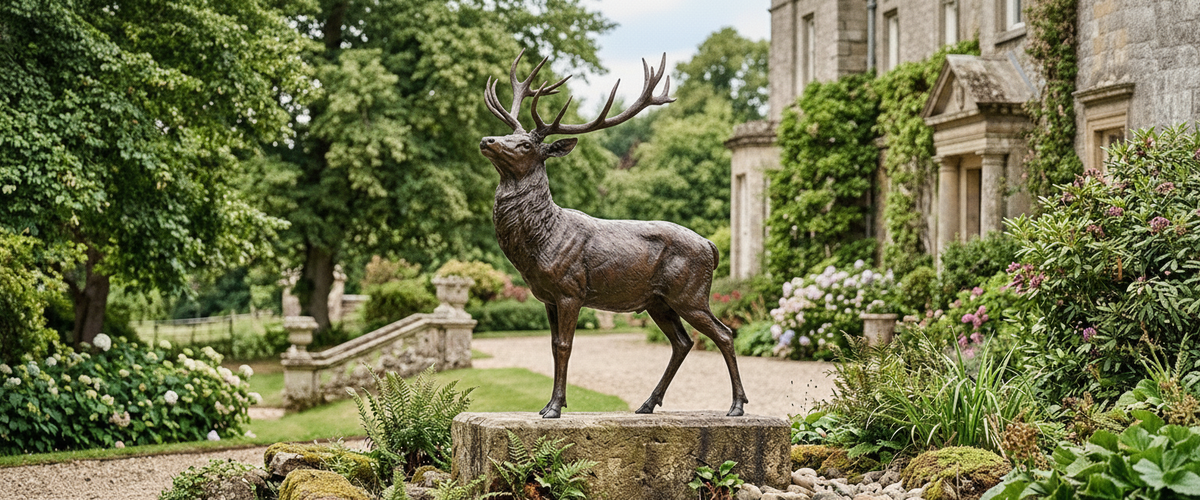

A bronze figure that looked commanding against bare soil in April can be swallowed to the shoulders by the second week of July. It happens constantly. Most disappointment with bronze garden statues has nothing to do with the casting or the patina; it comes from siting a fixed object inside a landscape that grows eight inches a month and then wondering why the piece stopped reading from the terrace.
Bronze garden statues are the most forgiving outdoor sculpture we work with, which is exactly why placement carries so much weight. The metal will outlive the planting scheme, the irrigation system and probably the house. Your job is to put it somewhere that still works in year five.

Key Takeaways Before You Choose a Spot
Plan around mature plant height, not nursery-pot height. Most borders gain a third of their bulk after installation.
Dark patina against dark evergreen kills contrast. Bronze garden statues need a lighter or emptier backdrop.
Raise the base above the mowing line. Gravel skirts and mower strikes cause more damage than weather does.
Pick one winning sightline and commit. Two half-good views beat nothing, but one great view beats both.
Keep the metal out of direct sprinkler spray and away from hard-water runoff.
Some subjects need a companion to read as a scene. Others are ruined by company.

The Planting Error That Swallows a Bronze Figure
Designers specify from plant tags; gardens grow from root systems. A grass that lists at 4 ft (120 cm) will push past 5 ft (150 cm) in a well-fed Napa border by its third season, and a miscanthus clump spreads sideways faster than it climbs. Check mature spread as well as height before you commit a position, using a reference like the Missouri Botanical Garden Plant Finder rather than the nursery label.
The practical fix is to set the sculpture's visual center above the tallest planting within a 6 ft (1.8 m) radius. For a life-size figure that usually means either a plinth or a deliberate clearing. We have shipped bronze garden statues into gardens where the client held back the border by a full three feet and filled that gap with low gravel or clipped box. It looks intentional, and it keeps working when the perennials go feral.
Dark Patina Against Evergreen: Where Contrast Quietly Collapses
Brown-black and green-black patinas are gorgeous in the studio and can be invisible in a shaded yew or laurel border. Bronze needs something behind it to push against: a lawn, a pale stone wall, water, gravel, sky. A piece with air behind it will read from 100 ft (30 m). The same casting against a dense hedge in flat north light reads as a shadow.
Air and open sky behind the form keep the silhouette legible from the far end of the garden.
If the ideal position for one of your bronze garden statues is genuinely in a shaded border, discuss finish at the commission stage. A lighter chestnut or verdigris-leaning patina, or selective polishing on raised surfaces, gives the form edges to catch what light there is. Silhouette does the rest, which is why animal subjects with open profiles work so well in planted settings. Where the backdrop is busy, an extended form such as the Life-Size Contemporary Leaping Dolphin Bronze Sculpture - 250cm at roughly 8 ft (250 cm) holds its outline through negative space rather than mass, and that keeps it legible where a solid block would flatten out.

Plinth Height, Gravel Skirts and the Mowing Line
Most damage to outdoor bronze garden statues happens in the bottom 12 inches (30 cm). String trimmers chew at the base, mower wheels clip the plinth corner, and splash-back from bare soil deposits mineral staining around the feet.
A gravel skirt wide enough to keep mowers and trimmers away from the base.
Three decisions solve it. First, set the plinth so the sculpture's base sits clear of the grass line, typically 12 to 24 inches (30 to 60 cm) for a life-size figure viewed from a path. Second, ring the plinth with a gravel or stone skirt wide enough that no mower needs to touch it. Third, make sure the base is engineered for the ground it sits on; a heavy casting on soft clay will lean within two winters unless the footing is specified properly. We size foundations and fixings as part of the commission, because a piece that tilts is a piece that looks cheap regardless of what it cost to cast.
Sightline From the Kitchen Window or Sightline From the Path
Clients often try to satisfy both. The result is a compromise angle where the sculpture shows its least interesting profile to everyone.
Decide which view you actually use. In most homes the kitchen or living room glazing is the view seen 300 times a week, and the garden path is seen on weekends. If the interior view wins, orient the strongest profile square to that window and accept that walkers get a three-quarter view, which is usually the better one anyway. Long approaches deserve a high-drama subject: something like the Life-Size Bugling Bull Elk Bronze Sculpture - 260cm at about 8.5 ft (260 cm) wants distance to be read properly, so place it at the end of a lawn run on a Texas or Aspen property and let the approach do the work.
Coastal Air, Hard Water and Sprinkler Spray
Bronze handles weather. What marks it fastest is water that carries something else. Chlorinated pool splash, hard-water sprinkler spray and salt-laden coastal air all leave deposits that etch through the protective wax layer and force the patina to shift unevenly, often in streaks rather than the even bloom people actually want.
This matters for anyone typing bronze garden statues for sale Los Angeles into a search bar, and for owners anywhere along the California coast. Sea air plus automated irrigation plus hard municipal water is a demanding combination. One Malibu client had a figure positioned inside the throw of a pop-up sprinkler head; within a season the lower third had a chalky mineral band the rest of the piece did not share. Moving the head cost fifty dollars. Re-patinating would have cost considerably more.
Site bronze garden statues outside irrigation arcs, rinse with clean water a few times a year in coastal zones, and rewax annually. The Smithsonian's Museum Conservation Institute is a sound reference on protective coatings for outdoor metals if you want the technical background before you set a maintenance rhythm.

One Figure, a Pair or a Group of Three
Scale is only half the question. Bronze garden statues can be read singly, in matched pairs or as a group of three, and the subject usually decides which. Some pieces are self-contained and lose authority when flanked. Others describe a relationship and feel unfinished alone.
A single monumental animal or abstract form holds a space on its own. Narrative pieces behave differently: a self-contained group such as the Life-Size Traditional Lioness and Cub Bronze Sculpture at around 3.5 ft (110 cm) already carries its own story, so it reads beautifully as a lone incident in a border and gains nothing from a companion. Matched pairs work at thresholds, gate piers and pool ends, where symmetry is the point. Groups of three want a shared floor plane, usually gravel or lawn, and enough spacing that the eye travels between them rather than lumping them into one mass. Browse the wider bronze animal sculptures range to see how differently solitary and grouped subjects behave.
Placement Checklist
For wider placement ideas, Antlers Break First: An Insider's Guide to Bronze Deer Garden Statues is useful companion reading before finalising the setting and sightlines.
Mock up the footprint with stakes and cardboard at full height for a week before finalizing.
Photograph the position from your main interior window at morning, midday and evening.
Check mature height and spread of everything within 6 ft (1.8 m).
Confirm the backdrop gives tonal contrast to the chosen patina.
Map irrigation heads and pool splash zones.
Specify plinth height, footing and fixing method for the actual soil conditions.
Plan crane or forklift access before the piece is cast, not after it lands at port.
Agree an annual wash and wax schedule from day one.

Commissioning Bronze Garden Statues That Suit the Site
Every good outcome we have delivered started with site information rather than a catalog page. Scale, patina, base design and orientation all shift once we know the backdrop, the light and the viewing distance. Giant Sculptures produces bespoke bronze work at architectural scale, adjusting subject, finish and mounting to the garden it is going into, and budget depends on material, size, complexity, engineering, installation and finishing, so a tailored quote is always the honest starting point. Buyers hunting for bronze garden statues for sale Los Angeles delivery included get the same treatment: crating, freight and siting advice quoted together.
Start with the bronze garden statues collection to test proportions against your space, then send photographs and rough measurements. We will tell you if the position works before anything is cast.