





































































































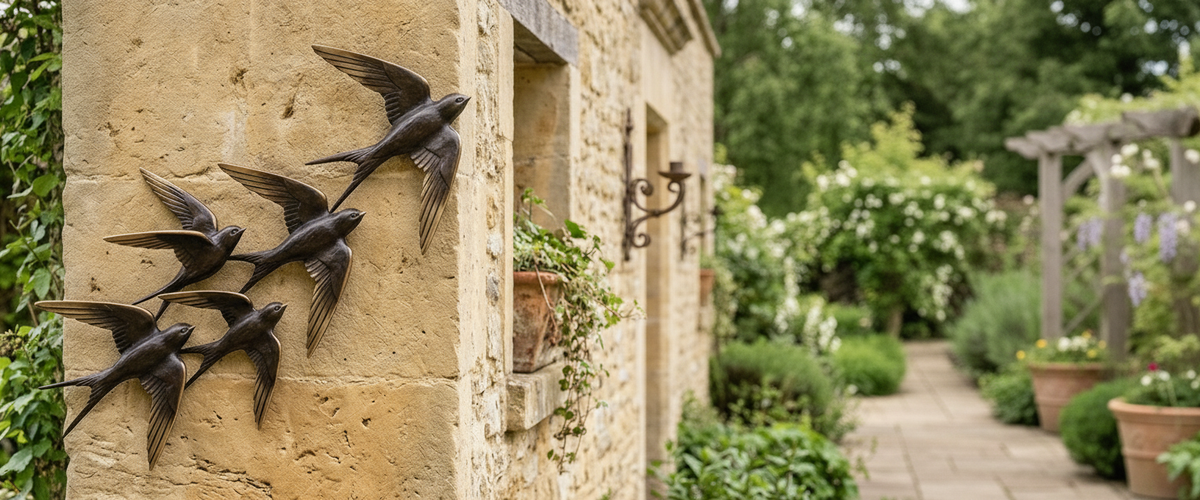

A single cast bird on a wide plaster wall does not look like flight. It looks like something that got separated from the group. Bronze bird wall art lives or dies on the illusion of movement, and movement needs at least three bodies at different heights, different angles and different distances from the eye. Get the count and the climb right and the wall stops being a surface. Get them wrong and you have an expensive paperweight nailed six feet up.

Key Takeaways
Odd numbers move. Three, five or seven birds read as a flock; two read as a matched pair; one reads as a mistake unless it is large and deliberately solitary.
Set the group on a rising diagonal, not a level row. The eye follows the climb.
Total wingspan across a bronze bird wall art group should sit at roughly two thirds of the usable wall width, agreed before anything goes to the foundry.
Side light carves the feathers. Flat overhead light flattens them into silhouettes.
Outdoors, plan for rainwater runoff before you plan for the view.
Why Bronze Bird Wall Art Needs an Odd-Numbered Flock
Two birds at matching heights make a symmetry your brain solves instantly, then ignores. Three or five give it something unresolved to track. We usually build the group around one dominant bird with the fullest wing extension, a second slightly behind and lower, and the rest trailing at decreasing scale. That is the whole trick: no two birds should share a height, a wing position, or a distance from the wall.
If a client insists on a solitary piece, it needs to earn the wall through scale and drama rather than count. A big single relief works the same way. The Galloping Herd Bronze Relief Wall Art - 120cm (roughly 4 feet across) carries a bare wall on its own because the movement is already inside the composition. A 10-inch swallow cannot do that job alone.
Spacing the Flight Path so the Group Climbs
Hang the birds along an invisible diagonal that rises about 20 to 30 degrees, usually toward a corner, window or stairwell the eye already travels to. Vary the gaps. Tight clustering at the lead, wider spacing at the tail, so the flock appears to be stretching out rather than parading.
Every bronze bird wall art group we install starts life as paper. Cut silhouettes to the real wingspan, tape them, then stand across the room and photograph the wall on a phone. The camera flattens the arrangement the way memory does and shows you instantly whether the group is climbing or sagging. One Napa courtyard project went through four tape layouts before the client agreed the flock was pulling toward the pergola rather than drifting sideways.
Five birds on a rising diagonal, tight at the lead and looser at the tail.

Wingspan Against Wall Width: The Ratio to Settle Early
Measure the usable wall, meaning the plaster you can actually fill without crowding a door frame, light switch or picture rail. The combined horizontal spread of the flock, gaps included, should land near two thirds of that measurement. Under half and the group floats like an afterthought. Over three quarters and it feels wedged in.
This ratio decides casting sizes, so it belongs in the first conversation of a bespoke bronze bird wall art commission, not the last. A stairwell wall of 12 feet (3.6 m) might take five birds with individual wingspans from 14 to 26 inches (35 to 66 cm). A double-height great room in Aspen might need three birds at three times that scale. Scaling up a small model late in the process usually means new patterns and a longer lead time, which is why we settle the ratio before the foundry starts. Browse the bronze wall art range to see how existing sizes behave, then use those as a starting point for a bespoke set.
Raking Light Does Half the Sculpting
Bronze sculpture wall art depends on shadow. A wing edge only reads as thin and sharp when light crosses it at a low angle; lit straight on, it turns into a flat brown shape. Find the lamp before you find the hook. An adjustable spot set 12 to 18 inches (30 to 45 cm) out from the wall, aimed down at roughly 30 degrees, will pull the feather chasing forward and throw soft shadows that double the sense of depth. Lighting is the cheapest upgrade available to any bronze bird wall art installation.
Low side light separates each feather; flat frontal light collapses the wing.
Daylight counts too. A wall that gets low morning sun from one side is doing the job for free for two hours a day, and the flock will look different at noon. That change is a feature, not a fault, as long as you have not relied on a single fixed spotlight to make the piece work.
Warm Bronze on Cool Plaster Versus Warm Bronze on Oak
A dark brown or chocolate patina on cool gray plaster gives you maximum contrast and a graphic, near-silhouette effect. Good for modern interiors. Put the same patina on warm oak panelling and the birds vanish into the grain. On timber walls we push toward a lighter verdigris, a green-brown, or a partially polished finish that catches light where the panelling is darkest.
The same logic applies to stone. When a client wants birds on a pale limestone wall, a carved option can beat bronze outright; the Peony and Longtail Birds Grey Stone Relief Wall Art - 120cm holds its own against masonry in a way a small dark casting would not. Patina choice is reversible in theory and awkward in practice, so test a sample against your actual wall color before committing.
Flush Mounting Without Burying the Tail Feathers
Most cast birds are hollow, produced by the lost-wax process, with a threaded stud or keyhole plate set into the back. Sink that stud too deep and the tail feathers press into the plaster, killing the shadow gap that makes the bird float. We normally specify a standoff of half an inch to an inch (12 to 25 mm) so air, and therefore shadow, sits behind the body.
Projection is a design decision as much as a fixing detail. Where a commission needs the piece to read from an oblique angle, down a corridor or across a stairwell, deep relief work such as the Contemporary Emerging Male Figure Bronze Wall Sculpture - 60cm holds its form in a way a shallow casting never manages, and the same casting and patination options are open on a bird group.
Fixings for bronze bird wall art matter more than people expect. A 20-pound (9 kg) bird cantilevered off a wing needs a masonry anchor or a stud, never a drywall plug on its own. For plasterboard, we supply mounting plates that spread the load across two fixings, and we mark them left and right because a bird hung upside down at the tail loses its whole line.

Taking the Flock Outside
Bronze bird wall art sculpture works beautifully on a sheltered porch, a courtyard wall or a shaded loggia. The problem is not the metal. It is what runs off it. Copper alloys weather to a green patina, and rainwater carrying those corrosion products will streak porous stone, stucco and light brick below the piece. The Copper Development Association documents this runoff behavior on architectural copper, and the fix is the same for sculpture: mount under an overhang, add a discreet drip edge, or accept the staining as part of the look.
Wax the birds annually with a microcrystalline wax, rinse salt off if you are near the coast, and check fixings each spring for movement. Pieces we have shipped to Texas courtyards get a second wax coat in fall because the UV load is punishing. More outdoor-ready formats sit in the outdoor wall art collection.
Checklist Before You Commission
Measure the usable wall width and height, excluding trim and switches.
Decide the count: three, five or seven, with one dominant lead bird.
Tape paper silhouettes at full size and photograph the wall from your normal viewing spot.
Confirm the light source and its angle before finalizing patina.
Check wall construction: masonry, stud, or plasterboard, and specify fixings accordingly.
Outdoors, identify what sits directly below the piece and plan for runoff.
Agree standoff depth so tail feathers are not compressed against the wall.
Bespoke bronze bird wall art starts with the wall, not the bird. Send us photographs, dimensions and the light conditions, and our studio will model the flock to fit rather than shrinking a stock arrangement into a space it was never sized for. Budget depends on scale, casting complexity, patina, mounting engineering and installation, so ask for a tailored quote once the count and wingspan ratio are settled. More depth-led options are grouped in the 3D wall art range if you want to compare relief styles first.
For wider placement ideas, How to Choose a Bronze Eagle Statue That Reads as a Bird, Not a Decoy is useful companion reading before finalising the setting and sightlines.