





































































































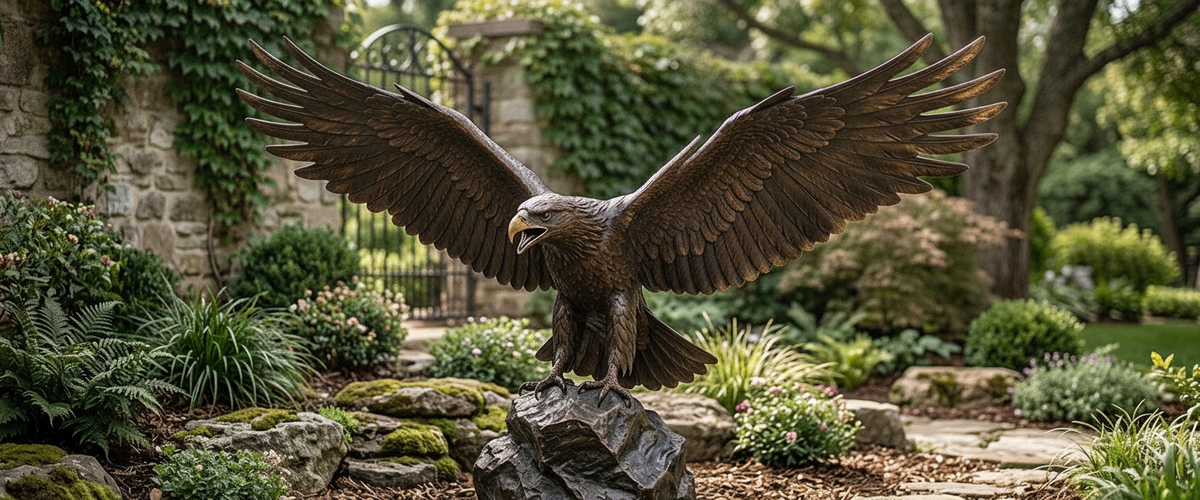

Most eagle sculptures fail in the same place: the head. Set the eye too high in the socket, soften the hook on the beak, and a bronze eagle statue drops straight into decoy territory no matter how crisp the feathers are underneath. Get that head right and the bird holds a forecourt from fifty feet (15 m) away, before anyone is close enough to read a single primary feather. Pose, ground plan and anchoring decide the rest.

At a Glance
Two silhouettes: a spread-wing bird needs open air around it; a perched or folded bird needs height under it.
Gate piers suit folded wings. Forecourts and memorial lawns can carry a full span.
Detail hierarchy: head, beak and eye first, talons second, feather chasing third.
Patina should read as depth in the plumage, not a single flat brown coat.
Wind load on a spread-wing bronze eagle statue is the number one engineering issue. Anchor into concrete, never into gravel or glued pavers.
Budget follows scale, wall thickness, complexity of the wings, patina work and installation. Ask for a tailored commission quote.
Two Silhouettes, Two Ground Plans
Every bronze eagle statue we cast begins as one of two shapes. The spread-wing bird, wings out and talons dropped for a landing, is a horizontal object pretending to be vertical. It eats lateral space and needs sky or a plain wall behind it, otherwise the wingtips collide visually with hedging, railings and window mullions. The perched or half-folded bird is a compact vertical mass that gains everything from a plinth. Same subject, completely different site plan.
A full wingspan needs open air and a plain backdrop behind it.
A useful test before you buy: mark the wingspan on the ground with tape and stand back at the distance visitors will actually approach from. Clients are routinely surprised. A 7 ft (2.1 m) span reads modest in a ranch forecourt and enormous on a suburban terrace. Browsing our bronze eagle statues alongside a taped footprint is a faster way to settle scale than any drawing.
Gate Piers, Forecourts and the Memorial Lawn
Paired gate piers reward a folded eagle. The bird sits within the cap stone footprint, wings tucked, head turned inward or outward depending on whether you want welcome or warning. Nothing overhangs, so nothing gets clipped by a delivery truck mirror. If you want a pair, ask the studio to mirror the head turn rather than casting two identical birds; identical twins on gate piers look mechanical. The plinth arithmetic is the same as for any paired guardian. On the Large Traditional Chinese Guardian Lion Bronze Sculpture (Tiered Greek Key Plinth) - 140cm, the height comes from the base rather than the animal, which is exactly how a folded eagle should be lifted to eye level without widening its footprint.
Forecourts, roundabouts and memorial lawns are where the full span earns its keep. Here the sculpture is viewed in the round and from a distance, so the underside of the wings matters as much as the top. Figurative groupings work at this scale too. At 200cm (roughly 6 ft 7 in), the Life-Size Contemporary Man and Eagle Bronze Sculpture takes the alternative route: the bird gains narrative weight by being anchored to a human figure rather than floating on a column, which is often the right call for a civic or campus setting.

Head, Beak and Eye: What Separates a Cast Eagle from a Decoy
Ask for close-up photos of the head before you commit to any large bronze eagle statue. Look for the brow ridge shading the eye, a cere (the fleshy band at the base of the beak) that is modeled as a separate plane, and nostrils that are drilled rather than dimpled. The hook of the beak should have a sharp under-curve with a visible cutting edge. Talons should grip whatever they stand on, with the branch or rock compressing slightly under the toes. When a foundry skips that compression the bird looks glued on.
Head detail decides the piece: brow ridge, modeled cere, drilled nostrils and a cutting edge on the beak.
Feet are also where cheap castings show their limits. Thin, splayed talons usually signal a thin-walled pour, and thin walls plus long cantilevered wings is a bad combination outdoors.
Feather Work Under the Patina
Patina is not paint; it is a controlled chemical reaction on the surface of the alloy, and on a bird it should do structural work for the eye. Our preference on eagles is a dark brown base driven into the feather channels with a lighter highlight lifted on the barbs and the wing coverts, so the plumage keeps depth in flat overcast light. A single even brown flattens the whole bird by mid-afternoon.
Verdigris tips can look superb on a bald eagle where the head and tail are worked lighter against a dark body, but green needs restraint outdoors because rainwater will keep developing it. A feathered bronze eagle statue holds water in every channel, which is why we specify wax maintenance more often on birds than on smooth abstract forms. The same logic applies to any plumage piece in our bronze animal sculptures range, and water changes the brief again: a piece such as the Large Traditional Crane Pair Bronze Fountain - 190cm lives in permanent wet contact, so its patina has to be specified for constant runoff rather than occasional rain.

Wind Load and the Anchoring Spec We Insist On
A wide-wing bronze is a sail. The metal is heavy, which helps, but the load path runs through two narrow ankles into whatever you have bolted to, and that is where failures happen. Our standard for a spread-wing bronze eagle statue is a stainless steel armature carried up through the legs into the body, welded to a hidden base plate, then bolted into a poured concrete pad sized for the exposure of the site. No resin plugs into pavers. No dry-set on gravel.
Coastal and ridge sites need more. Where a client wants the eagle landing on a natural boulder, the rock is core-drilled and the sculpture pinned into it with grouted stainless rod, because a bird on a rock still has to survive a canyon gust. Tell your supplier the exposure category, the mounting surface and whether the piece sits near a road or a walkway before the model is finalized. It changes the internal engineering, not just the plate.
Bald Eagle and American Eagle Poses: Symbolism Changes the Brief
A bronze bald eagle statue with the head turned and wings half raised reads as vigilance. Wings fully spread with talons forward reads as arrival and power. That difference matters on a memorial, a veterans' plaza or a corporate entrance, where the bird is carrying meaning as well as mass. The bald eagle has carried the national emblem of the United States since Congress adopted the Great Seal in 1782, a design you can read in detail at the U.S. Department of State, and that long symbolic career shapes what American audiences expect from the pose: head up, gaze level, no drooping wingtips.
If you want a bronze American eagle statue in the heraldic tradition, ask for a shield, olive branch or arrows to be modeled as separate elements rather than cast flush, so they catch light independently. Purely naturalistic birds should avoid those props entirely.
Reading an Antique Bronze Eagle Statue
An antique bronze eagle statue hides its history in the plumage. Run your hand along the wing joins: sand-cast pieces from the nineteenth century often show filed seam lines where sections were joined, and plugged core pins appear as slightly different colored discs under the patina. Repairs tend to sit at the wingtips and tail feathers, the two places a falling bird lands. Uneven patina across a single wing usually means a later restoration, not age.
Check the underside of the base for foundry marks, edition numbers and any stamped weight. Marks are a starting point for research, not proof; commercially produced bronze editions circulate widely through galleries and auction rooms, so independent appraisal is worth the fee before you buy at any level.

Buyer Checklist Before You Commission
Tape out the wingspan and the plinth footprint on site, then view from the real approach.
Request close-up photos of head, eye socket, beak hook and talons before approving a maquette.
Confirm wall thickness and internal armature, especially at the wing roots.
Agree the patina scheme in writing: base tone, highlight areas, any verdigris.
Give your supplier the exposure conditions, mounting surface and access route for delivery.
Specify the anchor detail: base plate, bolt count, pad depth.
Plan for washing and rewaxing on a set schedule; feathered surfaces trap more grime than smooth ones.
For pairs, mirror the head turn instead of duplicating the model.
Commissioning With Giant Sculptures
Giant Sculptures works on bespoke bronze at architectural scale, so a bronze eagle statue can be modeled to your span, your plinth height and your patina, then engineered for the site rather than shipped as a generic garden ornament. Pricing depends on scale, alloy, wall thickness, the complexity of the wing casting, patina work, crating and installation, so the honest answer on cost is always a tailored quote. If you are still comparing subjects and heights, our large bronze sculptures collection is the fastest way to calibrate what a serious outdoor bronze looks like on the ground.
For wider placement ideas, A Large Bronze Horse Sculpture Needs Room to Move is useful companion reading before finalizing the setting and sightlines.