





































































































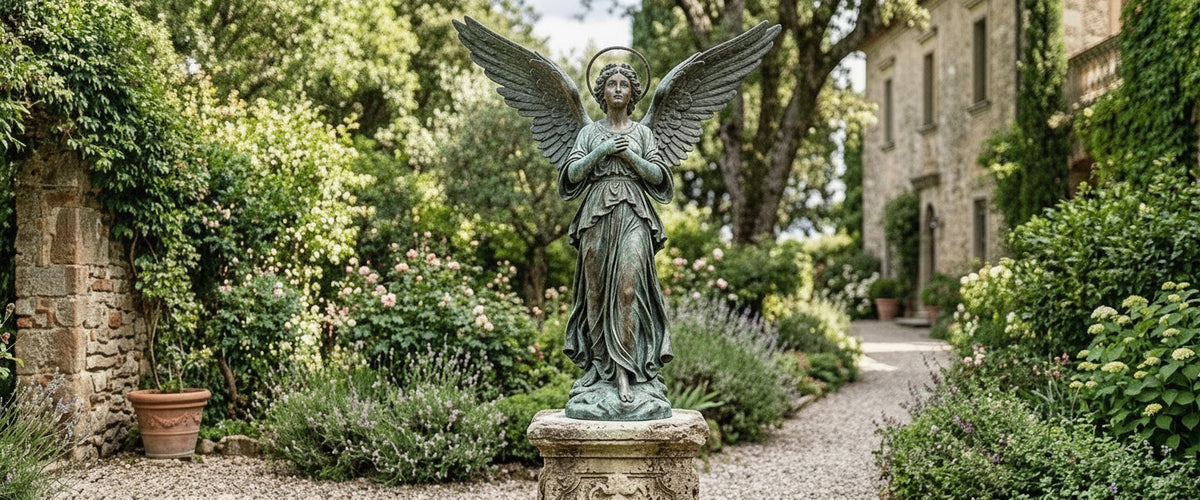

A life-size statue that looks commanding in a photograph can disappear the moment it lands in the wrong spot. We see it often: a client falls for a bronze at full studio scale, then sets it against a busy hedge or in the middle of an open hall, and the piece reads smaller and quieter than they expected. The sculpture did not shrink. The setting swallowed it. Getting large life size statues to hold their ground is mostly a question of scale relationships, sightlines, and what sits behind the work.
This guide walks through the placement decisions that change how large life size statues read, indoors and outdoors, and the errors we help buyers avoid before a commission ever leaves the studio.

Key Takeaways
- A statue reads by comparison, not by its own height. Nearby doorways, furniture, and planting set the perceived scale.
- Pedestal height and sightline angle change the whole character of a piece; raise a figure and it gains authority, lower it and it gains intimacy.
- Indoor placement rewards controlled backdrops and viewing distance; outdoor placement rewards sky, contrast, and a clear approach.
- Bronze, stainless steel, and Corten each behave differently against light and background, so choose the material with the setting in mind.
- Most placement failures trace back to one of three things: wrong viewing distance, a cluttered backdrop, or a pedestal at the wrong height.

What Large Life Size Statues Actually Look Like in Real Rooms and Gardens
Life-size does not mean modest. A standing human figure runs close to 6 feet (1.8 m), and many large life size statues push well beyond that once you add a raised arm, wings, or a pedestal. A life-size baroque angel bronze at 240cm stands roughly 7 feet 10 inches tall, so it needs ceiling height and breathing room that a smaller decorative bust never asks for.
Indoors, large life size statues work best where the architecture already has generosity: a double-height entry, a stair landing, a gallery wall with 3 to 4 feet (about 1 m) of clear floor around the base. Outdoors, the same figure can absorb far more space because the sky becomes its backdrop and there is no ceiling to compress it. That is why animal groups like a Life-Size Bugling Stag and Deer Bronze Sculpture - 290cm read so well across a lawn or a wide terrace. They are built for open sightlines.

Scale, Sightlines, and Pedestal Height
The single most misunderstood part of buying at this scale is that a statue's size is relative. Set a 6-foot figure next to a 9-foot door and it looks slight. Set the same figure in a 7-foot alcove and it fills the frame with real presence. Before you commit to a piece, look at what stands within about 15 feet of it and ask whether those objects will make it look larger or smaller. This is where large life size statues either win or lose.
Pedestal height then does the fine tuning. Raise a figure so its focal point sits near or slightly above eye level and the piece gains formality and command; this is the classical museum instinct, and it is why so many portrait and heroic works are plinth-mounted. Drop the base so you look slightly down at the work and it becomes more intimate and approachable, which suits a garden seating area or a courtyard where people pass close. For a commercial forecourt where the motion of a pose needs to register from a distance, a piece with height and a clear approach such as a Life-Size Baseball Pitcher Bronze Statue - 310cm earns its plinth.
Sightlines matter as much as height. Decide the primary view first: the angle people see when they walk in, drive up, or turn a corner. Orient the sculpture's strongest face and its most active line toward that approach. Secondary views can be quieter. Large life size statues designed to be circled, like a full animal group, need 360-degree clearance so no angle feels blocked.

Indoor Versus Outdoor Placement: When Each Wins
For wider placement ideas, Life Size Animal Statue Placement: How Scale and Sightlines Decide the Room is useful companion reading before finalizing the setting and sightlines.
Indoor placement gives you control. You can manage light, keep the backdrop plain, set an exact viewing distance, and protect the finish from weather. It suits polished bronze portraiture, figurative work with fine surface detail, and pieces where you want people to stand close and read the modeling. The trade-off is space; large life size statues eat floor area, and they compete with furniture and traffic flow.
Outdoor placement gives you scale and drama. Sky and planting extend the piece, weather adds character to the right materials, and there is room to walk around. Bronze develops a natural patina over decades and is a proven exterior material; conservation guidance from the Smithsonian's Museum Conservation Institute underlines why regular washing and protective waxing keep exterior bronzes stable over the long term. Corten steel is built to weather to a stable rust surface, and stainless steel throws light in a way that changes hour to hour. Our wildlife sculptures are generally specified for exterior life precisely because the subject and the setting belong together.
If you are torn, ask where the piece will be seen most. A sculpture admired daily from a kitchen window earns a garden position framed by that window. A work meant to greet guests belongs at the threshold, indoors or out, on the primary approach line.

Light, Backdrop, and Contrast
Light does more for large life size statues than any spotlight brochure suggests. Side light rakes across a surface and reveals form; flat frontal light erases it. For bronze, a backdrop a few shades lighter or darker than the patina makes the silhouette read cleanly. Set a dark bronze against dark foliage and the outline dissolves; give it sky, pale render, or a clipped light-green hedge and the form snaps into focus.
Contrast is the quiet lever. A life-size Texas longhorn bull bronze at 180cm looks powerful against open grass and horizon because the mass of the animal has nothing to compete with. Put the same bull in front of a fussy planted border with variegated leaves and the eye struggles to find its edges. When we plan placement with clients, we often recommend simplifying the backdrop before spending anything on lighting.
Indoors, watch reflective surfaces. Polished bronze and stainless steel bounce whatever is around them, so a mirror, a bright window, or a glossy floor can create hotspots that flatten the form. A matte wall behind a reflective piece usually does more good than a fixture aimed at it.

Common Placement Mistakes We See in Commissions
Three errors turn up again and again with large life size statues, and all are avoidable.
Wrong viewing distance. Buyers place a large figure too close to the main path, so nobody can step back far enough to take it in. A tall statue generally wants a viewing distance of at least one and a half times its height. Give it room to be seen whole.
A busy backdrop. The most common reason a piece looks smaller than expected is visual clutter behind it. Competing texture, pattern, or color steals the outline. Plain sky, plain wall, or a single-tone hedge lets the work carry itself.
The wrong pedestal height. A base chosen for looks rather than sightline throws off the whole reading. Test the focal-point height against eye level before you finalize; a few inches change the mood entirely.
Two more worth flagging. First, ignoring the ground. Outdoor bronzes need a proper foundation and drainage, not a paver laid on soft turf, or they settle and lean over the years. Second, forgetting winter and off-season views; a garden piece framed by summer planting can look stranded in January, so plan for the bare view too.

A Quick Placement Checklist
- Measure the full height including any raised limbs, wings, and the pedestal, then confirm ceiling or overhead clearance. Large life size statues fail fast when this step is skipped.
- Identify the primary approach and orient the strongest face toward it.
- Leave a viewing distance of at least 1.5 times the piece's height.
- Simplify the backdrop: sky, plain wall, or single-tone hedge beats a busy border.
- Set pedestal height so the focal point lands near eye level for authority, lower for intimacy.
- Check light direction; favor raking side light over flat frontal light.
- For exterior work, plan a proper foundation, drainage, and a patina care routine.
- Review the off-season and nighttime view, not just the peak-season shot.

Commissioning at This Scale
When a stock piece nearly fits but the height, pose, or base is not quite right for your setting, a bespoke commission solves it. As a specialist in large life size statues and large-scale work, Giant Sculptures can adjust scale, orientation, patina, and pedestal to suit a specific approach and backdrop, and we advise on foundations and installation for heavy exterior bronzes. Budget at this scale depends on material, size, complexity, engineering, installation, and finishing, so the sensible route is a tailored quote for your exact piece and site rather than a guessed figure. If you want to browse the range first, the life size and large statues collection is the place to start, and the life size bronze statues collection narrows it to bronze specifically.
Get the placement right and large life size statues stop being objects in a space and become the reason the space works. Get it wrong and the finest casting in the world looks lost. The good news is that almost every placement problem is solved before delivery, with a tape measure, an honest look at the backdrop, and a decision about where people will actually stand.