





































































































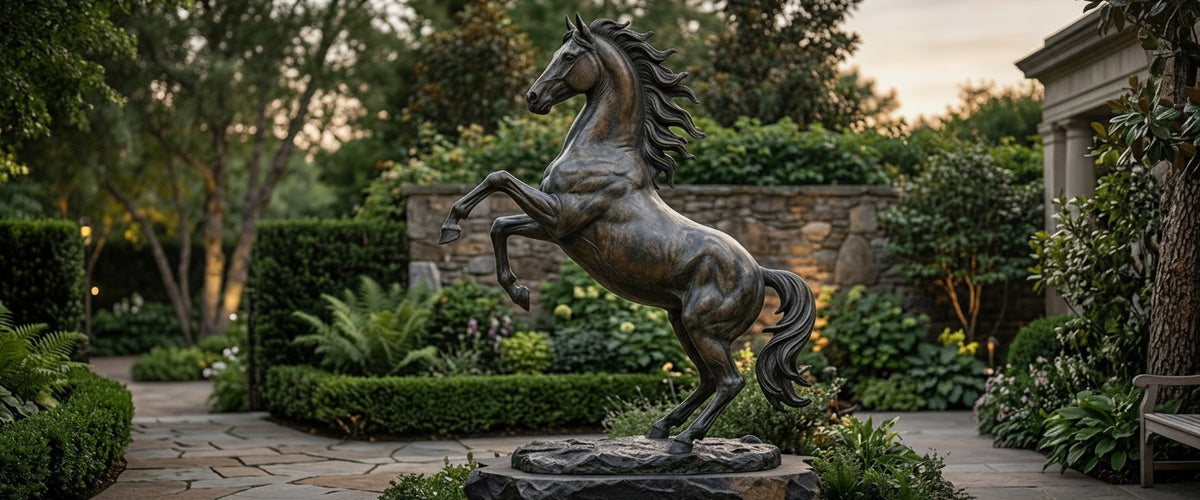

A life size animal statue fails or wins in the first three seconds someone walks into the room. Get the scale, pedestal and sightline right and the life size animal statue commands the space the moment you see it. Get them wrong and a five-foot figure looks lost in a corner, half-hidden behind a sofa, fighting a busy wall for attention. The sculpture itself is rarely the problem. Placement is.
Looking for the full range in this category? Browse our Bronze Horse Statues collection for every available finish, size, and configuration.
We build large-scale bespoke work at Giant Sculptures, and the same rules that govern a life size horse statue in a Napa vineyard govern a stylized character figure in a media room. Character subjects have their own quirks, though: dramatic poses, exaggerated silhouettes, and fans who know the source material and will notice if the piece is crowded or badly lit.
A tall character figure given room to breathe in a glass-walled entryway.

Key Takeaways
Scale reads relative to what surrounds it. A life size statue next to an oversized sectional looks small; give it breathing room.
Pedestal height sets the eyeline. Two or three inches of base can change whether a face meets your gaze or floats above it.
Indoor rewards detail; outdoor rewards silhouette. Choose the setting to match what the piece does best.
Contrast beats brightness. A plain backdrop makes a dynamic pose pop harder than any spotlight.
Material drives longevity. Bronze, stainless steel and stone outlast resin outdoors by decades.
What a Life Size Animal Statue Looks Like in Different Rooms and Settings
A life size animal statue behaves differently depending on where you put it. In a double-height entryway with a lot of glass, a tall dynamic figure has room to breathe and the pose can be as theatrical as you like. Drop that same figure into a standard eight-foot ceiling and a low-lit den, and the silhouette gets cramped; the sculpture ends up feeling like it is ducking.
Outdoors changes the equation again. A life size animal statue in a courtyard or beside a pool reads against sky and planting, so the outline does the heavy lifting rather than the fine surface detail. We have shipped large figurative work to clients in Texas and California who wanted a statement piece visible from the driveway. In those cases the pose and profile matter far more than the crispness of a facial expression that nobody will study up close.
The lesson from commissions we have handled is simple: decide how people will actually approach the piece before you decide anything else. A statue viewed head-on from ten feet needs different framing than one you circle at arm's length.

Scale, Sightlines and Pedestal Height
People treat "life size" as a fixed number. It is not. A life size animal statue can be five feet or six-and-a-half feet tall and still qualify, and the surrounding furniture rescales your perception dramatically. Put a slim character figure beside a low console and it towers. Put it next to a tall bookcase and it shrinks. Measure the neighbors, not just the sculpture.
Pedestal height is the lever most buyers forget. A base of even a few inches lifts the figure's eyeline toward yours, which reads as presence and confidence. Lift it too high and the face tilts out of view, and a piece designed to make eye contact becomes a chin. For a standing character intended to greet visitors, aim to bring the eyes roughly to the height of an average adult's gaze from the primary viewing distance.
Sightlines are the other half. Walk the actual path guests take. If the first view of the statue is a three-quarter angle from a doorway, orient the pose so that angle shows the dynamic line rather than the flat back. We often rotate a piece fifteen or twenty degrees off square during install because dead-on symmetry can kill the energy of an action pose.
A few inches of base can bring a character figure's eyes to your own.

Indoor Versus Outdoor: When Each Wins
Indoor placement favors detail. Under controlled light, close viewing distances and a stable climate, fine surface work, painted color and delicate elements all survive and get appreciated. A media room, home cinema, studio or gallery wall is where a life size animal statue earns its keep visually.
Outdoor placement favors durability and silhouette. If you want a large figurative piece in a garden or courtyard for the long term, material choice decides everything. Bronze develops a stable patina and lasts for generations; stainless steel resists corrosion and holds a clean modern line; Corten and stone weather gracefully. The life size bronze statues we make for outdoor settings are engineered for exactly this, with internal armatures and fixings sized for wind load. Many mass-market character figures are cast in resin or PVC, which chalks, fades and embrittles in UV and frost. Fine for a display case, poor for a Hamptons terrace.
If your heart is set on a life size animal statue outdoors, the honest route is a bespoke commission in a weatherproof metal or stone rather than trying to make an indoor collectible survive the seasons. That is a conversation worth having before you buy, not after.
Light, Backdrop and Contrast
Contrast decides impact more than sheer brightness. A dark bronze figure against a pale limestone wall separates cleanly; the same figure against dark walnut paneling disappears. Before you order, hold a swatch of your wall color behind a stand-in and see whether the outline survives.
For indoor lighting, a single directional source raking across the form at roughly forty-five degrees carves out the pose and reads the surface. Flat, even lighting flattens everything. Avoid a spotlight aimed straight at the face; it blows out expression and casts a hard shadow on the wall behind. The Getty's guidance on displaying sculpture stresses controlling glare and directional light for exactly this reason (Getty Conservation Institute).
Outdoors, use the sun you already have. East-facing morning light or the low warm angle of late afternoon models a figure far better than harsh noon overhead sun, which drops shadow into the eyes and under the jaw. Plant a simple dark hedge or a plain wall behind the life size animal statue so the silhouette reads against something calm rather than a busy border.
Common Placement Mistakes We See in Commissions
For wider placement ideas, Life Size Bronze Statues: How to Place Them so They Actually Land is useful companion reading before finalizing the setting and sightlines.
The recurring errors are predictable, and every one is fixable before install:
Corner exile. Pushing a life size statue into a corner kills two of its best viewing angles. Give it a wall behind and open space in front.
Furniture crowding. A figure hemmed in by a sofa arm and a side table looks trapped. Leave a clear standing zone around it.
Wrong eyeline. No pedestal when one is needed, or a base so tall the face vanishes. Test with the real viewing distance.
Busy backdrop. Patterned wallpaper or a cluttered shelf steals attention from the pose.
Ignoring approach. Orienting the piece to the wall rather than to the door people actually enter through.
Material mismatch. Placing a resin collectible outdoors and expecting it to last.
Scale mistakes translate straight across subjects. The clearances we plan around a dynamic form such as Life-Size Galloping Horse Bronze Sculpture, 190cm, where the extended stride needs clear air on all sides, apply just as directly to a mid-action life size animal statue: dynamic poses need room to complete the movement in your eye. Crowd them and the drama collapses. A more contained pose behaves differently. Something like the Life-Size Grazing Horse Bronze Sculpture, 180cm holds a settled silhouette that tolerates tighter placement, which is worth keeping in mind if your character subject stands calm rather than lunging.
How to Choose and Commission
Work through these before you commit:
Setting first. Indoor detail piece or outdoor statement piece? This decides material.
Primary viewing distance and angle. Measure it. It drives pose orientation and pedestal height.
Backdrop and contrast. Confirm the outline will separate from the wall or planting behind.
Material and longevity. For anything outdoors or high-touch, bronze, stainless steel or stone over resin.
Weight and fixing. A life size metal figure is heavy; floors and terraces may need load checks and anchored bases.
Budget by scope, not guesswork. Cost tracks material, scale, complexity, engineering, finishing and installation. Ask for a tailored quote rather than assuming a figure.
If you are commissioning a life size animal statue from scratch, bring reference images, agree the pose and proportions at maquette stage, and lock the finish before casting. Browsing our life size statues and large pieces is a useful way to calibrate what a given height actually feels like at full scale before you brief a bespoke life size animal statue.