






































































































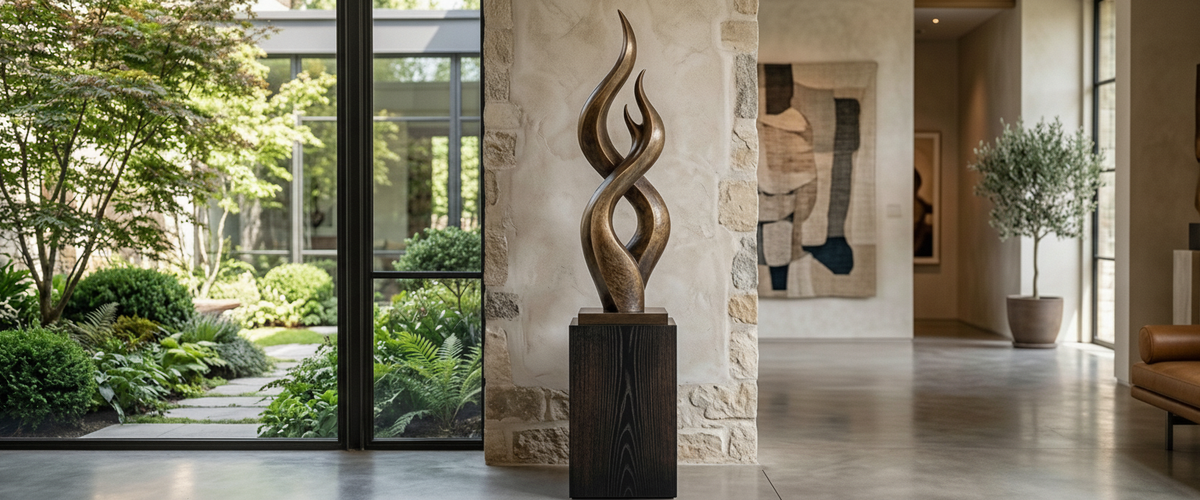

Most large sculptures fail from the bottom up. A hollow box hums every time someone walks past, and an oak column opens a hairline crack by February. That is why choosing large indoor pedestals for sculpture is a structural decision dressed up as a styling one. This guide covers how to get it right: size the top to the real footprint, set height against the ceiling, pick a construction that can carry the weight, and protect timber from floors and heat. Buyers who treat the plinth as engineering end up with a large sculpture for indoor rooms that looks settled, and stays settled, for decades.
We see the same handful of mistakes on almost every commission involving large indoor pedestals. Here is the short version before the detail.

Quick Answer
Size the pedestal top to the sculpture's full footprint, including any overhang, then add a margin.
Drop the eye-level rule once a piece is bigger than a bust. Total height matters more than pedestal height.
Solid oak suits mid-weight work. Veneered MDF suits light pieces. Steel-cored plinths carry bronze and stone.
Check floor loading and underfloor heating before you commit to solid timber for large indoor pedestals.
Pick a grain and finish that recede, so the sculpture stays the subject.
Size Large Indoor Pedestals for Sculpture to the Footprint, Not the Base
Most people measure the base of the sculpture and order a top to match. That is how a piece ends up looking perched, and it is the most common error we see with large indoor pedestals. The real footprint is the outline the work casts from above: the reach of an arm, a sweep, a leaning form. Measure that, then add roughly 2 to 4 inches (5 to 10 cm) on each side so the top reads as a deliberate stage rather than a ledge.
The margin earns its place in daily life, too. It keeps hips and bags clear of the piece in a busy hallway. Tall, narrow pieces raise a different issue for a large indoor pedestal. A vertical piece such as the Twin Flame Bronze Abstract Wood Sculpture - 165cm has a modest footprint but real height, so its plinth needs to be broad and weighted enough to keep the center of gravity low. A wider top with a ballasted interior beats a slender column every time.
Why the Eye-Level Rule Breaks Down at Scale
For busts and small bronzes, the gallery rule holds: bring the focal point to standing eye level, roughly 60 inches (152 cm) from the floor. Apply that to a large indoor pedestal carrying a piece around 5 feet (1.5 m) tall and the top of the sculpture nearly meets the ceiling.
With large indoor pedestals for sculpture, work from the finished total height instead. As a rule of thumb, leave clear air above the piece equal to at least a third of its own height. Under a standard 8-foot (2.4 m) ceiling, that rule separates two sizes of the same design quite sharply: the Twin Flame Bronze Abstract Wood Sculpture - 150cm can still take a plinth of around 16 inches (40 cm), while the 165 cm version leaves room for little more than 8 inches (20 cm). Big floor-standing work often wants only a low plinth of 4 to 12 inches (10 to 30 cm). That lifts it out of foot traffic and away from the vacuum cleaner without turning it into a trophy. Sightlines shift the answer as well. A piece seen mainly from the stairs of a double-height entry in Austin can sit lower than one viewed across a flat living room.

Solid Oak, Veneered MDF or Steel Core: What Each Can Carry
Large indoor wood pedestals for sculpture come in three broad constructions, and you cannot swap one for another.
Solid oak. Dense, handsome and honest at the edges. As a large indoor pedestal, it suits timber, lighter bronze and mixed-media work. Its weakness is movement, because solid wood shrinks and swells across the grain as humidity changes.
Veneered MDF. Flat, stable and easy to finish. It has poor screw-holding strength and can sag across a wide span, so keep it for lighter pieces that need no bolted fixing.
Steel-cored. A welded steel frame clad in veneer or solid oak lippings. We specify this for cast bronze, stone and marble, and for anything that must be bolted through to resist a knock or, in California, a tremor.
When a sculpture arrives already mounted on stone, as the bronze and teal oval wood sculpture on black marble does, its weight is carried low and concentrated in the base. In that case, as with most stone-mounted work on large indoor pedestals, the plinth must support the marble evenly across the whole top rather than at four corner points, which usually rules out veneered MDF.
Floor Loading, Underfloor Heating and Moving Timber
These are the failure points nobody mentions in a showroom. Start with the floor. A bronze sculpture on a steel-cored large indoor pedestal puts a lot of weight on a small area. A concrete slab shrugs that off. A suspended timber floor in a Brooklyn brownstone may not. We have shipped to Manhattan buildings where the managing agent wanted an engineer's sign-off before the crate went up in the service elevator, and that paperwork took longer than the delivery. Ask early. If the floor is marginal, spread the load with a broader base or a discreet steel plate.
Underfloor heating is the quieter threat. It dries the air exactly where a solid plinth stands, so the bottom loses moisture faster than the top. That uneven drying is how oak columns check and twist in their first winter. The USDA Forest Products Laboratory's Wood Handbook sets out how timber shrinks as moisture content falls, and why flat-sawn boards move more than quarter-sawn ones. If you are placing large indoor pedestals over a heated floor, choose quarter-sawn or steel-cored construction, add felt pads or a small air gap beneath, and keep room humidity steady.
We learned one lesson the hard way. Our studio now conditions the timber for large indoor pedestals toward the destination's moisture level before final finishing. Oak finished in a damp workshop will shrink once it reaches a dry, heated home in Aspen.

Matching Grain and Finish So the Plinth Supports the Piece
The best pedestal is the one you stop noticing, and that matters most with large indoor pedestals, where the plinth is big enough to compete. If the sculpture is itself timber, avoid a near-match in species, because a near-match reads as a mistake. Go clearly darker or clearly paler, with quieter figure. Under bronze, ebonized oak picks up the patina without arguing with it. Under pale marble, limed oak keeps the composition light.
Sheen matters as much as color. A matte or satin oil lets polished bronze do the reflecting, while gloss lacquer on the plinth competes with it. Run the grain vertically on tall columns. Horizontal figure cuts the height and makes a tall piece look squat.
Buyer Checklist Before You Order
Weight, full footprint and total height, measured on the actual piece.
Floor construction: slab, suspended timber or raised access floor.
Heat sources: underfloor heating, nearby radiators, direct sun through glass.
Fixing: does the piece need bolting, and can the plinth take it?
Traffic: hallway, open-plan living room or hotel lobby.
Finish chosen against the sculpture's patina or polish, not in isolation.
If any answer is uncertain, a bespoke plinth makes sense. Giant Sculptures designs large indoor pedestals for sculpture alongside the work itself, so engineering, scale and finish are settled together. Explore our indoor sculptures and statues, including sculpture for large indoor spaces, or send us the room, the floor and the piece, and we will return a tailored quote for both.
For wider placement ideas, Wooden Indoor Sculptures and Heat: Where to Place Them Before They Crack is useful companion reading before finalizing the setting and sightlines for any large indoor pedestal and the sculpture it carries.