


















































































A carved walnut figure that looked flawless in October can show a hairline crack by February, and nobody touched it. Wooden indoor sculptures respond to every swing in the air around them, so where you put one matters almost as much as which one you buy. Dry heat and direct sun do most of the damage. Good placement and a few seasonal habits prevent most of it.
At a glance
Wood gains and loses moisture all year. Cracks come from fast or uneven change, not from movement itself.
Keep pieces at least 3 feet (about 1 m) from radiators, heat registers and stoves, and out of direct afternoon sun.
Teak and well-seasoned walnut forgive heated rooms better than large sections of oak or suar.
Finishes slow moisture exchange. None of them stop it.
Aim for steady indoor humidity of roughly 40 to 55 percent, and check pieces as the heating season starts.

Wooden Indoor Sculptures Keep Moving Long After the Carver's Bench
Timber is hygroscopic. It trades moisture with the air until it reaches what wood scientists call equilibrium moisture content, and that balance point shifts every time your home gets drier or more humid. The USDA Forest Products Laboratory's Wood Handbook notes that wood shrinks roughly twice as much along the growth rings as it does across them. That uneven pull is why checks on a large carving tend to radiate outward from the heart of the log.
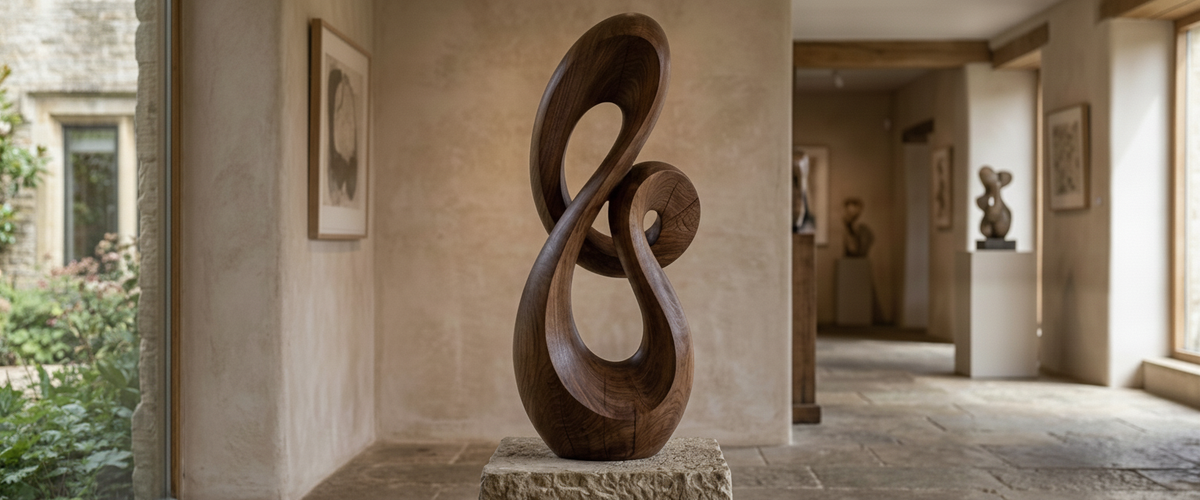
For wooden indoor sculptures carved from a single block, this matters more than it does for furniture. A chair is built from thin, stable boards. A 4-foot (1.2 m) figure may hold the whole trunk, pith included, and that mass reacts slowly on the inside and quickly on the surface.
Radiators, Underfloor Heating and Wood Stoves: How Checks and Splits Begin
Heat itself is rarely the problem; the moisture gradient it creates is. Stand a carving beside a baseboard radiator or a forced-air register and the near face dries while the core stays put. The outer layer tries to shrink, the core refuses, and the surface opens in fine checks. Left alone, a check can deepen into a split.
Fine checks like these usually start on the face nearest the heat source.
Radiant floor heating (what UK owners call underfloor heating) is sneakier, because it dries the base first. A wood stove does the opposite, baking one flank for hours each evening. A floor register is just as risky: a walnut figure left standing over one through its first winter will often show checking at the base by spring. Moving it across the room onto a stone plinth usually stops the problem from progressing. Repairs are possible. Avoiding them is easier.

Oak, Walnut, Teak and Suar: Which Timbers Tolerate a Heated Home
Teak is the steadiest of the four. Its natural oils slow moisture exchange, and it moves very little once seasoned. Walnut is a close second: dense, even-grained and calm when properly dried, which is why carvers love it for figurative work. Oak is handsome and tough, but thick sections hold moisture for years, and white oak in particular will check if it is carved before it is ready. Suar, the large tropical rain tree often sold as slabs and organic forms, can look spectacular, yet poorly dried suar is notorious for splitting in a centrally heated room.
With wooden indoor sculptures, species is only half the story. A well-seasoned oak carving will outlast a rushed teak one.
Oil, Wax or Lacquer: Why the Finish Changes How Fast Wood Reacts
Oil soaks in and gives a warm, matte depth, but it only lightly slows moisture movement. Wax adds a thin surface barrier and a soft sheen; it needs renewing, though it is easy to touch up. Lacquer and other film finishes slow exchange the most, which sounds ideal until the wood moves underneath and the film cracks, leaving pale lines that are harder to repair than the timber itself.
For most large carvings we favor a penetrating oil followed by wax. It lets the wood breathe evenly, and a scuff or dry patch can be refreshed without stripping the piece.

A Safe Spot Away from Heat Sources and South-Facing Glass
Sunlight through south- or west-facing windows warms one side of a sculpture and bleaches it at the same time. Walnut fades toward honey, and teak loses its golden depth and turns pale. A sunroom in Austin or a glass-walled living room in Malibu can do in one summer what a shaded hallway would take a decade to manage.
Indirect light and a stone plinth keep a carving away from sun and floor heat.
Before you commit wooden indoor sculptures to a spot, run through these criteria:
Distance from heat: at least 3 feet (about 1 m) from any radiator, register, stove or fireplace.
Light: indirect daylight, or UV-filtering film on nearby glazing.
Air flow: avoid the direct path of HVAC vents and drafty exterior doors.
Floor: on radiant heating, raise the piece on a stone or metal plinth.
Stands and bases: treat them as wood too. A timber stand under a stone, resin or metal form deserves the same distance from a register as any carving.
If the only wall that works is a sunlit atrium or a spot above a fireplace, be honest with yourself. Bronze or stainless steel will shrug off conditions that would punish timber, and Giant Sculptures can suggest a metal alternative in a similar form. Where you still want the warmth of wood in a warmer room, a cast form raised on a timber base, such as the Clear Russet Leaf Rippled Cliff Rock Resin Sculpture - 80cm, is a more forgiving choice than a solid carving: the resin body is unaffected by dry air, and only the stand needs watching.

Winter Humidity, Summer Sun: The Seasonal Checks That Catch Cracks Early
A few minutes each season is usually enough to keep wooden indoor sculptures stable year-round.
Start of heating season: run a hygrometer in the room. If humidity drops well below 40 percent, add a humidifier.
Midwinter: look at end grain and the base under raking light for fine new lines.
Spring: re-wax any areas that look dry or chalky.
Summer: track where the sun falls as its angle changes, and draw blinds during peak hours.
Any time: photograph small checks with a coin for scale so you can tell whether they are growing.
How We Season and Stabilize Timber Before a Large Indoor Piece Leaves the Studio
Most cracks start long before delivery. In our studio, large blocks are air-dried slowly, then brought down to an indoor moisture level and checked with a meter before final carving. Big forms are roughed out and rested so internal stresses can show themselves while we can still respond. Where a design allows, we relieve the core from the back or base so the piece dries more evenly.
For bespoke commissions we ask about your heating, your windows and your climate before quoting. A Manhattan apartment with steam radiators and a coastal home in the Hamptons need different timber and finishing choices. Budget depends on species, scale, complexity, finishing and installation, so we prepare a tailored quote for each piece. If you are weighing timber against metal or stone, compare materials across the full collection and then talk to us about the room it will live in.
For wider placement ideas, How Tall Should an Indoor Giraffe Statue Be? Let the Room Decide is useful companion reading before finalising the setting and sightlines.