





































































































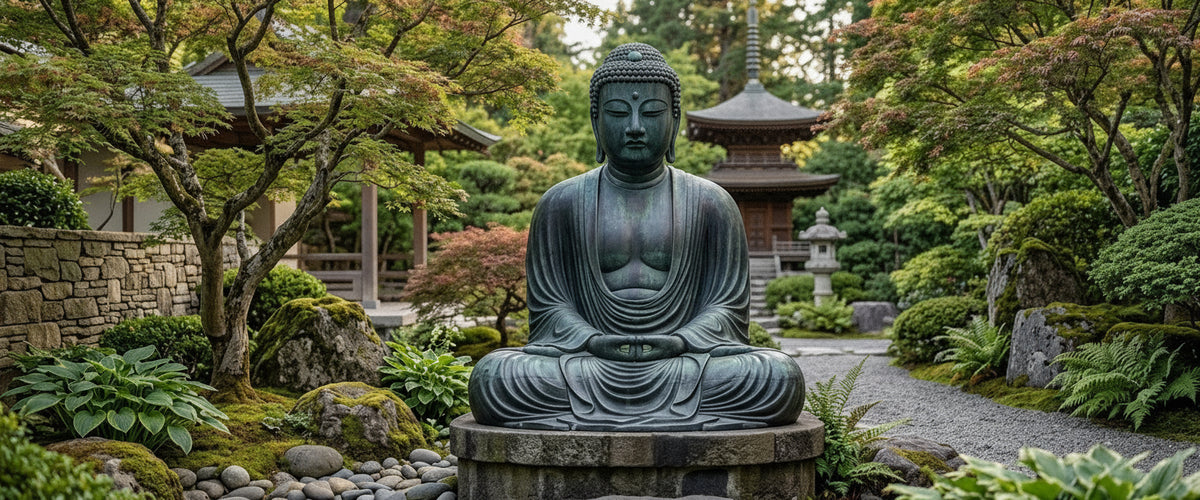

A large Buddha garden statue placed badly reads as an ornament. Placed well, it slows the whole space down and gives the eye somewhere to rest. That gap between the two outcomes rarely comes down to the piece itself; it comes down to scale against its setting, the line you see it along, and how high it sits. We have shipped Buddha sculptures to courtyards in Napa, poolside terraces in Texas, and shaded meditation corners in the Hamptons, and the pieces that land are almost never the biggest ones. They are the ones sized to their sightline.
So before you fall for a specific pose or finish, work through the decisions below. A large Buddha garden feature earns its place when the setting is doing half the work.

Key Takeaways
Scale is relative. A 6 ft (183 cm) seated Buddha can look modest in an open lawn and overwhelming in a small courtyard. Judge it against the space, not the tape measure.
Sightline beats size. The distance and angle you first see the piece from matters more than raw height.
Pedestal height changes the reading. Ground-level feels grounded and human; raised feels formal and devotional.
Material decides longevity outdoors. Bronze, stone, and Corten handle weather; lightweight decorative castings often do not.
Contrast makes the piece. A dark bronze needs a light or green backdrop to read; a pale stone needs shadow behind it.

What a Large Buddha Garden Actually Looks Like in Different Settings
The same sculpture behaves differently depending on where it lands. In a walled courtyard, a large Buddha garden centerpiece becomes the room's focal point by default, so it needs enough negative space around it to breathe. Crowd it with planters and it reads as clutter. In an open setting, the challenge flips: the piece competes with sky, trees, and distance, so a head or bust that looked large indoors can shrink to nothing.
Indoors, scale reads bigger because ceilings and walls compress the space. We have had clients order a 150 cm (roughly 5 ft) Buddha head expecting it to dominate a lawn, only to find it works far better in an entrance hall or a double-height atrium. Where the gilding is the whole point and needs interior light to earn its keep, a piece such as the Large Traditional Gilded Buddha Head Bronze Sculpture - 150cm has real presence up close. Set it on a lawn 40 ft away and much of that detail is lost.
Outdoors, the winners in a large Buddha garden tend to be full seated figures or fountains. Water and mass hold their own against open space. Where you want scale and sound together rather than a static bust, a moving-water figure such as the Large Traditional Meditating Buddha Bronze Fountain - 220cm fills a space in a way a head alone cannot.

Scale, Sightlines, and Pedestal Height
Start with the sightline, not the sculpture. Stand where people will first see the piece: the back door, the end of a path, the seating area. Measure that distance. As a rough working rule, a large Buddha garden figure needs to grow with viewing distance to keep its impact. Something read from 10 ft can be life-size; something meant to anchor a view 50 ft away often needs to be monumental to register.
This is why our catalog runs from busts at 150 cm up to seated figures at 220 cm and monumental pieces at 300 cm. Where a long axis needs the far end of a plot held with real weight, the Monumental Traditional Seated Buddha Bronze Sculpture - 300cm makes more sense than a bust; put that same figure in a courtyard, though, and it looms.
Pedestal height is the quiet variable most people forget. Set a Buddha at ground level and it feels human, approachable, part of the planting. Lift it onto a plinth and the reading turns formal and devotional; the eye looks up, which changes the mood entirely. For meditation corners, we usually recommend keeping the base low so the figure meets you at a calm, seated eye line. For a grand entrance or a piece meant to be seen across water, a raised plinth adds authority. A bust like the Large Traditional Buddha Head Bronze Bust - 180cm reads very differently at ground level versus on a 2 ft plinth; test both with a mock-up before you commit.

Indoor Versus Outdoor Placement: When Each Wins
For wider placement ideas, Bronze Garden Statues: A Buyer's Guide to Scale, Finish, and Placement is useful companion reading before finalizing the setting and sightlines for a large Buddha garden.
Bronze and stone are happy outdoors for decades with basic care, so material rarely forces the decision. Setting does. Choose outdoor when you want the piece to interact with light through the day, with planting, and with weather; a bronze Buddha develops character as its patina settles, and rain and sun give it life. The Getty's conservation notes on outdoor bronze explain how a stable patina actually protects the metal over time, which is worth reading before you worry about weathering (Getty Conservation Institute).
Choose indoor when detail and finish are the point. Gilded surfaces, fine facial modeling, and polished areas show best in controlled interior light. A large head or bust in a hallway or spa room lets people get close, which is exactly where those pieces reward you. Indoors also removes freeze-thaw risk entirely, which matters for stone in colder US climates.
If you cannot decide, a covered loggia or a colonnaded pool house gives you the best of both: outdoor scale, sheltered finish.
Light, Backdrop, and Contrast
A large Buddha garden piece is only as strong as what sits behind it. Dark bronze disappears against dark foliage or a dark fence. Give it a lighter backdrop, a rendered wall, a clipped hedge in fresh green, or open sky, and the silhouette snaps into focus. Pale stone works the opposite way; it needs shadow or dense planting behind it to stop it looking flat.
Track the sun across your site for a full day before you place anything. Morning east light on a meditating figure is soft and forgiving; harsh midday sun flattens detail; low evening light rakes across the surface and picks out every modeled line, which is usually when a good Buddha looks its best. If you plan to enjoy the space at night, add discreet uplighting; a single warm ground-level fixture angled up the front of the figure does more than a row of path lights ever will.
Common Placement Mistakes We See in Commissions
Every year we watch the same avoidable errors on a large Buddha garden project, so here is a short checklist to work through before you buy.
Buying by height alone. A number on a listing means nothing until you have staked out the footprint on site with a box or a cutout.
Ignoring the approach. Buddhas have a clear front. Face it toward the primary viewing point, not the neighbor's fence.
Skipping the base engineering. A 220 cm bronze is heavy. It needs a level, load-rated foundation, not a paver dropped on soft ground. We size footings as part of any bespoke commission.
Crowding the piece. Give it breathing room. Negative space is what makes a large Buddha garden feature read as calm rather than busy.
Forgetting winter. An evergreen backdrop keeps the composition working when deciduous planting drops. Plan for the leafless months.
Placing it as an afterthought. The best results come when the sculpture and its setting are planned together, not when a finished space gets a statue wedged in later.
Finding Unique Pieces and Commissioning Your Own
Plenty of large Buddha garden statues for sale online are mass-produced resin castings that fade and crack within a few seasons. If you want a large Buddha garden centerpiece that lasts and reads as considered, look for cast bronze or carved stone, and ask how the piece is finished and mounted. Our full Buddha statues collection is a good place to compare poses, from serene seated figures to the more expressive laughing form.
For a truly unique focal point, commissioning is the route. We adjust scale, pose, patina, and base to suit a specific sightline, which is how you get a large Buddha garden piece that fits your space rather than one you bend the garden around. Because cost depends on material, scale, complexity, engineering, installation, and finish, we quote each commission individually rather than list a figure. Tell us the distance, the backdrop, and the mood you want, and we will size it to the space.
Get the scale and sightline right first, and almost any well-made large Buddha garden statue will hold its ground. Get them wrong, and no amount of gilding will save it.