





































































































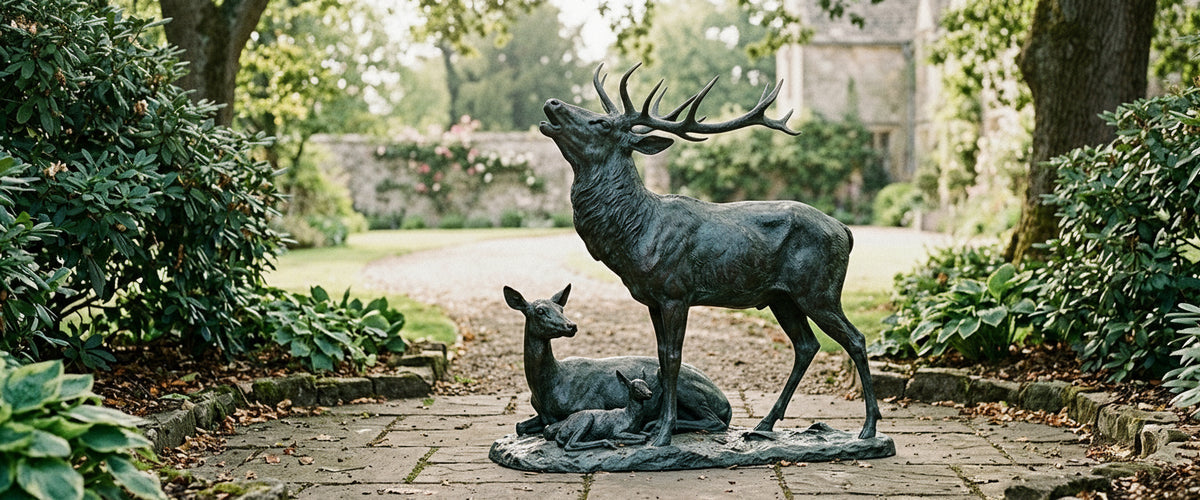

A good bronze garden statue will outlive the fence, the planting scheme, and probably the person who bought it. That is the quiet argument for buying in bronze: it ages into a surface that looks better at thirty years than at three. Most other garden ornaments are temporary tenants. Bronze garden statues are residents. The trick is choosing the right piece, at the right scale, with a finish that suits where it will stand for decades.
Looking for the full range in this category? Browse our Bronze Deer Statues collection for every available finish, size, and configuration.
We ship large bronze work to private gardens and commercial grounds, and the same questions come up every week. So before you fall for a pose or a price, here is what actually matters.

Key Takeaways
- Bronze is a long-term buy. A real cast-bronze piece develops a patina over decades and needs little more than washing and occasional waxing.
- Scale is the most common mistake. Pieces that look big indoors shrink outdoors. Measure the sightline, not just the plinth.
- Finish changes the mood. A dark traditional patina reads classical; a lighter or verdigris finish reads softer and more weathered.
- Cost depends on the work, not a sticker. Material weight, size, casting complexity, finishing, and installation all move the number. Ask for a tailored quote.
- Bespoke is normal at this scale. Most large bronze garden statues are made to order, so pose, patina, and base can be specified to the site.

What Bronze Garden Statues Are, and Who They Suit
Bronze garden statues are figures or animals cast in a copper-tin alloy, usually by the lost-wax method, then chemically patinated and sealed. The result is a sculpture that handles rain, frost, salt air, and full sun far better than resin, plaster, or cast stone. Bronze does not flake or fade in the way painted composites do. It corrodes slowly and decoratively, forming the green-brown skin that collectors actually want.
They suit anyone treating the garden as architecture rather than decoration: a homeowner anchoring a long gravel axis, a landscape designer closing a view with a single figure, a hotel or vineyard wanting a focal point that survives twenty winters of guests and weather. If you want something cheap and disposable, bronze is the wrong call. If you want a piece you can hand down, it is the obvious one.

How to Compare Bronze Garden Statues Before Buying
Start with the cast, not the catalog photo. True foundry bronze has weight and a surface with depth; the patina sits in the metal rather than on top of it like paint. Cold-cast or bronze-resin pieces are lighter and far cheaper, and they have their place indoors, but outdoors over many years solid bronze is what earns its keep.
When you compare bronze statues for garden use, work through five things in order:
- Casting quality. Look at fine detail, like feather edges or muscle definition, and at how seams are chased. Clean joins signal a serious foundry.
- Patina type and sealing. Ask what chemicals were used and whether the piece is lacquered or waxed. This affects how it ages and how you maintain it.
- Wall thickness and weight. Heavier is generally sturdier and more theft-resistant, though it changes how you install.
- Base and fixing. A piece designed to be bolted down behaves very differently from one meant to sit free.
- Scale relative to the site. More on this below, because it sinks more purchases than any other factor.
The bronze garden statues collection is a useful place to see how those variables play out across figures, animals, and water pieces at different heights.

Materials, Finishes, and Scale Decisions
Most of our garden bronzes use a traditional dark brown or near-black patina, which reads as classical and recedes handsomely against green planting. A lighter chestnut or honey patina catches afternoon sun and feels warmer in a Mediterranean or California setting. A controlled verdigris finish, the muted green of weathered copper, suits formal and historic gardens; it is the look the metal would eventually reach on its own, accelerated by the foundry. The American Institute for Conservation has good background on how outdoor bronze patinas form and why they should be maintained rather than stripped (conservation guidance).
Subject changes the register of the whole space. Bronze cranes garden statues bring height and stillness to water edges and are a long-standing choice beside ponds and reflecting pools. For woodland-edge planting and meadow gardens where the figures look as if they wandered in, a naturalistic group such as the Life-Size Bugling Stag and Deer Bronze Sculpture - 290cm sits more convincingly than a single static deer. A bronze cat garden statue works as a quieter accent, tucked beside steps or on a terrace wall where guests find it rather than face it. For classical figure schemes, a garden statue Hebe bronze reference, the cup-bearer of the gods, remains one of the most requested poses for formal beds and fountain surrounds.
Now the part people get wrong. Scale. A statue that feels imposing in a showroom can vanish on a wide lawn. The rule we give clients: stand where the piece will most often be viewed, then judge it against a person standing at the proposed spot. A figure meant to read from 40 feet (12 m) away usually needs to be life-size or larger. For an animal closing a long view, bigger is safer. Where an estate entrance or courtyard needs presence that a half-size piece could never hold, a monumental bronze elephant such as the Monumental Life-Size Walking Elephant Bronze Sculpture - 360cm carries the distance.
Where to Place Bronze Garden Statues for the Strongest Impact
For wider placement ideas, Bronze Cranes Garden Statues: A Placement Guide for Real Gardens is useful companion reading before finalising the setting and sightlines.
Bronze rewards a single confident decision over a scatter of small ones. Pick the one place the eye naturally travels and put the work there.
- End of an axis. A long path, lawn, or hedge alley wants a full stop. A figure or animal at the far end pulls you down the route.
- Against a dark backdrop. Yew, holly, or a shaded wall makes a dark patina read crisply. Avoid setting bronze against busy mixed borders where it disappears.
- Beside or in water. Reflection doubles the piece. Cranes, herons, and fountain groups belong here. Where a focal point should also move water, the Large Traditional Elephant and Calf Bronze Fountain - 320cm earns its footprint twice over, working as both a water feature and a sculpture.
- Raised on a plinth. Lifting a figure 18 to 36 inches (45 to 90 cm) changes how it commands a space and keeps it above ground splash and mower lines.
One lesson from the studio: clients almost always underestimate the base. A monumental bronze on a too-low plinth looks grounded in the wrong way. We have re-specified bases more than once after a piece arrived and the owner felt it sat too humbly in the landscape. Decide the eyeline early.
Budget, Commissioning, and Delivery
There is no honest single price for bronze garden statues, and anyone quoting one without seeing the brief is guessing. Cost is driven by the weight of metal, the finished size, the complexity of the cast (a rearing elephant has far more in the air than a seated cat), the finishing hours, and the logistics of moving and installing something that can weigh several hundred pounds (well over 100 kg). A small accent figure and a complex piece like the Monumental Classical Rearing Elephant Bronze Sculpture - 320cm, with most of its mass cantilevered into the air, are not in the same conversation. The sensible path is to send us the site, the subject, and the scale you have in mind and ask for a tailored quote.
Most large bronzes are made to order, so build the lead time into your project. Casting, patinating, and finishing a monumental piece is not a same-week affair. For overseas delivery we crate to protect the patina in transit, and for the heaviest works we advise on craneage and fixing before the piece leaves the studio, not after it lands in the driveway.
Quick Commissioning Checklist
- Confirm the viewing distance and main sightline before choosing size.
- Choose patina against your actual backdrop, not a white wall.
- Decide plinth height and material early; it affects the whole composition.
- Plan access for delivery and lifting heavy crated bronze.
- Agree fixing method, especially in coastal or high-wind sites.
- Ask how to maintain the specific patina and sealant used.
How Giant Sculptures Helps With Bespoke Bronze Projects
We work as a bespoke supplier of large-scale bronze, so much of what we ship is specified rather than picked off a shelf. That means pose, size, patina color, and base can be matched to a particular garden, courtyard, or commercial frontage. If you have seen a piece you like but need it taller, or in a warmer finish, or fixed for a windy coastal plot, that is a normal request rather than an exception.
Our range leans toward animals and classical figures at garden and monumental scale, from deer and cranes to the elephant groups that anchor estate entrances. If you are weighing garden bronze statues for a specific spot and are not sure what scale will hold the space, send a photo and the dimensions. It is far cheaper to get the scale right on paper than to rehome a piece that arrived too small.