





































































































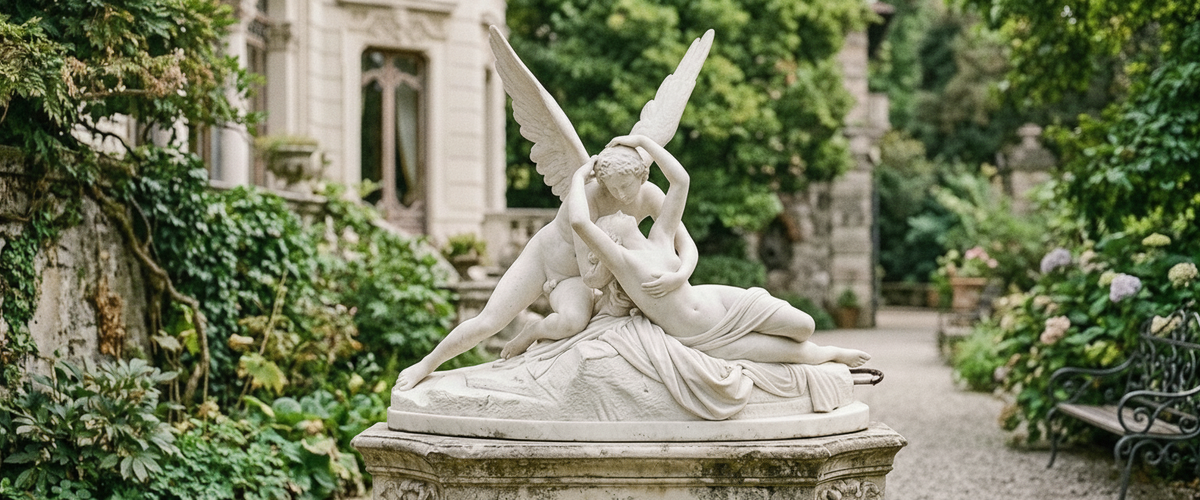

Canova resolved this embrace around one dominant angle, and most buyers never find it before the crate is open. A cupid and psyche sculpture is the rare classical group that lives or dies on sightlines: from the favored side you read the arch of the arms, the lift of the wing and the hair falling toward Psyche's shoulder. Step twelve inches to the left and it can flatten into two backs and an empty triangle of air. Placement is not decoration here. It is the whole composition.

At a Glance: What Decides the Right Spot
One hero view. Find the angle where the arms and wings form a closed shape, then build the setting around it.
Back it up. Full 360-degree access exposes the least resolved side of most versions of this group.
Keep the kiss near eye line. Tall plinths make you stare up a chin; low ones make you look down on the embrace.
Light low and raking. Overhead downlight kills the undercuts that make the arms legible.
Protect the wing tips. Fingertips and feathers at shoulder height in a corridor will eventually meet a suitcase.
Match material to site. Marble, composite and bronze each fail in different conditions; pick for the spot you actually have.
Canova Carved One Viewpoint, So Find It First
Antonio Canova's Psyche Revived by Cupid's Kiss, commissioned in 1787 and finished in 1793, was carved for a private interior rather than an open gallery floor, and visitors met it on a fixed approach. The group's famous lozenge of arms and wings reads best from one oblique angle, which is why photographs taken from behind look so oddly disjointed. Smarthistory's discussion of the composition and its intended viewing angle is a useful primer before you choose a site.
Do this physically. When a cupid and psyche sculpture arrives at our studio for finishing, we walk a slow circle with a phone camera and shoot every 30 degrees. One frame always wins. That frame should face your main approach: the door you come through, the gate at the top of the drive, the seating group by the pool.
From the favored oblique angle the arms and wing close into a single readable lozenge.
Why 360-Degree Access Turns a Tender Group Awkward
An island position in the middle of a lawn or lobby sounds generous and usually is not. Behind the embrace you get wing roots, two shoulder blades and the join line of the drapery, all the parts a sculptor treats as support rather than subject. Most carved versions of a cupid and psyche sculpture leave that rear elevation deliberately quiet. A clipped hedge, a stone wall, a run of pleached trees or a water feature solves it in one move by removing the weak view entirely.
If the piece genuinely must be seen in the round, choose a version modeled fully for it. Cast bronze groups are usually worked over the whole surface because the clay original is turned constantly on the stand, which is why a piece like the Large Classical Cupid and Psyche Bronze Sculpture - 150cm survives an island plinth where most carved versions of the same subject start to look unfinished from behind.
Plinth Height and Eye Line: The Embrace Collapses When You Look Down
Aim to bring the kiss to roughly average standing eye level, around 5 ft 4 in (1.63 m), or slightly above it. Below that and you look down onto the tops of two heads, which reads as slumped rather than tender. Well above it and you get the underside of a jaw and a lot of nostril.
Simple arithmetic saves grief. A group standing about 5 ft 3 in (160 cm) needs almost no lift indoors; 12 to 18 in (30 to 45 cm) of plinth is often plenty, and sometimes a shallow stone pad is better still. We had a Napa courtyard commission where the client had already poured a 3 ft plinth for a tall marble group; the faces ended up over 7 ft in the air and the whole embrace disappeared. We reset the piece on a low limestone slab and the composition came back.

Lighting the Undercuts: Raking Light Keeps the Arms Readable
Any cupid and psyche sculpture is built from deep undercuts: the tunnel between the two chests, the gap under Psyche's raised arm, the shadow beneath the wing. Grazing light from low down and 30 to 45 degrees off the hero view picks all of that out. Overhead downlight does the opposite, dropping a flat pool on the shoulders and turning the arms into a single pale mass.
Two fixtures beat one. A warm key light on the hero side and a weaker fill on the opposite side keeps the far arm from vanishing. For marble, stay warm; cool white light makes carved stone look chalky and slightly clinical.
Low raking light from the hero side keeps the undercuts and the far arm legible after dark.
Wings in a Corridor: The Chip Risk at Shoulder Height
Every projecting element on a cupid and psyche sculpture sits at exactly the height that gets knocked: outstretched fingertips, the leading edge of a wing, a trailing foot. We repaired a wing tip for a Dallas hotel where the group had been set in a service-adjacent corridor; a luggage cart had done in three months what a garden would not do in thirty years.
If your only spot is a circulation route, reduce the footprint rather than gambling. Where the wall line is tight, a single figure such as the 90cm hand carved Cupid marble sculpture keeps the same classical register with far less to catch, and it will sit in a niche that a two-figure group can never occupy safely.
Conservatory Glare Versus Sheltered Garden Frost
Two popular homes for a cupid and psyche sculpture both punish thin wings. A glazed conservatory bakes the piece, floods it with UV (composite versions yellow and go brittle fastest here) and throws flat glare that erases the shadows you need. An exposed garden bed does the reverse: water sits in the undercuts, freezes and spalls the surface. Freeze-thaw cycling is one of the main mechanisms behind stone loss on outdoor carving, as technical conservation guidance on building stone sets out.
The workable middle ground is a sheltered, well-drained position: raised off soil on a plinth with a slight fall, out of the drip line of trees, away from sprinkler spray. In hard-winter states, a breathable cover over winter helps. Plastic sheeting does not; it traps moisture against the stone.
Marble, Composite or Bronze: Which Version Tolerates Your Site
For wider placement ideas, How to Place a Large Outdoor Giraffe Statue so the Height Actually Lands is useful companion reading before finalising the setting and sightlines.
Marble gives you the translucency and crisp carving the subject was invented for. It suits interiors, loggias, walled gardens and mild climates such as coastal California. For a walled courtyard where the group will be read from a few feet away rather than across a lawn, a full-height carved pair like the 160cm Cupid and Psyche marble outdoor sculpture is usually the specification that rewards the close viewing distance.
Composite is lighter and easier on a roof terrace or an upper floor with load limits, and it takes knocks without shattering. It trades away surface depth and long-term UV stability, so treat it as a solution to a weight problem rather than a default.
Bronze is the durable answer if a cupid and psyche sculpture has to face freeze-thaw regions, coastal salt air or a busy public site. It handles thin projections better than stone, and a waxed patina can be maintained indefinitely. Compare our bronze sculptures and marble sculptures side by side and you will see how differently the same subject behaves in each.

Placement Checklist Before You Commit
Photograph your cupid and psyche sculpture (or the product images) every 30 degrees and pick the hero view.
Line that view up with your main approach, then block or plant out the weakest side.
Set plinth height so the kiss lands at or just above standing eye level.
Check clearance at shoulder height for wings, fingertips and elbows in any walkway.
Plan two low fixtures, a key on the hero side and a weaker fill opposite, before the electrician leaves.
Confirm drainage, sprinkler throw and tree drip lines for outdoor sites.
Verify access route, door widths, crane or gantry needs and floor loading.
Commissioning a Bespoke Cupid and Psyche Sculpture
If your site fights the catalog sizes, a commission is often the cleaner route. We regularly adjust scale, tighten a wing profile for a narrow niche, change the base to suit an existing plinth, or cast a marble subject in bronze for a hard-winter garden. Cost depends on material, scale, carving or modeling complexity, engineering, finishing and installation, so the sensible next step is a tailored quote rather than a guess. Send us the approach photo, the ceiling or sightline height and a rough plan, and Giant Sculptures will tell you honestly whether the spot suits the piece.