





































































































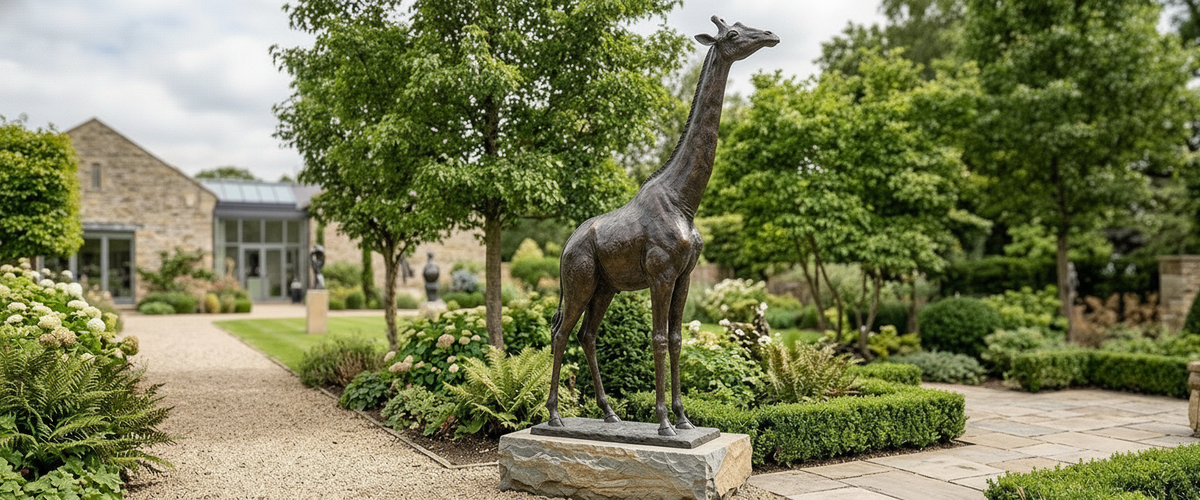

Most buyers fall for the height. Then they set a large outdoor giraffe statue against a mature hedge, and 14 feet of bronze quietly disappears into green. The animal is still there. The drama is gone. Of every subject we ship, the giraffe is the least forgiving of a lazy site decision, because almost all of its impact lives in a narrow vertical line that needs open air behind it.

Key Takeaways Before You Choose a Piece
Backdrop beats size. Sky behind the head of a large outdoor giraffe statue is worth more than an extra three feet of bronze.
Viewing distance should be roughly twice the height. Stand too close and the head sits above your natural eyeline, unread.
Footing must be over-engineered. Tall, top-heavy figures load a foundation very differently from a crouching lion.
Pose changes the room. A browsing head reads calm and horizontal; an upright stare reads formal and axial.
Check access first. Gate width, overhead cable height and crane swing decide what can actually reach the lawn.
Budget follows material, scale, engineering and installation, so ask for a tailored quote rather than guessing from a photo.
A Giraffe Reads as Height First and Animal Second
Wild bulls reach around 18 feet (5.5m), and the San Diego Zoo Wildlife Alliance notes that a newborn calf already stands about 6 feet tall. That biology is your design brief. A viewer clocks the vertical before they clock the spots, the ossicones or the legs, which means the outline of a large outdoor giraffe statue needs to be legible from 100 feet away in flat light.
Two approaches work. The naturalistic route sculpts real anatomy, real weight in the shoulder, real slack in the neck; it rewards close inspection and suits a lawn where people walk right up. The contemporary route abstracts the animal into planes and long simplified curves, which holds up better against modern architecture and hard landscaping. Where the setting wants that cleaner language rather than full anatomical detail, a piece such as the Life-Size Contemporary Giraffe Bronze Sculpture at 450cm (just under 15 feet) carries enough anatomy to be unmistakable without fighting a glass elevation.

Sky Behind the Head, Not Hedge
This is the single rule that separates a well-sited large outdoor giraffe statue from a wasted one. Walk your site at the height you actually approach from, whether that is a driveway, a terrace or a gallery window, and look at what sits directly behind the point where the head will be. If it is foliage, brick or a garage roof, move the piece.
Open sky behind the head keeps the vertical line reading from a long approach.
Open sky, water or a long lawn all give the neck the contrast it needs. One client moved a planned position about twenty feet downhill after we photographed a survey pole on site, and that shift alone turned a decent installation into the thing everyone photographs. Pale materials need this even more than dark ones, because a white marble giraffe against light limestone loses its edges. If stone is the material you want, the Graceful Giraffe White Marble Outdoor Sculpture - 350cm (about 11 feet 6 inches) belongs against a dark yew line, deep planting or open sky rather than a pale gravel court.
Footing, Ballast and Why the Plinth Needs Over-Sizing
A large outdoor giraffe statue behaves like a sail. Wind pressure on a slender neck acts high above the base, so the overturning moment is far greater than the weight alone suggests, and coastal or ridge-top sites see gusts that a sheltered suburban courtyard never will. We size foundations to the exposure category, not to the sculpture's mass.
In practice that means a reinforced concrete pad set below the local frost line, cast-in stainless anchor bolts or a threaded baseplate matched to the bronze, and a plinth footprint noticeably wider than the animal's stance. Hollow cast bronze can be internally ballasted and stiffened at the leg junctions; marble needs doweling and a bedded joint. Do not let a landscape contractor improvise this on the day. Ask your supplier for anchor drawings before the slab is poured, because retrofitting a fixing into cured concrete is the most avoidable cost in the whole project.

Set the Viewing Distance at Twice the Height
A comfortable head-up viewing cone puts the whole figure in frame at roughly two times its height. For a 13 foot large outdoor giraffe statue, that is a primary viewpoint around 26 feet back. Closer than that and the visitor sees legs and belly while the head vanishes above their eyeline; further than four times the height and the detail flattens out.
Design the approach as a sequence. One long view for the silhouette, one mid view where the animal gains volume, one close position where texture and tool marks pay off. A standing figure of around 400cm (roughly 13 feet) placed at the end of a lawn axis does all three jobs if the path lets people arrive gradually rather than turning a corner into it.
Browsing Pose or Upright Stare
A browsing pose, head lowered or turned to the side, softens a space and gives you a horizontal element to balance the vertical. It suits lawns, meadow planting and courtyards where you want the piece to feel inhabited rather than ceremonial. The upright stare is directional and formal; point it down a driveway or along a central axis and it behaves like architecture.
A herd needs frontage; varied heights lead the eye across a wide site.
Groups change the arithmetic. A herd creates rhythm and lets you use varied heights to lead the eye, which works beautifully across a wide frontage where a single large outdoor giraffe statue would look stranded. A composition on the scale of the Monumental Life-Size Giraffe Herd Bronze Sculpture at 600cm (around 19 feet 8 inches) needs a genuinely large field of view; in a small courtyard it becomes crowding rather than composition. The wider range of animal sculptures is worth comparing if you are still weighing single figures against grouped arrangements.

Planting: Mature Trees Compete, Young Planting Maroons the Piece
Set a large outdoor giraffe statue under established oaks and the canopy wins. Set it in a newly planted scheme and it looks parked. The workable middle ground is planting that reaches about a third to a half of the sculpture's height at maturity, arranged to frame rather than enclose. Grasses and low massed shrubs are ideal; they move, they catch light, and they never reach the head.
Give yourself a maintenance ring of at least three feet of clear surface around the base. It keeps irrigation off the metal, stops string trimmers scarring the legs, and makes annual care straightforward. For exterior bronze, conservation guidance from the US National Park Service covers washing and protective coating cycles worth building into your grounds schedule.
Access Before Art: The Delivery Checklist
A large outdoor giraffe statue is a rigging job before it is an art delivery. We have had a delivery stall at a gated driveway because the stone piers were four inches narrower than the drawing. Run these checks before you sign anything.
Measure the narrowest gate, arch or side return, then subtract for rigging clearance.
Note overhead limits: cables, tree canopy, bridge and parking structure heights on the final approach.
Confirm the truck can turn and stand where the crane needs to sit, and check crane swing radius over pools, glass roofs and septic fields.
Check ground bearing for outriggers and whether lawn matting is needed.
Agree whether the neck ships separately and is joined on site, which is common at monumental scale.
Have the foundation cured and anchor positions verified before delivery day.
Confirm who supplies lifting eyes, slings and the method statement.
Commissioning a Large Outdoor Giraffe Statue
Cast bronze remains the default for this subject: strong at slender sections, patinable in warm browns through to near black, and it improves with weathering. Marble suits sheltered, formal settings and pale material palettes. Stainless steel and Corten open up abstracted forms for contemporary architecture. Giant Sculptures makes bespoke pieces to site, so height, pose, patina and base detail can all be adjusted rather than accepted, and we can supply anchor and load information for your engineer. Cost depends on material, scale, complexity, engineering, finishing and installation, so send site photographs and sight-line notes and ask for a tailored quote.
Get the backdrop and the footing right, and a large outdoor giraffe statue will outlast the planting scheme around it, the paint on the house and probably the owner who commissioned it. That is the point of buying at this scale.
For wider placement ideas, Extra Large Outdoor Sculpture: How Scale, Sightlines and Placement Decide the Whole Effect is useful companion reading before finalising the setting and sightlines.