





































































































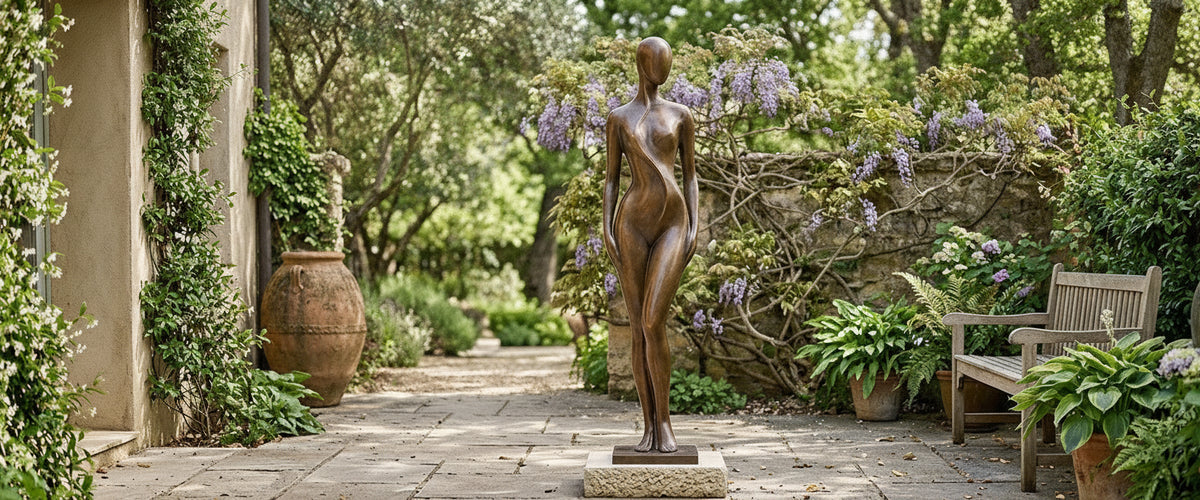

The same contemporary bronze sculpture can dominate a hallway in Dallas or disappear into a busy Napa garden bed, and the piece itself has nothing to do with it. What changes is placement: how far the viewer stands, what sits behind the form, how high it rides on its base, and how light hits the patina at different hours. Buyers spend weeks choosing a subject and finish for their contemporary bronze sculpture, then lose most of the impact in the last ten minutes by putting it in the wrong spot.
Looking for the full range in this category? Browse our Bronze Sculptures collection for every available finish, size, and configuration.
This is the part of buying a large contemporary bronze sculpture that almost nobody plans for, so let's fix that.

Key Takeaways
- Scale is relational, not absolute. A 5 ft (1.5 m) figure reads large in a study and small on a lawn.
- Pedestal height sets the eyeline and can make or break a piece more than the sculpture's own size.
- Backdrop contrast decides whether the silhouette registers from across the room or the yard.
- Indoor and outdoor each reward different subjects, finishes, and viewing distances.
- Most placement mistakes are fixable before casting if you plan sightlines during the commission, not after delivery.

What a Contemporary Bronze Sculpture Looks Like in Different Settings
This category covers a wide field: pared-back abstract forms, stylized animals, figurative work with a modern edge. The material behind a contemporary bronze sculpture is a copper alloy, usually bronze mixed with tin and small amounts of other metals, finished with a chemically induced patina and often sealed with wax or lacquer. That patina is why the same casting can look almost black in a shaded courtyard and warm amber in afternoon sun.
Indoors, a smaller contemporary bronze sculpture earns its keep by rewarding close inspection. Where guests pass within a few feet of a console or plinth and can read the tooling and the facets, a head such as the Contemporary Boar Head Bronze Sculpture - 45cm makes more sense than a full figure competing for the same footprint. The detail is the point, so give it a short viewing distance.
Outdoors, the rules flip. Distance grows, competing texture grows with it, and fine surface detail gets lost past 15 or 20 ft (about 5 to 6 m). That is where a bold silhouette matters more than intricacy. Something with a clean vertical read, such as the Contemporary Upright Dolphin Bronze Sculpture - 170cm, holds a driveway turning circle or a pool terrace because the shape registers against sky or planting from across the garden.

Scale, Sightlines, and Pedestal Height
Three choices change how a contemporary bronze sculpture reads more than any other, and buyers control all of them.
Scale is comparative. A sculpture never exists alone; it competes with ceiling height, door frames, trees, and furniture. In a room with 9 ft ceilings, a 6 ft figure feels commanding. Move it onto a lawn beside mature hedging and it can look stranded. Before you settle on size, measure the space and mock up the footprint. We ask clients to cut a cardboard outline to the piece's silhouette and live with it for a few days. It sounds crude. It has saved more commissions than any render.
Sightlines decide the first impression. Walk the actual route a visitor takes. Does the sculpture greet them head-on, or do they meet it at a three-quarter angle? Many contemporary bronze sculptures are designed with a primary face, and a striking profile can fall flat if the approach shows the back first. Where a piece has an unmistakable front and full-height presence, such as the Large Contemporary Violinist Bronze Sculpture - 220cm, orient it toward the main approach and let secondary angles reward a second look.
Pedestal height sets the eyeline. This is the lever people most often ignore. Raise a piece too high and viewers see the underside; set it too low and it reads as an afterthought on the floor. For most standing figures, aim to put the visual center of the work near or slightly above adult eye level, roughly 5 ft to 5 ft 6 in (1.5 to 1.7 m). Animal and abstract forms sometimes want to sit lower so you look down into them. When we quote a commission for a contemporary bronze sculpture, we treat the base as part of the work, not an accessory.

Indoor Versus Outdoor: When Each Wins
Indoor placement wins when the work rewards intimacy and controlled light. Busts, heads, and detailed figurative pieces belong where people slow down: a stair landing, a library, the end of a gallery hallway in a NYC apartment. You control the backdrop and the lighting, so you can stage the contemporary bronze sculpture precisely.
Outdoor placement wins when you want scale and changing light to do the work for you. Bronze is well suited to the outdoors; its patina develops naturally over years, and conservators behind the Smithsonian's outdoor sculpture guidance note that a maintained wax coating protects the surface from weathering while letting the metal age gracefully. A garden piece catches morning and evening sun differently, so the sculpture effectively changes through the day without you touching it.
The middle ground, covered terraces and atriums, gives you both distance and shelter. Those spots suit larger animal forms; on a shaded loggia, a contemporary bronze sculpture like the Large Contemporary Crab Bronze Sculpture - 120cm reads well because you get outdoor scale with indoor viewing control.
Light, Backdrop, and Contrast
A sculpture is a silhouette before it is anything else. If the form does not separate from what sits behind it, no amount of casting quality saves the impact.
Dark bronze against dark foliage disappears. Set the same piece against a pale rendered wall, a clipped hedge in flower, or open sky and the outline snaps into focus. Indoors, a mid-tone wall usually flatters a dark patina better than stark white, which can flatten the form by killing shadow.
Light direction matters as much as brightness. Raking light from the side, low and angled, carves out surface modeling and makes texture legible. Flat frontal light erases it. For evening display, a single directional spot placed to graze the surface will out-perform a bright, even wash every time. Plan the lighting during the commission if the contemporary bronze sculpture will be a night-time feature; it is far easier to run a discreet ground-level fitting before hardscaping goes in than to retrofit later.
Placement Mistakes We See, and How to Avoid Them
For wider placement ideas, Affordable Contemporary Bronze: Where to Place It so It Actually Reads is useful companion reading before finalising the setting and sightlines.
Certain errors come up again and again in commissions. Here is the shortlist worth checking against.
- Buying for the room you photograph, not the room you live in. A piece staged for a listing photo often sits where furniture actually needs to go. Place for daily sightlines first.
- Skipping the base decision. Ordering the sculpture, then improvising a plinth, throws off the eyeline. Specify base height and material with the piece.
- Under-scaling outdoors. Open ground swallows objects. When unsure between two sizes for a garden, the larger one is almost always right.
- Ignoring the approach angle. A dramatic front means little if visitors meet the back first. Orient to the main path.
- Fighting the backdrop. Dark on dark or busy on busy kills the silhouette. Give the form a clean field to read against.
- Forgetting wind and footing outdoors. Tall, top-heavy forms need proper anchoring and a level, load-rated foundation. We spec fixings as part of any outdoor commission.
How Placement Shapes a Commission
When we start a bespoke contemporary bronze sculpture at Giant Sculptures, placement is one of the first conversations, not the last. Where a piece lives changes its ideal size, its patina, its base, and sometimes its pose. A form built to be seen in the round on an open lawn is engineered and finished differently from one designed to sit against a wall in a Texas foyer.
If you are weighing a contemporary bronze sculpture for a specific spot, browse the bronze abstract sculptures for pure form, or the bronze figures and statues range for figurative work, then send us the location details. These contemporary sculptures reward planning: photographs of the space, ceiling or fence heights, and the main approach let us advise on scale and base before anything is cast. Get those decisions right and your contemporary bronze sculpture reads exactly as intended, from the first glance to the fiftieth year of ownership.