



























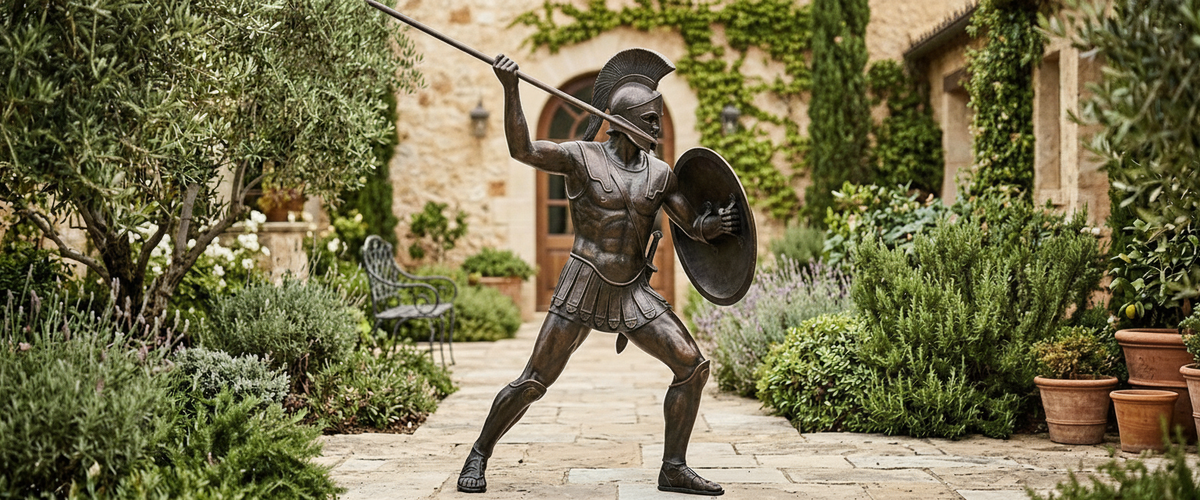

Most warrior figures fail for one reason, and it is rarely quality of casting. The pose gets chosen from a catalog photograph, then the piece arrives and the site refuses to cooperate. A bronze warrior statue braced mid-charge needs ground to charge across. A figure holding guard needs something to guard. Get that relationship wrong and you own a beautifully made object that looks stranded on its own lawn.

Key Takeaways Before You Choose a Pose
Guard stances belong at thresholds: gates, drive entries, pool house doors, the top of a stair run.
Charge and lunge stances need a run of open ground in front of them, ideally 20 to 30 feet (6 to 9 m) of clear sightline.
Face the approach. Visitors should be met by the figure, not walk up behind its shoulder blades.
Raised weapons change everything: clearance, wind load, eye-height hazard and shipping crate size.
Patina reads at distance. A dark chocolate finish reads as mass; rubbed highlights read as movement.
Budget follows scale, bronze thickness, base engineering and finishing, so ask for a quote against your actual site rather than a generic figure.
Guard Stance Needs a Threshold, Charge Stance Needs a Run
A guard pose is closed and vertical. Weight sits evenly, the shield or blade is held across the body, the eyeline is level. That silhouette does its work when it has a boundary to defend, which is why paired figures flanking a gate or a pair of steps have survived as a device for two thousand years. Set the same figure in the middle of an open lawn and it loses its argument, because there is nothing behind it worth standing in front of.
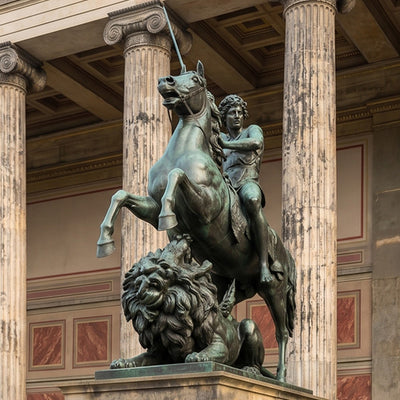
A charge or lunge pose is the opposite. The mass is thrown forward, one leg trails, and the whole composition points somewhere. That pointing needs distance. On a Hamptons commission we sited a forward-braced classical figure at the far end of a mown allee so the lunge read the length of the lawn; from the terrace it looked like it had been holding that position for a century. Crowd it against a hedge four feet behind and the energy has nowhere to go.
A closed, vertical guard pose earns its place at a threshold rather than mid-lawn.

Samurai Crouch Versus Hoplite Line: Two Silhouettes, Two Spaces
A bronze samurai warrior statue in a low crouch is a wide, horizontal shape. The armor flares, the stance spreads, the blade often cuts a diagonal across the body. That footprint suits gravel courts, entry motor courts and generous planted terraces where you can walk around it and read the profile from several angles. Where the ground plan allows that kind of circulation, a piece at the scale of the Monumental Traditional Samurai Warrior Bronze Sculpture at 350cm (roughly 11 ft 6 in) asks to be approached from several sides rather than dropped into a niche, because the silhouette changes with every few steps you take around it.
A Greek warrior bronze statue works on different rules. Hoplite and Spartan figures are built on the vertical line of the spear and the column of the body, which means they hold up beautifully against architecture, hedging or a wall. A figure built on that vertical, such as the Life-Size Classical Spartan Warrior Bronze Statue - 250cm (about 8 ft 2 in), can sit far closer to a facade than a crouching figure without feeling squeezed. If you are comparing both traditions side by side, our bronze samurai and warrior statues collection is the fastest way to see how differently the two silhouettes occupy ground.
Face the Approach, Not the House
The single most common siting error we see: the figure is rotated to look good from the kitchen window, which means everyone arriving on foot meets its back. Decide first who the primary audience is. If it is guests arriving up a drive, the statue faces the drive. If it is the family on the terrace, it faces the terrace and the drive gets a three-quarter view, which is usually the more flattering angle anyway for a bronze warrior statue with a raised arm.
Rotate on site before you bolt down. We ask clients to mock the footprint with stakes and a tall cane at weapon height, then walk the approach twice, once at midday and once at dusk. A 20-degree turn often does more for the piece than moving it 10 feet.
Raised Spears and Extended Blades: Clearance and Wind
Extended weapons are the part buyers underestimate. A spear held aloft adds height that no product title mentions, and it also adds use. Bronze is heavy and stable, but a tall figure with an outstretched arm still transfers wind load into the base, which is why our engineered bases are sized to the pose rather than to the statue height alone. Coastal sites, roof terraces and anywhere in a Gulf or Atlantic wind corridor need that conversation early.
Then there is the human hazard. A blade tip or spear butt sitting at chest or eye height beside a path is a liability in a hotel courtyard or a venue lobby. Either raise the whole figure on a plinth so the extremities clear head height, or pull the piece back from the circulation route. Do not simply hope people walk around it.

Why a Resting Warrior Is the Hardest Pose to Site
For wider placement ideas, Bronze Greek Gods Statues: Placing Zeus, Apollo and Poseidon Well is useful companion reading before finalising the setting and sightlines.
Seated, leaning and post-battle figures are the ones clients most often ask us to reposition. They have no direction. A guard pose points at a threshold and a charge pose points down a lawn, but a resting warrior points inward, so it needs a setting that gives it a reason to rest: a walled garden corner, a courtyard with a bench, the end of a shaded loggia. Give it an open field and it reads as fatigue rather than composure. Lower plinths help. So does letting planting come close, because the pose is intimate and the site should agree.
Dark Chocolate or Rubbed Highlights
The same pose can read two completely different ways depending on the patina. A deep chocolate brown patina absorbs light, flattens surface detail at distance and emphasizes overall mass, which suits a heavy samurai silhouette against gravel or stone. A lighter patina with rubbed highlights on the armor edges, calf muscles and knuckles catches sun and pulls the eye across the form, which flatters classical anatomy. On a classically proportioned figure such as the Life-Size Classical Greek Warrior Bronze Statue - 250cm, that highlight rubbing is what keeps the musculature legible from 30 feet away rather than collapsing into one dark mass.
Two finishes, one pose: chocolate patina reads as mass, rubbed highlights read as movement.
Patina is a chemical film, not paint, and the surface of an outdoor bronze keeps changing as it reacts with the atmosphere. That slow change is a feature of the material rather than a fault; the Copper Development Association documents how copper alloys form stable protective surface layers outdoors. A wax coating applied once or twice a year, plus a rinse to clear salt or fertilizer splash, keeps the finish where you want it. Conservation guidance from the V&A on caring for metalwork is a sensible baseline for owners.

Site Checklist Before You Commission
Who is the primary viewer, and from which direction do they arrive?
Is there a threshold, axis or open run that the pose can respond to?
Clear distance in front of a charging figure: at least 20 feet (6 m)?
Weapon tips: above head height, or set back from the path?
Foundation access for a crane or gantry, and a route wide enough for the crate?
Exposure: coastal salt, prevailing wind, irrigation overspray?
Backdrop tone: will a dark patina disappear against dark yew or brick?
Plinth height and material agreed against the pose, not chosen afterward?
Commissioning a Bronze Warrior Statue at Scale
Cataloged sizes cover most residential sites, but civic plazas, hotel forecourts and estate entrances usually need something built to the ground plan. Giant Sculptures works from client photographs, elevations and sightline notes to adjust height, stance width, weapon angle and base engineering before casting begins. Scaling a pose means more than enlarging it; a figure that reads well at 8 feet often needs its stance widened and its extremities thickened at 14 feet to survive the change in viewing distance and load. If you are still narrowing down subject and finish, browse the wider bronze sculptures range or the bronze garden statues collection, then send us your site and we will quote against it properly.