






































































































The most common disappointment we hear about a bronze animal sculpture has nothing to do with the casting quality. The piece arrives, it is beautifully modeled, and it still looks marooned. Nine times out of ten the cause is the approach: the distance a visitor covers before they reach the animal, and what sits behind it while they walk.
Mass, pedestal height and patina all get decided long before delivery, and they are far harder to fix afterward. Get them right and a bronze animal sculpture reads as if it wandered into place. Get them wrong and you own a very good object sitting in the wrong spot.

Key Takeaways
Scale to the viewing distance, not the room or the lawn. A 10 ft (3 m) approach and a 100 ft (30 m) approach need completely different mass.
Even 6 inches (15 cm) of pedestal is often the difference between an animal that stands and one that looks stranded.
Dark patina against a dark hedge kills the silhouette. Test the backdrop before you fix the position.
Indoor pieces get inspected at arm's length, so chasing, seam work and hoof or paw joins matter more than outdoor scale ever will.
Patina choice should answer the light your site actually gets, not the light in the studio photograph.
Ten Feet for a Hare, a Hundred for a Stag: Matching Mass to the Approach
Walk the route your visitors will take and count your paces. That number sets the mass. A hare, fox or resting hound viewed from a terrace at 10 ft (3 m) can sit at 18 to 30 inches (45 to 75 cm) and still carry authority, because you read fur texture, ear angle and the tension in the haunches. Push that same animal to the end of a 100 ft (30 m) lawn axis and it becomes a dark smudge on the grass.
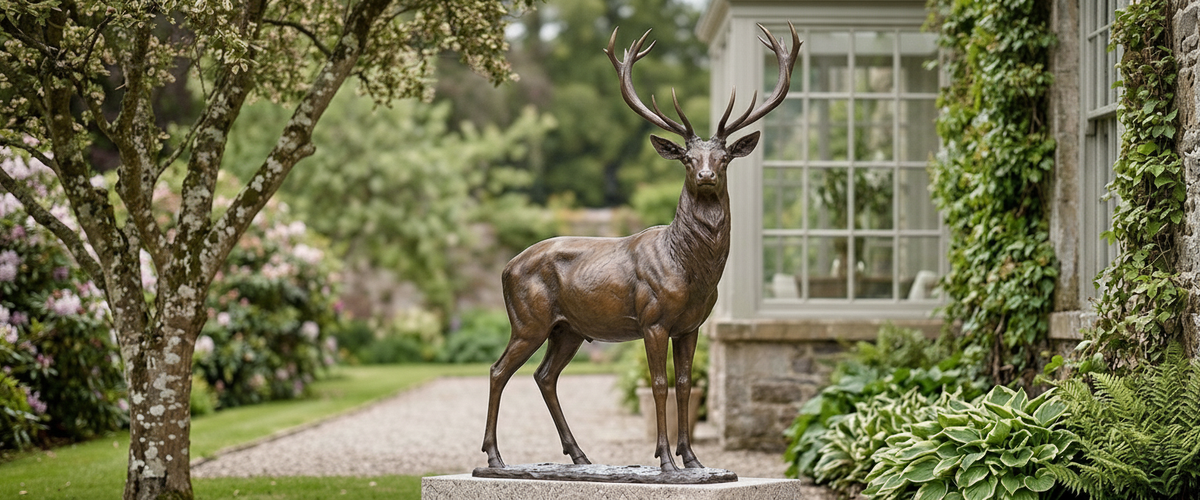
At long range the outline does the work: antlers, wings and a turned head survive the distance.
At long range you lose surface detail entirely and buy silhouette instead. That is why monumental commissions favor animals with legible outlines: raised wings, antlers, a rearing line, a turned head. On a long drive, the wing profile of something like the Monumental Heraldic Winged Lion Bronze Sculpture - 350cm (roughly 11 ft 6 in) is what survives the distance, while the same form set in a courtyard would simply crowd you. Where a site is wide rather than deep, a walking pose such as the Life-Size Classical Walking Unicorn Bronze Sculpture - 240cm stretches the outline sideways, which a broad lawn often needs more than sheer height.

The Six Inches of Pedestal That Separate a Live Animal from a Stranded One
We shipped a pair of guardian lions to a winery entrance in Napa a while back. The client set them straight onto compacted gravel, sent a photo, and asked why they looked flat. They were sinking visually into a surface of almost identical tone. We specified two granite pads about 6 inches (15 cm) high, and the pieces immediately read as guardians rather than garden ornaments.
Height does three jobs at once. It lifts paws and hooves clear of the mowing line and gravel splash. It creates a shadow gap under the body, which is what your eye uses to separate object from ground. And it signals intent, which is why traditional forms arrive with their own base logic already resolved, as with the Large Traditional Chinese Guardian Lion Bronze Sculpture (Tiered Greek Key Plinth) - 140cm. If your piece is a naturalistic species study, keep the plinth low and quiet. If it is heraldic or classical, a formal base belongs to the language of the work.

Hedge, Render or Open Sky: Which Backdrop Eats the Silhouette
A rich brown or near-black patina in front of a mature yew hedge disappears at twenty paces. It is the single most frequent siting error we correct. Dark bronze wants pale render, limestone paving, water, snow or open sky behind it. Green and lighter verdigris patinas hold up better against masonry and gravel, where a dark piece would simply read as a hole.
Before you pour a foundation, cut a full-size profile from plywood or cardboard, stake it in position, and photograph it from every approach at morning, midday and late afternoon. Ten dollars of cardboard has saved several of our clients from re-excavating a footing.
Close Range Indoors, Where Casting Seams Get Audited
Interior bronze is judged with reading glasses on. Guests lean in. They run a thumb along a fetlock. Anything the foundry rushed at the chasing stage, where sprue points and mold seams are cut back and re-textured, shows up in raking window light. Ask specifically how seams are dressed and whether the patina is applied hot and sealed with wax.
Scale changes too. A console table, stair landing or entry niche suits something in the 3 ft (90 cm) range, and a piece like the Large Contemporary Winged Horse Bronze Sculpture - 90cm sits at the point where the surface can be read properly instead of guessed at. The lost-wax method behind all of this is thousands of years old and worth understanding before you commission; the V&A sculpture collection documents the technique across periods.

Weathered Green or Warm Brown: Choosing Patina for the Light Your Site Actually Gets
For wider placement ideas, A Large Bronze Horse Sculpture Needs Room to Move is useful companion reading before finalising the setting and sightlines.
Patina is chemistry, not paint, and it behaves differently under coastal gray light than under hard desert sun.
Light does different things to the same finish. In the flat gray coastal light of Seattle or coastal Maine, a warm chocolate or liver brown keeps a piece from looking cold and dead. Under hard Texas or Southern California sun, deep browns can go harsh and glary at midday, while a green or mottled verdigris stays readable all day. Snow country is its own case: in Aspen, everything darker than mid-brown reads as a cutout for months at a time.
Coastal salt air will also push an outdoor bronze toward green over time whatever you start with. Decide whether you want to fight that with annual waxing or let the piece move with its site. Both are legitimate; only one is low maintenance.
Sightlines We Redraw Most Often After a Commission Lands
Turn the head, not the body. Animals should acknowledge the approach. A stag facing away from the drive reads as an accident.
Move off the dead-center axis. A few feet to one side usually gives a better three-quarter view from the house.
Escape hedge shadow. Pieces set too close to planting lose their edges for half the day.
Raise the base. Almost always the first fix on soft ground or gravel.
Light from low and to the side. Uplighting straight from below flattens muscle and exaggerates the jaw.
What to Settle Before You Commission a Bronze Animal Sculpture
Longest and shortest viewing distances, measured on site
Backdrop tone at each of those distances
Pedestal material, height and foundation requirement
Patina choice tied to your climate and light
Wall thickness and internal armature for wind or snow loading
Access route for delivery: gate widths, ground protection, crane or forklift need
Maintenance plan, including who waxes it and how often

Working With Bronze Animal Sculpture Artists on a Commission
Good bronze animal sculpture artists start with anatomy, not styling. Expect to supply reference photographs, breed or species specifics, and ideally a site plan. Expect a maquette before anything goes to mold, because pose corrections are cheap in clay and painful in metal. Organizations such as the National Sculpture Society are a useful starting point for understanding how figurative and animalier sculptors work.
At Giant Sculptures we work across catalog pieces and full bespoke commissions, and the conversation is always the same at the start: where is it going, how far away will people stand, and what is behind it. Cost depends on material, scale, complexity, engineering, installation and finishing, so we quote each project individually rather than pretending a range exists.
If you are still narrowing down subject and scale, the bronze animal sculptures collection is the place to compare species and pose, and the life-size bronze statues range is worth a look if the approach on your site demands real presence.