













































































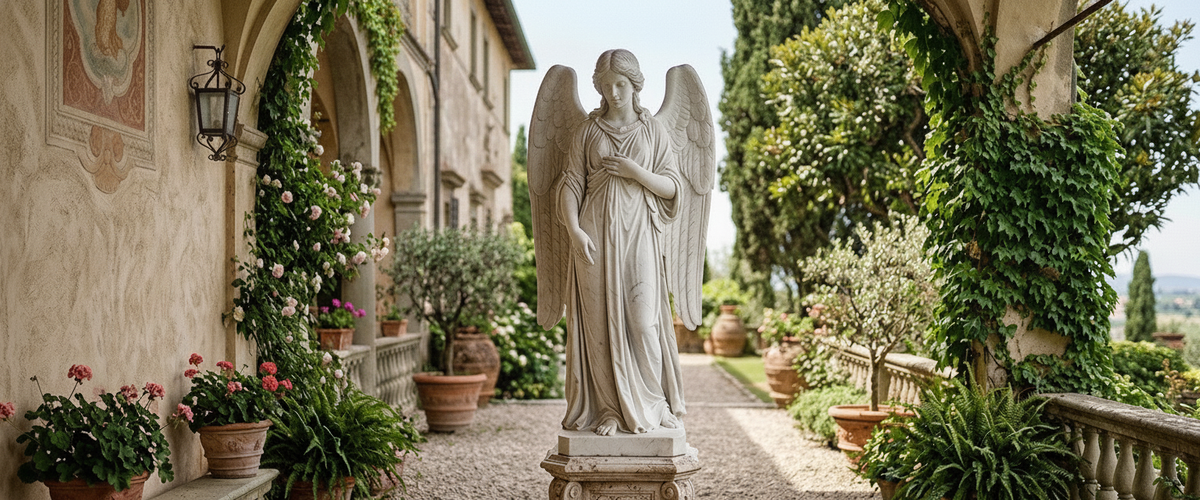

Italian hand angel statues are figurative marble sculptures cut by hand from a single quarry block, almost always in the Carrara district, and commissioning one well comes down to six decisions: the block, the marble grade, the pose approved in clay, the extra stone left at the extremities, the finish chosen for the setting, and the rigging plan for installation. The drawing is always beautiful. The block has opinions. That gap is where most commissions go sideways, because a wingspan that reads gracefully on paper may simply not exist inside the stone a quarry can supply that season. Buyers who understand this early get a better angel, a calmer process, and a piece that survives its first winter on a plinth in the Hamptons rather than shedding a fingertip in transit.

Key Takeaways
Italian hand angel statues are carved from one block, so its dimensions cap drapery depth and wingspan before any design conversation matters.
Carrara, Statuario and Bianco Perlino each allow a different level of carving risk.
Settle the pose in a clay maquette; changing your mind in marble means starting again.
Carvers leave extra stone at fingertips, wingtips and slender attributes as structural insurance.
Approve the face from about 10 feet (3 m), not from a close-up phone photo.
Interior niche or exterior plinth changes the finish, the base detail and the long-term care plan.
Budget depends on stone grade, scale, undercutting, engineering and installation; ask for a tailored quote.
The Quarry Block Sets the Limit, Not the Rendering
A carved angel starts as a rectangular mass, and everything in the finished piece has to fit inside it. Outstretched wings, a raised trumpet, a lifted hem of drapery: each one pushes the silhouette outward, and every inch of that reach has to be paid for in block width. Push too far and the carver either laminates on a separate piece (visible, and a weak point outdoors) or flattens the gesture until it loses its life.
This is why studio conversations about Italian hand angel statues begin with the envelope, not the mood board. A 6 ft (183 cm) standing figure with wings folded close needs a very different block to the same figure with wings half-open. Buyers who start out browsing Italian hand carved marble angel statues for sale often shift to a commission at exactly this point, because a finished stock piece fixes the silhouette, while a bespoke block still leaves it open. Where the brief asks for depth of carving rather than reach, a folded-wing composition such as the Standing Angel With a Bouquet Marble Memorial, 190cm stays inside a manageable block and still carries deep drapery folds, because the stone saved on wingspan is spent on the cloth instead.
Roughing-out stage: the block dictates how far the wings can reach.

Carrara, Statuario or Bianco Perlino: What Each Stone Lets a Carver Risk
Classic Carrara is the workhorse: fine, even grain, soft gray veining, forgiving under the point chisel. It takes undercut drapery well and weathers predictably outdoors, which is why most Italian hand angel statues destined for gardens are cut from it. Statuario is rarer, whiter, and more dramatically veined, prized for interior figures where the face and hands will be read at close range. The catch is that veining is not decoration; it is a structural fact, and a vein running through a wrist or a wing root is a fracture waiting for a frost cycle.
Bianco Perlino, warmer and more clouded, suits garden settings where a cool white can look clinical against planting. Whatever the grade, marble outdoors is a calcite stone reacting slowly to acidic rain, which is why exposed surfaces eventually lose crispness in a process conservators call sugaring. The Smithsonian's Museum Conservation Institute has published extensively on stone deterioration, and the practical takeaway is simple: the more exposed the site, the less you should ask the carver to cut lace-fine detail into the outer surfaces.
Argue About the Pose in Clay, Never in the Marble
Clay is cheap. Marble is not, and it does not grow back. A full maquette (or a scaled clay study plus a full-size profile template) is where you should be difficult: tilt the head five degrees, drop the shoulder, lengthen the trailing foot, open the hand. We once had a client in Napa revise a wing angle three times at maquette stage. It cost a week. Had that conversation happened after roughing-out, it would have cost the block.
Photograph the maquette from the exact viewing angles the finished statue will have: the approach path, the terrace, the window it will be seen from in February when the border is bare. Angels are directional figures. A composition that sings from the front can look collapsed from a three-quarter view, which is the view most gardens actually deliver.
Extra Stone at the Extremities: The Carver's Insurance Policy
Watch an Italian carver finish and you will notice they leave a fraction more material at fingertips, wingtips, trumpet bells and flower stems than the drawing calls for. It is not laziness. Thin projections are the first casualties of handling, crating, and ninety years of weather. A slightly thicker wingtip edge reads identically at viewing distance and survives a forklift nudge.
The same logic shapes how attributes are designed on Italian hand angel statues. A trumpet held against the body is stronger than one held clear of it. A bouquet resting in the crook of an arm outlives one gripped at arm's length. For an exposed lawn or a coastal garden, a seated composition such as the Seated Angel With Roses Marble Garden Statue, 170cm is the safer bet than a tall figure with open wings, because the mass sits low and the vulnerable elements stay tucked inside the silhouette.
Extra material at the wingtips is invisible from ten feet and survives shipping.

Sign Off the Face at Ten Feet, Not Ten Inches
Studio photography lies to you, kindly. A macro shot of a cheekbone under raking light exaggerates every tool mark and makes a serene face look severe. Ask instead for a video walk-around shot from roughly 10 feet (3 m), which is the real viewing distance for a garden or chapel piece.
Carvers deliberately cut features slightly deeper than life so they hold shape at distance and in full sun. Judge the face on whether the expression carries across a lawn. A client in Dallas nearly rejected a head on close-ups, then approved it instantly on site once it stood on its plinth at eye height and thirty feet away.
Interior Niche or Garden Plinth: Decide Before the First Chisel
Destination drives the carving. An interior niche figure can carry a honed, almost waxy finish and fine undercutting, because it will never see frost. Exterior Italian hand angel statues want a slightly more open surface, thicker section at load points, and a base designed to shed water rather than pond it. Plinth height matters just as much as the figure: a 3 ft (91 cm) cherub set straight on the ground disappears into planting, while a compact piece such as the Hand Carved Cupid Angel Marble Outdoor Sculpture, 90cm raised on a 30 in (76 cm) stone plinth becomes the focal point of a walled garden.
Memorial work has its own rules again. Cemetery authorities often set height, footing and fixing requirements, so confirm them before design starts. Our marble headstones and figurative memorials are routinely adapted to meet those specifications without losing the composition.
Crating, Lifting and Setting a One-Ton Angel
A 6 ft (183 cm) marble angel can weigh around 2,200 lb (1,000 kg) before the plinth. That weight has to reach its final position without the rigging touching a wingtip. Good practice includes a purpose-built crate with internal bracing at the shoulders and hips, soft slings placed at the body's mass rather than at projections, a compacted and level footing, and a dry-set or lime-bedded joint that allows future removal.
Access is the detail most buyers of Italian hand angel statues forget. Gate widths, lawn bearing capacity, overhead cables, driveway turning circles: measure them before the crate leaves Italy, not when the truck arrives. Guidance from the Natural Stone Institute on handling dimensional stone is a useful reference for any contractor unfamiliar with figurative work.

Commissioning Checklist
Confirm block availability and maximum silhouette before approving a design.
Choose the marble grade for the setting, not only for the photograph.
Approve a clay maquette from every real-world viewing angle.
Ask where extra material is being left at extremities and why.
Request a walk-around video at viewing distance for face sign-off.
Fix plinth height, footing and drainage detail early.
Survey the access route end to end before shipping.
Agree a cleaning regime: soft water, non-ionic detergent, no acids or pressure washing.
Giant Sculptures commissions and ships large-scale marble figures worldwide, from single garden angels to memorial groups. Browse the angel statues collection or the wider marble sculptures range to compare scale and pose in practice, then send us the site photographs and we will quote the piece properly.
For wider placement ideas, Bronze Angel Statues for Sale: How to Read a Cast Before You Buy is useful companion reading before finalising the setting and sightlines.