





































































































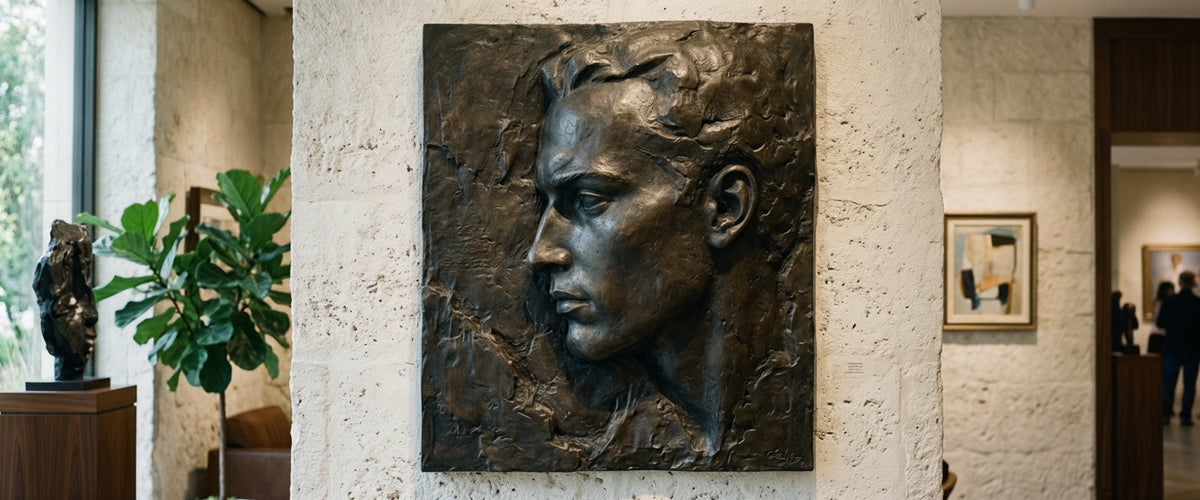

The best metal contemporary wall art rarely looks difficult, and that is exactly the problem. A clean sweep of brushed steel or a shadow-casting bronze relief reads as effortless on the wall, which hides the dozens of small decisions that made it work. Buyers see the finished plane. Sculptors see weld sequence, panel warp, mounting geometry, and the way a raking afternoon light will either flatter the surface or expose every flaw. This is what actually happens between a brief and a bolted-up piece, and why the same idea can succeed at one scale and fall apart at another.
We have shipped commissions to double-height entryways in California, gallery walls in NYC lofts, and covered loggias in Napa, and the pattern is consistent: the pieces that land are the ones where the craft questions got answered early. Here is how a studio thinks about a metal contemporary wall art commission.

Metal Contemporary Wall Art at a Glance
- Material drives everything: stainless steel, Corten, and bronze each behave differently in light, weight, and aging.
- Scale is not a slider: a design that reads well at 10 ft can look thin or busy at 30 ft, and it must be resolved before fabrication.
- Process protects you: maquette, then material sample, then fabrication, then a planned install. Skipping steps is where a commission goes wrong.
- Budget depends on inputs: material, size, complexity, engineering, finishing, and installation all move the number. Ask for a tailored quote rather than trusting a flat rate.
- Mounting is part of the art: how a piece sits off the wall changes shadow, and shadow is half the effect.

What Sculptors Actually Think About Before Taking on a Commission
Before anyone talks about design, a good studio interrogates the wall. Is it interior drywall over stud, exterior masonry, board-formed concrete, or a rendered facade in a coastal climate? That single answer shapes the whole metal contemporary wall art project. A heavy bronze relief on a stud wall needs blocking or a spreader plate; the same piece on concrete needs the right anchors and an installer who understands edge distance and pull-out loads.
Environment comes next. A piece of metal wall art contemporary enough for a Hamptons garden wall still faces salt air, UV, and freeze-thaw cycles that an indoor work never sees. That pushes the conversation toward stainless steel or Corten and away from finishes that will not hold. Corten in particular is chosen for its stable, self-protecting oxide layer; the American Institute of Steel Construction has published guidance on weathering steel and the drainage detailing it needs to age evenly rather than streak (aisc.org). If a studio does not ask where the piece is going in the first conversation, that is a signal.
Then there is intent. Where the brief calls for figure and negative space read from across a room, a piece like the Large Contemporary Emerging Male Profile Bronze Relief - 160cm at 160cm is built around a single strong silhouette rather than fine detail. A repeating abstract panel wants something else entirely: rhythm, edge crispness, and a mounting depth that keeps the shadow lines alive.

Craft Decisions That Change the Final Result (and the Price)
Most of the cost and most of the character in metal contemporary wall art live in choices the buyer never sees listed. Sheet gauge is the obvious one. Go too thin and a large panel oil-cans, meaning it ripples under its own tension and catches light in a way nobody wants. Go thicker and you buy flatness and presence, but weight climbs and so does the engineering behind the mount.
Finish is the next fork. Brushed stainless reads cool and architectural; a mirror polish throws reflections and demands a spotless install; a bead-blasted matte surface softens glare and hides fingerprints. On bronze, patina is a craft in itself. A hot patina laid by hand gives depth that a sprayed color cannot fake, and it ages gracefully if it is sealed and maintained. Where you want that hand-worked bronze character on a smaller wall footprint, a piece such as the Classical Figural Torso Wall Sconce Bronze Sculpture - 90cm at 90cm shows how patina depth carries a form that projects off the wall rather than sitting flat. The Smithsonian's conservation guidance on outdoor bronze is a useful primer on why wax maintenance matters for pieces that live outside (americanart.si.edu).
Weld strategy is the quiet cost driver in any metal contemporary wall art build. Every joint that has to disappear means grinding, blending, and re-finishing by hand. A design with dozens of clean intersections is far more labor than one with honest, expressed welds. Neither is wrong; they are different aesthetics with different price tags. This is exactly why we steer buyers toward a tailored quote. Material, scale, complexity, engineering, finishing, and install each move the figure, and a flat per-square-foot number usually hides a compromise somewhere.

Why Some Metal Contemporary Wall Art Reads Right at 10 ft and Wrong at 30
Scale is where enthusiasm meets physics. A composition tuned for a 10 ft viewing distance often relies on fine detail, tight linework, or subtle surface texture. Move the viewer back to 30 ft, in a lobby or across a courtyard, and that detail collapses into visual noise. The eye wants bolder masses, cleaner silhouettes, and stronger contrast at distance.
The reverse trap is just as real. Blow a simple abstract form up to fill a double-height wall and the areas that felt balanced at maquette size can turn into dead expanses. Proportion does not scale linearly with the wall. We resolve this by testing the design at true viewing distance, not on a screen, because a piece that photographs well at arm's length can disappoint the moment it is 20 ft up.
Weight and structure enter the same conversation. A larger bronze relief such as the Contemporary Horse Head Bronze Relief - 100cm at 100cm carries real mass, and the bigger the piece, the more the mount becomes a piece of engineering rather than a couple of screws. For heavier commissions we design a concealed cleat or standoff system that carries the load into structure while keeping the visible reveal clean.
Studio Process: Maquette, Sample, Fabrication, Install
A serious metal contemporary wall art commission follows an order for good reasons. Skip a stage and you pay for it later, usually in remakes.
- Maquette. A scaled model, physical or 3D, that fixes proportion, depth, and the read from distance. This is where changes are cheap.
- Material sample. A small panel in the actual metal and finish, so you can see the brushed direction, the patina depth, or the Corten's early tone under the light your wall actually gets.
- Fabrication. Cutting, forming, welding, and finishing, with structural elements engineered for the specific wall and mount.
- Install. Template first, then fixings, then hang. For large or outdoor work we plan access, rigging, and the mounting sequence before anything leaves the studio.
One lesson we learned the hard way: always sample the finish under the client's own lighting. A brushed panel signed off under studio fluorescents looked completely different under the warm downlights of a Texas great room, and we now build that check into every commission.
Honest Red Flags to Raise Before You Commit
Ask these before you sign anything, and watch how confidently they get answered.
- Who engineers the mount? If the answer is vague, the risk is yours. Ask what the fixing spec is for your specific wall type.
- Will I see a material sample, not just a render? Renders lie about reflection and patina. A real sample does not.
- How does this finish age outdoors? For exterior pieces, get a straight answer on patina, sealing, and maintenance intervals.
- Is the price fixed or does the finish drive it? A quote that ignores weld blending and finishing hours is a quote that will grow.
- Can you deliver and install internationally? Crating, freight, and on-site fitting for large metalwork is its own discipline. We ship worldwide and plan install as part of the commission rather than an afterthought.
- What happens if it warps? A studio confident in its gauge and welding will tell you exactly how flatness is controlled.
If you want to see the range of finishes and formats before briefing us on your metal contemporary wall art, the Metal Wall Art collection is the fastest way to calibrate your eye, and the Bronze Wall Art collection shows how relief depth and patina behave across figurative and abstract subjects. Whether you lean toward wall metal art contemporary in feel with brushed steel or a warmer patinated bronze, bring a photo of your wall, the viewing distance, and the light it gets. That is enough for us to start a proper conversation about a bespoke piece built to last.
For wider placement ideas, Contemporary Metal Wall Art: How to Place It so It Actually Lands is useful companion reading before finalising the setting and sightlines.