





































































































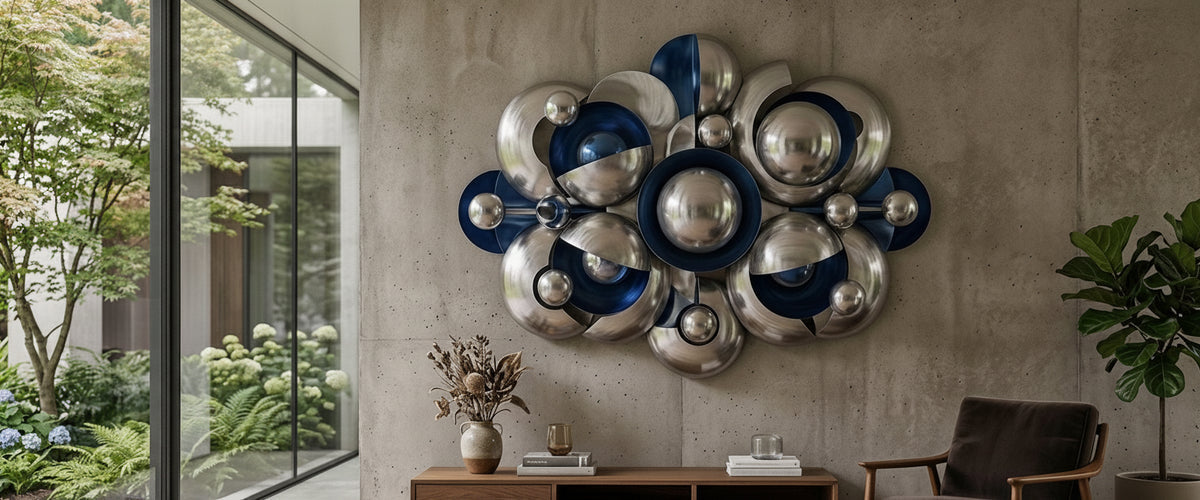

Most contemporary metal wall art does not fail in the workshop. It fails on the wall. We have shipped pieces that looked commanding in the studio, then landed in a client's home hung too high, lit from the wrong angle, or floating on a wall three sizes too big for it. The metalwork was never the problem. The placement was.
So before you fixate on finish and color, get the spatial decisions right. A well-chosen piece of contemporary metal wall art can anchor a double-height entryway or bring a flat stucco garden wall to life. The same piece, badly placed, reads like decoration someone forgot to finish. Below is how we think about it when advising buyers, designers and venue owners on their contemporary metal wall art commissions.

Key Takeaways
Scale is the first decision, not the last. Measure your wall and your viewing distance before you shortlist anything.
Sightline height beats "eye level." Where people actually stand or sit changes the ideal center height.
Indoor and outdoor pieces are engineered differently. Marine-grade fixings and finish matter outside.
Backdrop contrast decides impact more than the piece's own color does.
Bespoke sizing exists for a reason. Odd walls almost always need a made-to-measure answer.

What Contemporary Metal Wall Art Looks Like Room by Room
The phrase covers a wide range, so let us be concrete. In a modern California living room with clean plaster and a lot of glass, metal contemporary wall art tends to run abstract and sculptural: layered discs, textured half-moons, spheres that catch and throw light across the day. In a room already full of daylight, a reflective curved form such as the Eclat Sphere Blue Abstract Metal Wall Art does something different every hour, which is exactly what you want against all that glass.
Move into a Texas dining room or a paneled study and the calculus shifts. Warmer, matte, hammered surfaces sit better against wood and richer palettes. Where the room leans into timber and stone, a contemporary metal wall art piece like the Astrid Rustic Glow Metallic Abstract Wall Art holds its own without fighting the materials around it. In a loft with exposed brick, texture is your friend; a smooth mirror finish can disappear against a busy surface, while a dimensional mosaic piece such as the Arcana Metallic Earth Textured Mosaic Half-Moon 3D Wall Art earns its place by reading as relief rather than reflection.
Outdoors changes the brief again. On a pool wall or an entrance courtyard, the metal wall art contemporary buyers favor has to survive weather and still read from a distance. That usually means bolder forms, deeper relief, and finishes chosen for longevity rather than gallery subtlety.

Scale, Sightlines and Center Height
The single most common question we get about contemporary metal wall art is "how big should it be?" Start with the wall, not the piece. A useful rule: a single work should fill roughly two-thirds to three-quarters of the usable wall width above a piece of furniture, and leave breathing room on either side. On a large blank feature wall with no furniture beneath, you can go bigger; the wall is the frame.
Then think about viewing distance. Fine surface texture and delicate linework read beautifully at 4 to 6 feet (1.2 to 1.8 m) but vanish across a 30-foot (9 m) great room. If the primary sightline is long, choose bold geometry and strong relief over intricate detail. We once had a client fall for a finely textured piece for a stairwell that people only ever saw from two floors up. The detail was wasted. A simpler, larger form would have carried the space.
On center height, forget the flat "58 inches to center" gallery convention when the room does not support it. That number assumes people stand and view at a museum. In a lounge where everyone is seated, drop the center so the work reads for a seated eyeline. Above a console or sofa, aim for roughly 6 to 10 inches (15 to 25 cm) of gap between the furniture top and the base of the piece so the two feel related rather than stacked.
Multi-Panel and Cluster Layouts
Sphere and disc pieces often come as a family, and grouping them lets you tune the scale of your contemporary metal wall art to almost any wall. If you are working with a set like the Eclat Sphere Teal Blue Abstract Metal Wall Art alongside its companions, cut paper templates to full size and tape them up first. Live with the arrangement for a day. Cardboard is cheaper than re-drilling a plaster wall, and clusters that look balanced on a screen often need adjusting once they are physically in front of you.

Indoor Versus Outdoor: When Each Wins
Indoors, you have controlled light, stable temperature and no corrosion risk, so your contemporary metal wall art can carry almost any finish for its look alone. This is where delicate patinas, brushed steel and painted floral forms such as the Fleur Halo Navy Blue Round White Metal Floral Decorative Wall Art earn their keep. The environment protects them.
Outdoors is a different engineering problem. A sculpture that lives on an exterior wall needs corrosion-resistant material and fixings rated for the setting; near coastal salt air, stainless steel should be a marine grade and fixings should be A4/316 rather than standard hardware. The American Galvanizers Association is a good technical reference on how coatings and metals hold up in real weather exposure over decades. If a piece was designed as interior decor, do not assume it will survive a cold winter or a salt-heavy coastal summer just because it is metal.
Outdoor wins when you have a large blank masonry or render wall doing nothing, a courtyard that needs a focal point, or a pool surround that feels flat. Indoor wins when the piece relies on fine detail, subtle reflectivity or a finish you want to keep pristine for the long term.
Light, Backdrop and Contrast
Metal is a light-driven medium, and contemporary metal wall art rewards attention to it. The same sculpture can look flat under one lighting setup and alive under another. Raking light, hitting the surface at a low angle, exaggerates texture and relief; that is why hammered and mosaic pieces look best with a light source off to the side rather than dead straight on. Flat frontal light kills dimension.
Backdrop contrast matters more than most buyers expect. A dark bronze-toned piece disappears against a charcoal wall and jumps off a pale limewash. A polished or mirror finish needs a backdrop with something worth reflecting, otherwise it just mirrors an empty ceiling. Reflective work such as the Eclat Sphere Red Abstract Metal Wall Art comes alive when there is color, greenery or movement nearby for it to catch.
For interiors, aim to light the work with adjustable fittings so you can dial the angle. The Illuminating Engineering Society's guidance on accent lighting is a sensible starting point if you want the technical numbers behind beam angles and contrast ratios. A small adjustment in aim often does more for a piece than any change to the artwork itself.
Placement Mistakes We See in Commissions
For wider placement ideas, A Placement Guide for Large 3D Metal Wall Art Panels is useful companion reading before finalizing the setting and sightlines.
These are the contemporary metal wall art errors that come up again and again when clients send us photos of a finished install that is not working.
Hung too high. The most frequent error by far. When in doubt, lower it. Art that floats near the ceiling detaches from the room.
Undersized for the wall. A modest piece marooned on a vast wall looks tentative. Either go bigger or build a cluster.
Wrong finish for the light. Choosing a matte piece for a dim corner, or a mirror finish that reflects nothing but blank ceiling.
Ignoring the backdrop color. Buying for how it looks in the product photo, not against your actual wall.
Interior-grade metal used outside. This ends in rust streaks and disappointment within a season or two.
Fixings that cannot carry the weight. Large dimensional pieces need proper anchors into studs or masonry, not drywall plugs.
Commissioning a Bespoke Piece
When a wall is an awkward shape, sits at an unusual height, or lives in a demanding outdoor spot, a stock piece rarely fits perfectly. This is where a bespoke contemporary metal wall art commission pays off. At Giant Sculptures we size, finish and engineer contemporary metal wall art to the specific wall, viewing distance and environment, which means the piece is built around your sightlines rather than forcing your room to accommodate it.
A good commission conversation covers wall dimensions and construction, primary viewing distance, indoor or outdoor exposure, existing palette and materials nearby, and how you want the piece lit. Budget depends on material, scale, complexity, engineering, installation and finishing, so the honest answer on cost is to send us the specifics and request a tailored quote. If you want to see the range of contemporary metal wall art forms and finishes before you brief us, the Metal Wall Art collection is the place to start, and the broader wall art and wall decor catalog shows how metal sits alongside other media.
Get the scale, height, light and backdrop right, and even a restrained piece of wall metal art contemporary in spirit will carry a room. Get them wrong, and the finest contemporary metal wall art in the world just hangs there. The workshop is the easy part; the wall is where it counts.