






































































































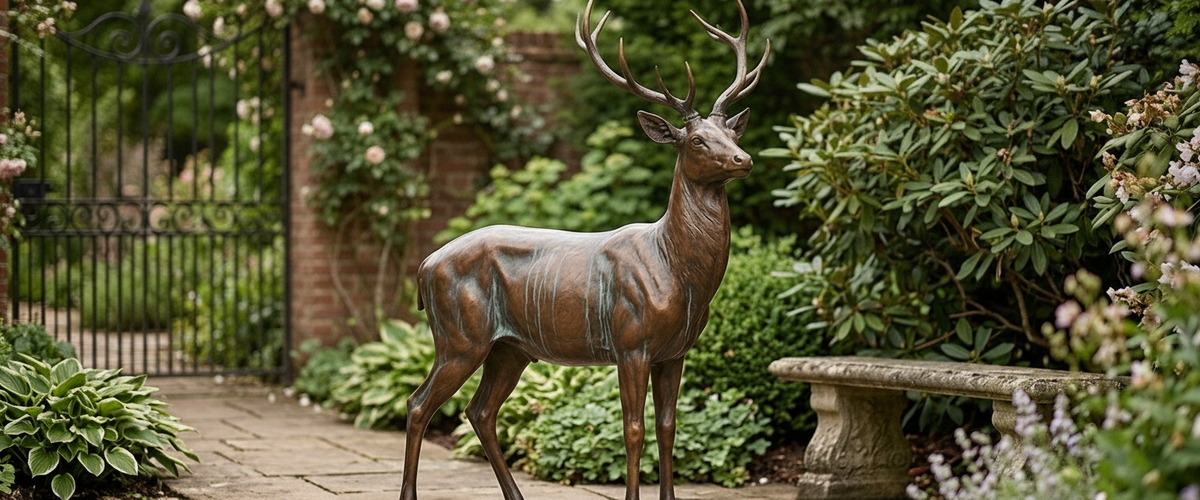

Put a bronze stag under a mature maple, and within a year it will map every drip line in the canopy. Most advice about a bronze deer garden statue assumes open lawn, full sun and a tidy twice-yearly wax. Real gardens are rarely like that. Deer belong at the edge of woodland, so that is where clients want them, and tree cover changes how bronze ages faster than almost anything else outdoors.
The pattern repeats from garden to garden, consistently enough to plan around. Here is what three winters in shade actually look like, and what to settle before the deer leaves the foundry.
Tree cover shapes how a stag weathers far more than open sky does.

At a Glance
Tree drip, more than rain, drives most early patina change on a shaded deer.
Bird lime and leaf tannin start green-gray streaking by the second winter.
Thin legs and antler joints are where weld seams first show through.
A hot patina sealed with hard wax holds color far better under a canopy than a cold patina.
A shaded deer needs waxing on a leaf-fall schedule, not a calendar one.
Winter One: Fresh Brown Turns Patchy Where the Drip Lands
A new hot-patinated bronze deer garden statue usually arrives a warm, even chestnut brown. Under trees, the first change shows up as spots rather than overall darkening. Water gathers on leaves and twigs, picks up dust and organic acids, then falls in the same places all season. On a standing deer, those places are the spine, the top of the rump and the haunches.
By spring you will often see lighter, slightly matte patches along the back while the belly and inner legs still look fresh. It looks alarming. Mostly it is the wax layer wearing through first where the drip hits, and a clean and rewax will even out most of it.
Winter Two: Bird Lime, Leaf Tannin and the First Green-Gray Streaks
Branches over a statue mean birds over a statue. Droppings are acidic and, left for weeks, etch through wax into the patina beneath, leaving pale rings that no amount of buffing hides. Fallen oak and walnut leaves add tannin; a wet leaf mat sitting on a deer's back for a month can leave a dark stain in the exact shape of the leaf.
The second winter is also when the first green-gray streaks run down the flanks. These are copper corrosion products carried by water along the easiest route, which on a deer runs from the spine, over the ribs and off the belly. Conservators, including the Canadian Conservation Institute, consistently favor gentle washing and protective wax over aggressive cleaning of outdoor bronze. Some owners like the streaks, which read like weathering on a real coat. Others want the even brown back. Decide which camp you are in before winter two, because removing established green runs means re-patination, and that is studio work.
By the second winter, water carries copper corrosion from the spine down over the ribs.

Winter Three: Thin Legs, Antler Joints and Where the Welds Show
Life-size bronze deer are cast in sections by the lost-wax method and welded together. On a horse or a bull those seams sit on broad surfaces and stay quiet. On a bronze deer garden statue, the joins are concentrated in the slenderest parts of the sculpture. Weld filler is a slightly different alloy from the cast metal, so it takes and loses patina at its own pace. By the third winter, faint lines can appear at the knees, the antler bases and where tines branch. They usually show first on the forelegs, which carry the most weight and catch the most splash from the ground.
Those lines are cosmetic. What deserves attention is the structure behind them. Check antler junctions every spring for hairline cracks, especially if storm limbs can fall on the piece, and confirm the base fixings are still tight. A pair doubles the question: in a composition such as the Life-Size Traditional Deer Pair Bronze Sculpture, eight narrow points carry two life-size animals, so ask how the legs are reinforced internally and how the plinth anchoring works before you sign off.
Hot Patina Versus Cold Patina Under a Dripping Canopy
A hot patina is built by heating the bronze with a torch and applying chemical solutions to the warm metal, so the color develops as a bonded layer. A cold patina goes on at room temperature, usually as a quicker decorative finish. On delivery day the two can look identical.
Under constant drip, the difference shows within a season. Cold patinas tend to wash thin on the back and haunches, exposing bright metal that then oxidizes unevenly. A properly layered hot patina, sealed with hard paste wax, holds its color for far longer. For any bronze deer garden statue going into shade, we recommend hot patina without hesitation, and we would steer you toward a mid to dark brown, which hides drip marks better than pale gold or a pre-applied verdigris.
If nobody in the household will realistically keep to a waxing rhythm under heavy oak or walnut, it is worth questioning bronze itself. Stainless steel has no patina to wear through, and a softly modeled form such as the Deer Organic Stainless Steel Outdoor Sculpture keeps the woodland-edge mood while asking for little more than a rinse.

Yew, Lawn or Silver Birch: Choosing a Backdrop for a Bronze Deer Garden Statue
Bronze darkens with age, and the backdrop decides whether that reads as depth or disappearance.
Yew hedge: dark, dense and matte. A deep brown stag can vanish against it by winter three. Choose a lighter golden-brown patina, or lift the deer on a pale stone plinth to separate it from the green.
Open lawn: the least drip and the clearest silhouette, with antlers reading sharply against the sky. The trade-off is stronger sun and wider temperature swings, which the standard twice-yearly wax handles well.
Silver birch: pale bark and light shade give a darkening deer more contrast each year, and birch drops lighter litter than oak. Aspen trunks behave much the same way, and a stag set among either tends to look better with every year it spends darkening in place.
Pose matters here too. A running deer relies on silhouette, so a leaping form like the Monumental Contemporary Running Deer Bronze Fountain wants a pale or open backdrop rather than a wall of yew, and, as a water feature, a spot clear of the heaviest leaf fall so the basin is not clogged by every autumn storm.
A Waxing Rhythm for a Deer in Shade
Standard guides say wax once or twice a year. That assumes sun dries the surface quickly after rain. A bronze deer garden statue in shade stays damp longer, so the wax works harder.
Late fall, after leaf drop: rinse with clean water and a soft brush, clear leaf mats, dry thoroughly and apply a thin coat of hard microcrystalline paste wax on a dry, mild day. Buff once it dries to a light haze.
Through winter: clear leaves and droppings every couple of weeks. Wet litter on the back does more damage than snow.
Late spring, after pollen and sap: wash with a pH-neutral soap, rinse well and rewax the back, haunches and antlers.
Midsummer: spot-wax the spine and rump only, where the drip wears hardest.
Skip abrasive pads, metal polish and pressure washers. If the patina has broken through to bright metal, call the maker.

Before You Commission: A Checklist for Shaded Gardens
Map the drip line. Bare or mossy patches on the ground show where water falls hardest; nudge the deer a few feet out of it.
Name the tree. Oak and walnut stain more than birch or aspen.
Pick patina for the backdrop, not the showroom photograph.
Ask about joins. How are the legs reinforced, and where do antler welds sit?
Raise the hooves. A plinth of a few inches (roughly 5 to 10 cm) keeps them out of leaf litter and splash.
Assign the waxing. Agree who does it, and when, before installation.
If you are comparing options, our bronze deer statues range covers single stags, pairs and larger figurative compositions, while the wider bronze garden statues collection helps when the deer is one part of a planted scheme. Giant Sculptures also takes bespoke commissions, adjusting pose, scale and patina to a specific site. Budget depends on material, scale, complexity, engineering, installation and finishing, so send us photographs of the spot where your bronze deer garden statue will stand, ideally including the tree above it, and request a tailored quote.
For wider placement ideas, Deer Statues for the Garden: Stag, Doe or a Small Herd? is useful companion reading before finalising the setting and sightlines.