





































































































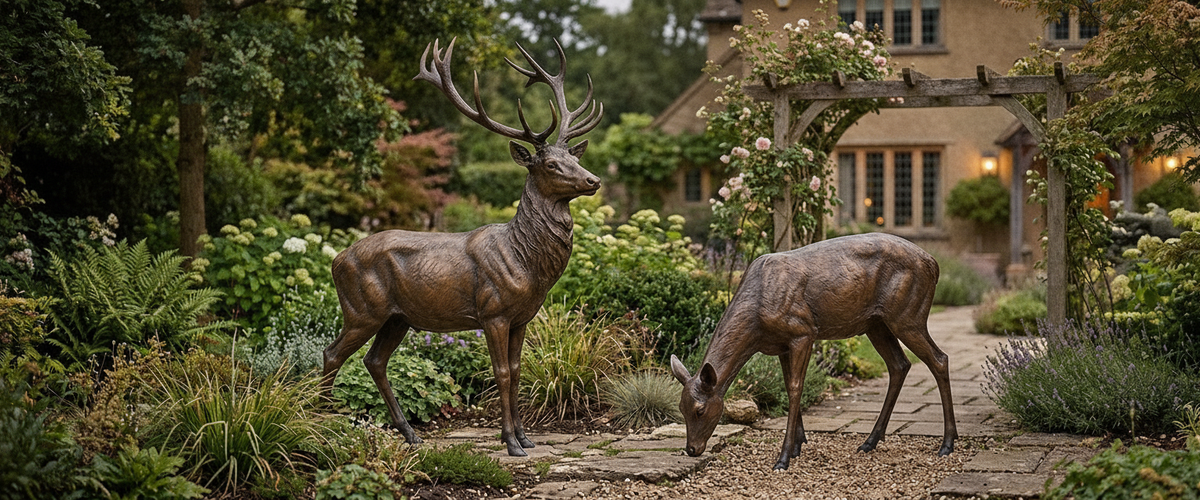

Most garden deer statues go wrong before they leave the crate. The buyer picks a pose from a photo, sets it on whatever patch of lawn looked empty, and the animal spends the next twenty years staring at a fence. A deer is a sightline sculpture. It needs a direction to face and a spot the house can actually see. Here is how we advise clients choosing deer statues for the garden, from a single stag to a bespoke herd.
Looking for the full range of garden deer statues? Browse our Deer Statues & Sculptures collection for every available finish, size, and configuration.

Quick Answer
One stag reads as a focal point. A doe with a fawn reads as a scene.
Grazing, head-down poses suit open lawn. Alert, head-up poses suit tree lines and woodland edges.
Offset a group and angle each animal differently so nothing looks staged.
Slender legs and antlers push you toward bronze or stainless steel, not stone.
Judge the scale of garden deer statues from your main window, not from the spot on the grass.
A Lone Stag Makes a Statement, a Doe With a Fawn Makes a Scene
A single stag carries antlers, posture and a certain arrogance. Put one at the end of an allée or on a rise and it behaves like a monument: the eye goes to it and stops. That is exactly what you want at a driveway turn or in a formal garden in the Hamptons.
A doe with a fawn works differently. The pairing implies a story (feeding, watching, about to move on), so the eye lingers instead of landing once. When choosing deer statues for a family garden or naturalistic planting, the scene usually outlasts the statement. A pair modeled as two animals that belong together is also very different from two separate figures placed side by side. The poses answer each other, and the pair reads as one moment rather than two purchases.
Head Down Suits Open Lawn, Head Up Belongs on a Woodland Edge
Pose is the decision most buyers of garden deer statues skip. A grazing deer, head lowered to the grass, sits into the ground plane and looks calm even from a distance. It belongs on open lawn.
Raise the head and the animal turns alert. An alert deer in the middle of a flat lawn looks lost. The same pose at the edge of a tree line, half in shade, looks like it just heard the back door open. On a Napa property with vines running to an oak boundary, we would set a grazing doe in the open and an alert stag near the oaks. The contrast quietly marks where the wilder part of the garden begins.
Head-up at the tree line, head-down in the open.

Placing Two or Three Deer Without the Garden-Center Look
With garden deer statues, the garden-center look comes from identical spacing, identical facing, and everything lined up parallel to the house. Break those habits. Set life-size animals at uneven distances, roughly 10 to 15 feet (3 to 4.5 m) apart, with one noticeably closer to the viewer. Turn them so their gazes cross or diverge. Two deer staring at the same point look posed, while one glancing back over the group looks alive.
Let planting overlap a hoof or a flank. A few inches of meadow grass hides the base plate and does more for realism than any patina choice.
Uneven spacing and a little long grass do most of the work.
Thin Legs and Tall Antlers Decide the Material
Garden deer statues are awkward subjects for outdoor materials. The legs are thin, the weight sits high in the chest, and a stag's antlers reach out with nothing underneath them. That anatomy rules out more options than budget does.
Carved stone can manage a resting deer with folded legs. A standing stone deer, though, needs thickened legs or a support mass under the belly, and at that point it stops looking like a deer. Bronze handles the form well. Cast in sections and welded, it holds slender limbs without bracing, and a waxed patina ages gracefully with sensible care. The American Institute for Conservation is a useful reference on how outdoor bronze is looked after over decades.
For garden deer statues in contemporary settings, stainless steel suits faceted designs, where the animal is built from planes rather than modeled muscle. Where the setting calls for a crisp, modern outline rather than a patinated wildlife study, a faceted piece such as the Deer Geometric Steel Outdoor Sculpture is closer to the right design language. Near the coast, ask about grade: 316 stainless resists salt air far better than 304, as the International Molybdenum Association explains.
In the studio, antlers take the longest to fit. On one stag we reworked the brow tines after the client's landscape architect pointed out that a low limb would brush them every spring. Measure your overhangs before you order a garden deer statue with a full rack.

Size Garden Deer Statues to the View From the Kitchen Window
This is the mistake we see most. A buyer walks the lawn, picks a spot and pictures a life-size deer there. Then they go inside, and from a window 80 feet (about 24 m) away the animal looks like a lawn ornament. Distance shrinks everything.
Decide where your deer statues in the garden will be seen most often, whether that is the breakfast table, the terrace or the drive, and judge scale from that point. A figure around 170cm (roughly 5 ft 7 in) overall reads well across a medium lawn. On a long view it may need a companion or a slightly heroic scale to hold its ground. At that distance, a pair modeled together, such as the Life-Size Traditional Deer Pair Bronze Sculpture (Doe Companion) - 170cm, holds the view better than a lone figure of the same height, because the eye reads the group's combined footprint rather than one silhouette. A client in the Texas Hill Country sent us phone photos from every main window before we finalized a pair, and the kitchen view changed the spacing entirely. Stake poles or cardboard silhouettes at the right height and look from indoors before committing.
Scaling a Bespoke Herd to One Site
For wider placement ideas, Why Bronze Garden Statues Vanish by July, and How to Place Them Right is useful companion reading before finalizing the setting and sightlines.
A bespoke herd of garden deer statues lets you design to the site rather than adapt stock pieces to it. We start with sightlines: the main windows, the approach, the paths guests actually walk. Then each animal gets a job. The stag stands where the drive first opens up. The doe grazes nearer the house. A yearling or fawn fills the gap so the eye travels across the lawn instead of jumping.
Water can join the group. Where one end of the herd meets a pool or rill, a fountain figure such as the Monumental Contemporary Running Deer Bronze Fountain (Companion Piece) - 170cm brings motion and sound to that end and anchors the rest of the group to the water. For hotels and estates we also check how the group reads under uplighting at night, since antler shadows on a wall can be half the effect. Commission budgets for bespoke garden deer statues depend on material, scale, the number of animals, foundation engineering, installation and finish, so Giant Sculptures quotes each herd individually.

Buyer Checklist Before You Order
Decide whether your garden deer statues should make a statement (one stag) or a scene (doe and fawn, or a group).
Match pose to ground: grazing on open lawn, alert at tree lines.
Photograph the site from every main window and the approach path.
Check overhanging branches and mower routes around legs and antlers.
Choose bronze for traditional anatomy and stainless steel for contemporary forms, with 316 grade near salt water.
Plan a concrete footing and fixings for any life-size metal figure.
Ask for a scale drawing or mock-up before a bespoke piece is cast.
Our bronze deer statues cover the traditional poses. If the garden calls for other company, the wider bronze animal sculptures collection is the place to look. If nothing fits your sightlines, send us photos and a rough site plan and we will scale a herd of deer statues to your garden and your ground.