





































































































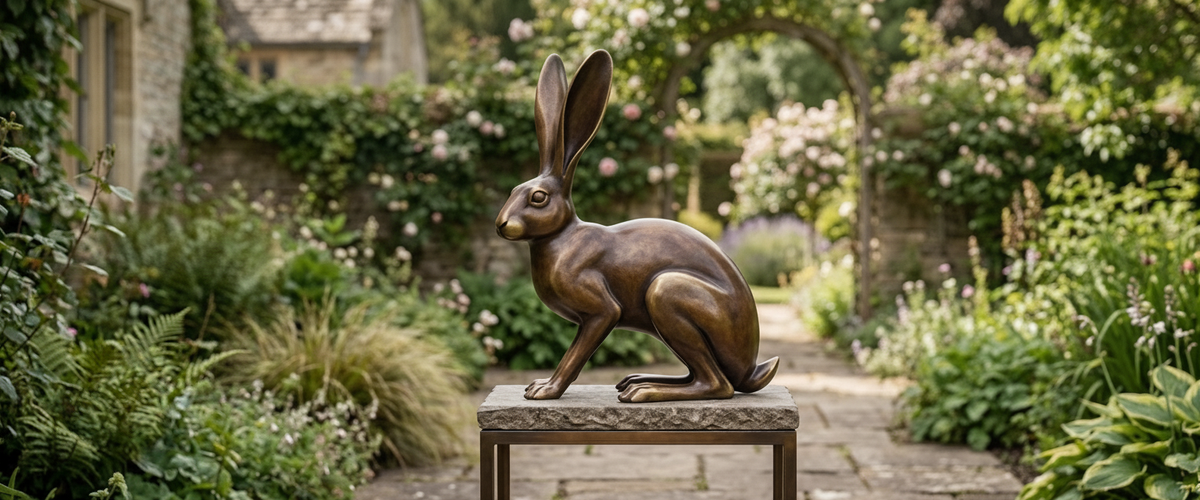

A surprising number of small bronzes end up on a conservator's bench for the same reason. Someone noticed a dull patch, reached into the kitchen cupboard, and turned a cosmetic job into a structural one. If you own a small bronze sculpture (a tabletop hare, a desk figure, a garden piece under about two feet or 60 cm), the restoration bill depends far less on size than on what has gone wrong and what has already been tried. Here is how restoring a small bronze sculpture is priced, and where a modest budget tends to break.

At a Glance
Clean and wax: the lightest tier, for dull or grimy surfaces with an intact patina.
Local repair: loose bases, bent tips and small dents, usually cheaper than owners fear.
Full repatina: stripping and recoloring the whole surface, the most labor-intensive option.
Bronze disease and failed DIY patinas are the two things that most often inflate a quote.
A clean and wax or a simple mechanical fix can often keep small bronze sculpture restoration cost to a few hundred dollars.
For damaged modern decorative casts, recasting can make more sense than restoration.
Wax, Polish or Full Repatina: The Three Price Tiers of Small Bronze Restoration
Conservators tend to price small bronze work in three broad tiers. Knowing which tier your piece belongs in is the fastest way to set realistic expectations. The first is a clean and wax: degreasing, lifting grime with soft brushes and mild solvents, then buffing in a microcrystalline or paste wax. The patina stays where it is. The surface simply wakes up, and this is the tier where small bronze sculpture restoration cost most often stays at a few hundred dollars.
Light work like this is where small bronze sculpture restoration cost can stay at a few hundred dollars.
The second tier is selective polishing and touch-up. Highlights on a nose, a paw or a raised edge are brought back, and small patches of lost color are toned to match. This takes judgment, because an over-polished highlight on a small piece is obvious from across the room.
Full repatina sits at the top. The old surface is stripped, the metal is heated, and chemical patinas are built up layer by layer with a torch and brush. On a small piece the hours rarely shrink in proportion to the size. A 6-inch (15 cm) figure still needs the same chemistry, test patches and curing time as something three times larger.

Bronze Disease Is the Pale Green Powder That Blows a Modest Budget
The one condition every owner should recognize is bronze disease: a pale, powdery, almost fluffy green that appears in spots and returns after you wipe it away. It is caused by chlorides in the metal reacting with moisture and oxygen, and it does not stay on the surface. Left alone, it pits the metal underneath. The National Park Service Museum Handbook puts humidity control at the center of metals care for exactly this reason. Even, stable verdigris that has built up over years is a different matter and is usually harmless.
Active bronze disease looks powdery and soft, unlike hard, even verdigris.
Treatment means removing the active corrosion by hand, stabilizing the metal, then rebuilding the finish over the affected area. That last step is where modest budgets fail, because blending one spot of new patina invisibly into old is harder than recoloring the entire piece. The most vulnerable small bronze sculpture is usually one kept beside a pool, on a coastal terrace in the Hamptons or near a salted winter path.
Loose Bases and Bent Fingers Are the Cheap Fixes Small Bronzes Need Most
Better news: the most common problems on small bronzes are mechanical, and mechanical problems are usually the affordable ones. Bases work loose when the threaded rod or epoxy fixing fails. Fingers, ears, tails and fountain spouts get knocked in transit or by a vacuum cleaner, and thin bronze elements often bend rather than snap.
A conservator can often ease a thin element back into line, re-tap a thread or reset a base without touching the patina at all. Animal pieces are especially prone to this. On a hare it is the ears that take the knocks; on a pocket-size fountain such as the Small Traditional Tortoise Bronze Fountain, 10cm, it is the projecting head and spout, which is why those are the first places to check after a move. If the patina survives the repair, the job stays small.

Why a DIY Repatina Can Double the Conservator's Bill
The most expensive mistake we hear about is the home repatina. Online tutorials make liver of sulfur and ferric nitrate look easy. On a real sculpture, uneven heat produces blotches, residue keeps reacting for weeks, and household abrasives leave scratches that must be worked out before any new finish can go on.
Consider a typical case: a 12-inch (30 cm) bronze hare scrubbed with a vinegar-and-salt paste to brighten it. The salt leaves fresh chlorides in every crevice, and within a season a piece that only ever needed wax can show early bronze disease. The conservator then has to strip the failed finish, neutralize the chlorides and repatinate from bare metal, roughly twice the work of the original problem. Our rule is blunt. Dust with a soft brush, wax once or twice a year, and leave the chemistry to someone with a torch and a fume hood.
What Pushes a Small Bronze Sculpture Quote Past a Few Hundred Dollars
Whether small bronze sculpture restoration cost stays within a few hundred dollars comes down to four factors, and size is the least important of them.
Type of damage: active corrosion, cracks and missing parts need investigation, not just cleaning.
Finish: multi-tone, gilded or silvered patinas take far longer to match than a single warm brown.
Provenance: a signed foundry cast or antique calls for documented, reversible treatment and slower work.
Construction: hollow casts with internal armatures or fountain plumbing add disassembly time.
Provenance cuts both ways. A documented piece justifies conservation-grade work, but the wrong repair can dent its value more than the original fault did. For anything signed or antique, ask for a condition report and written treatment proposal before work starts, and look for a conservator accredited through a body such as the Institute of Conservation or its US counterparts.

When Recasting a Small Bronze Sculpture Beats Restoring the Original
Sometimes the honest answer is to recast. If a modern decorative bronze has a structural crack, heavy pitting or a missing limb, and its value is sentimental rather than historic, a new cast from a mold (or a bespoke recreation from photographs) can cost less than rebuilding the original and will outlast it outdoors.
This is where commission work earns its place. Our studio regularly recreates pieces clients have lost, sometimes at a larger scale for a Napa or Aspen garden where the original always looked undersized. If the lost piece was a figurative group rather than a single animal, ask the foundry to match the standard of fur, faces and small limbs you would expect from a classical composition such as the Classical She-Wolf Nursing Two Infants Bronze Sculpture, 85cm. Properly handled lost-wax casting holds that level of detail, and a recreation should not settle for less. Recasting does not suit antiques or signed editions, where the original object is the value. For everything else, it deserves a line on the quote.
Before You Ask for a Quote: A Quick Checklist
Photograph the piece in daylight from every side, plus close-ups of the damage.
List any cleaning products or treatments already used. Be honest; it changes the approach.
Record height and base size in inches or centimeters, and estimate the weight.
Gather provenance: signatures, foundry marks, receipts, earlier condition reports.
Decide between conservation (keep the history) and restoration (make it look new).
Ask for recasting or a bespoke replacement to be priced alongside the repair.
If you are weighing restoration against a new piece, our bronze sculptures and bronze animal sculptures are a useful place to compare scale and finish, and Giant Sculptures can then prepare a tailored quote. Budget for new or recreated work depends on material, scale, complexity, engineering, installation and finishing, and we would rather talk it through with you than guess.
For wider placement ideas, Choosing a Large Bronze Fountain Statue That Sounds Right is useful companion reading before finalizing the setting and sightlines.