



























































































Weather is rarely what ruins a marble statue. More often the damage comes from a pressure washer, a hardware-store sealant or a well-meant patch of bright white filler. Good marble statue restoration starts with deciding what the stone actually needs, and the answer is very often less than the owner expects.
We see both ends of this at Giant Sculptures. We ship carved marble to gardens and courtyards across the US, and years later we take the calls about a hairline crack, a gray bloom or a missing hand. The advice below is what we give those owners.

Quick Answer
Clean gently and repair rarely. A soft brush, clean water and patience solve most surface problems.
Stable damage can wait. Spreading damage cannot. Sugaring and growing cracks need a conservator soon.
Rusting iron pins are the hidden threat in older statues. A professional should replace them with stainless steel dowels.
An honest, visible repair beats a bright white patch every time.
Where the statue goes after repair matters as much as the repair itself.
Cleaning, Conservation and Restoration Are Three Different Jobs
Cleaning removes dirt, algae and bird lime and leaves the stone itself unchanged. Conservation stabilizes what is already there: it consolidates crumbling surfaces, secures loose pieces and slows decay. Restoration goes further and replaces what has been lost, such as a carved nose or a broken wing tip. Each step intervenes a little more in the original object, so good conservators move up that ladder reluctantly.
If you are restoring marble statues, that order is the most useful rule to remember. Begin with the least invasive option and stop once the statue is stable and reads clearly. The National Park Service Preservation Briefs apply the same principle to historic masonry: use the gentlest effective method first.
Sugaring, Frost Cracks and Lost Fingers: Which Damage Is Stable and Which Is Spreading
Sugaring is the granular, sandy surface you can rub away with a thumb. Acid rain, pollution and repeated heating and cooling weaken the boundaries between the calcite crystals, and the surface loosens grain by grain. This is active decay, and scrubbing makes it worse.
Measure and photograph a crack each spring to see whether it is growing.
Frost cracks follow water. Moisture gets into a fissure, freezes, expands and pushes the gap wider every winter. Owners searching for marble statue restoration in Michigan usually face exactly this problem, often on north-facing figures near a lake. Compare the crack with last spring's photo. If it has grown, it is spreading. If it has not moved in a decade, it is probably stable.
Houston has a different set of problems. Requests for marble statue restoration in Houston tend to involve black biological growth, salty coastal humidity and storm damage from figures that toppled. Heat matters less there than owners expect. Standing water and organic growth do far more damage.
Lost fingers, chipped drapery and missing toes look alarming, yet they are often the most stable damage on the piece. A clean old break with weathered edges has stopped changing. It needs no urgent work, only a decision about whether to replace the lost part at all.

Old Iron Pins That Rust and Split Stone
Look closely at many older garden statues and you will see a rust-brown stain bleeding from a joint at the wrist, ankle or neck. Behind it there is usually an iron pin. Nineteenth- and early twentieth-century carvers used iron to join limbs and to fix figures to plinths. As iron corrodes it expands well beyond its original volume, and it splits the marble from the inside.
A rust-brown bleed at a joint usually means an iron pin is expanding inside the stone.
For this reason, serious marble statue restoration replaces iron with stainless steel dowels set in compatible, ideally reversible, adhesives or mortars. Taking out an old pin is delicate surgery, because the stone around it is already weakened. Drilling a corroded pin out of a slender ankle is not a weekend job.
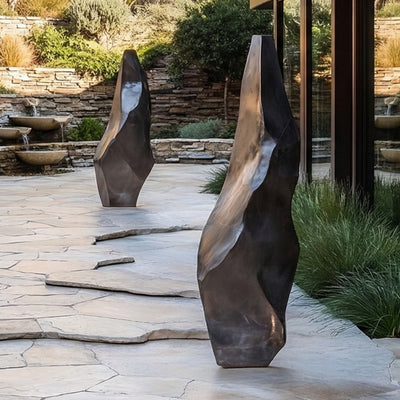
When we fix tall marble to a base for outdoor use, we specify stainless steel throughout, and the narrower the point of contact, the more that choice matters. A slender vertical carving such as the Abstract Flame Marble Sculpture - 55cm / 120cm, which stands up to about 4 feet (120 cm), carries its whole weight through a small footprint, and a rusting pin there would split the stone exactly as it splits an old figure's ankle.
Why a Too-White Repair Does More Harm Than an Honest Visible One
A century outdoors gives marble a soft, warm gray skin. If you patch it with bright white filler or a freshly carved fragment, the eye goes straight to the repair. Mismatched fillers are also often harder or less porous than the original stone. Water then collects at the joint, and decay speeds up around the patch.
In skilled marble statue restoration, conservators tone their repairs so they sit quietly at viewing distance and remain identifiable up close. The Getty Conservation Institute and most professional bodies share this ethic: a repair should be compatible with the stone, reversible where possible, and honest. Owners sometimes ask us how to make a weathered figure look new, and we usually talk them out of it. A figure that looks like a well-kept old statue keeps the character that gave it value in the first place.

Marble Statue Restoration at Home: Where Owner Care Stops
Owners can do more than they think, though less than they hope.
Safe for Owners
Rinse with clean, low-pressure water and a soft natural-bristle brush.
Use a pH-neutral, non-ionic stone cleaner, and use it sparingly.
Clear leaf litter and point sprinklers away from the statue.
Photograph the statue from the same angles every spring so you can track cracks and stains.
Call a Conservator
Any sugaring or powdery surface.
Cracks that have grown, or rust staining at a joint.
A figure that rocks, leans or has shifted on its base.
Missing pieces you want replaced.
Anything with historic or sentimental significance.
Never use bleach, vinegar, acidic cleaners, wire brushes or a pressure washer. Marble is calcium carbonate, and acid dissolves it. The same rule applies to polished marble pedestals indoors: spilled wine or citrus can etch a polished black marble base within minutes. When you hire professional marble statue restoration, ask for photographs of completed outdoor work and a written treatment proposal before anything starts, along with a record of every material used. If a specialist will not explain what is going into your statue, look for a different one.
After the Repair: Back Into the Garden, Under Cover or Indoors
Once you have finished restoring an outdoor marble statue, you have to decide whether it goes back outside. For a sturdy figure in a mild climate, the answer is usually yes. Set it on a well-drained plinth raised above splash height, away from trees that drip sap. In freeze-thaw regions, use a breathable winter cover. Plastic wrapped tight traps moisture and does more harm than good.
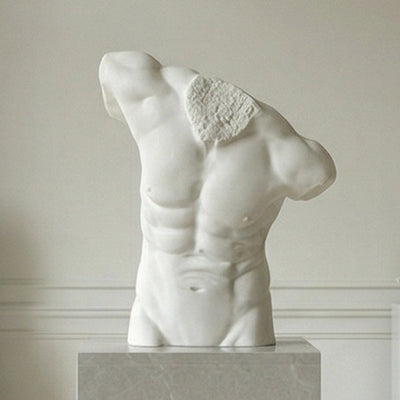
Fragile or significant pieces may be better under a loggia or indoors, with a new piece taking their place in the garden. When the original is a devotional figure, a newly carved replacement such as the Lourdes Virgin Mary Angel Marble Outdoor Sculpture - 100cm/170cm, offered in sizes from 100 cm to 170 cm, lets the garden keep its focal point while the older statue moves somewhere sheltered. Heads and torsos often move permanently into the house, and our marble busts and torsos show how well that scale works in an entrance hall or library.
Some old statues are beyond saving, and some are too precious to risk outside. In those cases, Giant Sculptures can commission a new carved piece sized and specified for the site, with the drainage, fixings and base designed for decades outdoors. Our marble sculptures and statues collection is a good place to start, and the wider outdoor sculptures and statues range covers pieces specified for year-round exposure. Budget depends on material, scale, carving complexity, engineering, installation and finishing, so we quote every commission individually.
For wider placement ideas, Cleaning Outdoor Marble Statues Without Ruining the Stone is useful companion reading before finalising the setting and sightlines.