






































































































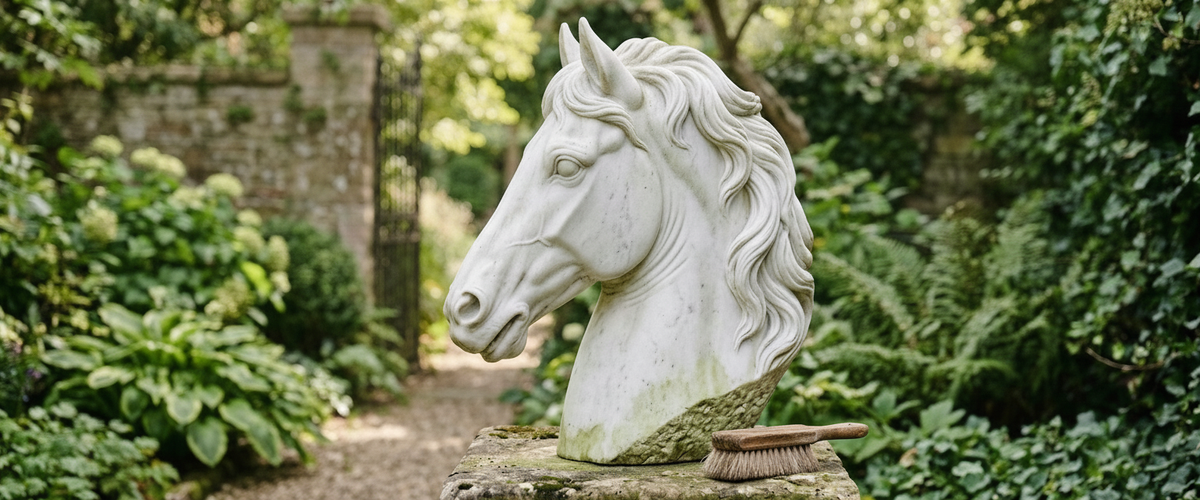

Plenty of marble statues suffer more from cleaning than from weather. Rain and frost take decades to soften a carved surface. An acidic spray or a pressure washer can do visible harm in an afternoon. Cleaning outdoor marble statues comes down to restraint. You need to know what the stain is, what marble is made of, and when to stop. This is the advice we give clients once a piece leaves our studio and settles into a garden in Napa, a courtyard in Austin, or a terrace in the Hamptons.
Looking for the full range in this category? Browse our Marble Headstones collection for every available finish, size, and configuration.

Quick Answer
Cleaning outdoor marble statues starts with identifying the growth or stain. Green algae, crusty lichen and black urban crust each call for a different approach.
Use clean water, a soft natural-bristle brush and, if needed, a pH-neutral stone soap.
Never use vinegar, lemon, bleach, limescale removers or a pressure washer on marble.
Clean on a mild, overcast day, never in direct sun or frost.
Antique or previously repaired marble belongs with a stone conservator.
Lichen, Algae or Black Crust? Each Stain Needs a Different Answer
Most mistakes in cleaning outdoor marble statues start with misreading what is on the stone. Green or slimy film is usually algae. It sits on the surface, loves shade and irrigation spray, and comes away with water and a soft brush. Lichen is tougher. Those gray, orange or pale green rosettes anchor themselves with fine threads that work into the grain of the stone, and scraping them off pulls marble away with them. Black crust is a third problem altogether. It forms where pollution and rain meet on sheltered areas, such as under a chin or inside the folds of drapery, and it is chemically bonded to the stone.
When you are cleaning outdoor marble statues yourself, algae can be handled at home, and lichen often can with patience. Thick black crust is conservator territory.
Algae, lichen and black crust can all appear on one figure, and each needs its own approach.
Why the Marble Statue Cleaner on the Hardware Shelf Is Usually the Wrong Bottle
Most products sold as a patio or masonry marble statue cleaner are made for concrete, brick or granite, which makes them a poor choice for cleaning outdoor marble statues. Many are acidic so they can cut mortar haze or rust. Marble is mostly calcite, which is calcium carbonate, and acid dissolves calcite on contact. The label may say "stone safe," but stone covers a lot of minerals that react very differently.
Look for a cleaner described as pH-neutral and formulated specifically for marble or limestone. If the label does not state a pH, put it back. A few drops of neutral, unscented soap in a bucket of water is a perfectly good marble statue cleaning solution, and it is the one we use on finished pieces before they ship.

Acids, Bleach and Pressure Washers: What Each One Does to Calcite
Acids such as vinegar, citrus or descaler etch the surface, and they are the most common shortcut people regret when cleaning outdoor marble statues. On polished stone you see dull, matte patches. On honed white marble the damage shows up later as roughness that holds dirt and greens over faster than before.
Bleach lightens algae quickly, but it leaves salt residues that can travel into the pores and crystallize as the stone dries, slowly flaking the surface. It can also discolor white marble.
Pressure washers cut grooves into soft calcite and drive water deep into fissures and joints. We have seen fine carving on the hands and hair of a white marble figure visibly soften after a single pass from a landscaper's power washer, and that kind of loss can only be refinished, not reversed. Historic England's technical advice on masonry makes the same point: aggressive cleaning removes stone along with dirt.
Water, a Soft Brush and Patience: Our Routine for Cleaning Outdoor Marble Statues
This is the routine that ships with our marble pieces. It works whether you are cleaning marble garden statues on a lawn or a sheltered bust on a loggia.
A soft brush, pH-neutral soap and a gentle shower setting do most of the work.
Pick a mild, dry, overcast day. Avoid frost and avoid full sun, which dries soap into streaks.
Rinse from the top down with a hose on a gentle shower setting, never a jet.
Wash with pH-neutral soap and a soft natural-bristle brush, working in small circles.
Use a soft toothbrush or wooden skewer wrapped in cotton for carved recesses.
Rinse thoroughly so no soap residue remains.
Let the piece dry naturally, then look again in raking light the next morning.
Polished black marble shows every water spot, so when cleaning outdoor marble statues in that finish we suggest a final wipe with a clean, damp microfiber cloth. On anything taller than you can comfortably reach, use a stable platform rather than leaning a ladder against the stone.
Antique Marble Is a Separate Job
Cleaning antique marble statues brings risks a new carving does not have. Old marble often suffers from sugaring, where the surface has weathered into loose, granular crystals that brush away like sand. Earlier repairs may use iron pins, plaster or old adhesives that react badly to water and soap. Some surfaces hold traces of original finishes that matter to the object's history and value.
If grains come off on your fingertip, or you can see joins, filler or rust bleeding through, stop. The usual home routine for cleaning outdoor marble statues is not built for fragile stone. Find a conservator who specializes in stone. In the US, the General Services Administration's historic preservation resources are a sensible starting point for professional standards.
Biocides and Timing: A Damp UK Spring Versus a Hot US Summer
Where lichen keeps coming back, a stone-safe quaternary ammonium biocide can help with cleaning outdoor marble statues. Test it on a hidden area, apply it, then leave it. Biocides work over weeks as the growth dies and weathers off, and scrubbing too early defeats the purpose.
Timing matters as much as technique when cleaning outdoor marble statues, and it changes with climate. In a damp UK spring or a Pacific Northwest garden, growth returns fast, so a gentle wash twice a year is realistic. In a hot Texas or Arizona summer, algae is rarer, but hard sprinkler water leaves mineral spotting. Redirect irrigation away from the stone before you reach for any cleaner. Moving a single sprinkler head is often enough to cut a twice-yearly wash down to once a year.

Buying With Long-Term Care in Mind
The easiest way to reduce the work of cleaning outdoor marble statues is to plan for it before you commission. Honed white marble forgives light weathering and develops a soft patina, so for an open terrace that sees rain and the occasional stray sprinkler, a honed carving such as the Graceful Horse Head White Marble Outdoor Sculpture will age more gracefully than a polished surface. Polished black marble looks crisp but shows spotting more readily, which is why a piece like the Black Marble Veiled Figure Bust is happiest on a covered loggia or sheltered plinth rather than out on an irrigated lawn. Placement counts as much as stone choice. A plinth that lifts the base clear of wet soil and a spot away from dripping trees will save you hours of cleaning.
Finish: honed hides weathering, polished highlights it.
Exposure: shade and irrigation spray mean more algae.
Detail: deep undercuts trap dirt and need more brushwork.
Access: taller pieces need safe reach for cleaning.
Scale changes the routine for cleaning outdoor marble statues as well. A large piece such as the Majestic Horse Black Marble Outdoor Sculpture, at roughly 7 feet (220cm), needs level ground for a cleaning platform and enough clearance to walk all the way around it, so it is worth planning that space before installation rather than after.
When we quote a bespoke commission, we talk through finish, plinth height and site conditions so that cleaning outdoor marble statues stays a light, manageable job. You can explore finished options across our garden statues and wider outdoor sculptures collections, or ask Giant Sculptures to suggest a stone suited to your climate.
For wider placement ideas, Large Stone Garden Sculptures Weigh More Than You Think is useful companion reading before finalizing the setting and sightlines.