





































































































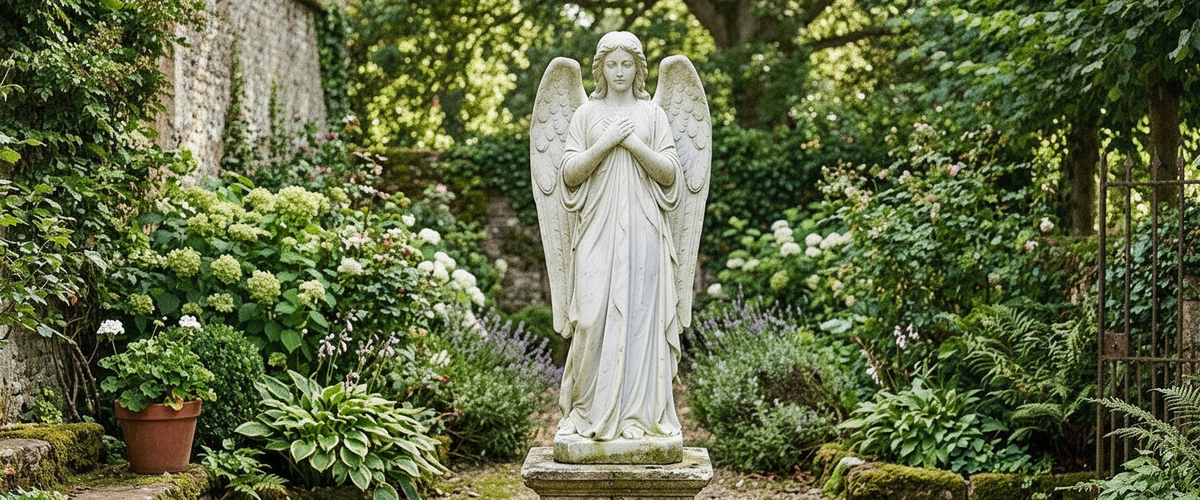

A pressure washer can undo a century of surface in a single pass. We have seen it happen: a client in Napa hired a general yard crew to "freshen up" a white marble angel before a family event, and they went at it on full pressure. The carving survived. The skin of the stone did not, and it now reads chalky and blank in flat light. That is the uncomfortable truth about how to clean marble sculpture. The weather is rarely the enemy. Enthusiastic cleaning is.
Marble is calcium carbonate, which means it is soft, slightly porous, and chemically vulnerable to anything acidic. Handled properly, a quarried marble figure will outlive everyone reading this. Handled badly, it dulls, etches, and stains in a single afternoon. The good news is that the right way to clean marble sculpture is cheap, slow, and boring.

At a Glance: The Safe Way to Clean Marble Sculpture
Identify the material first. How you clean marble sculpture depends on whether you own quarried stone or a marble dust cast composite.
Start with distilled water and a soft natural-bristle brush. Nothing else, on most pieces.
Never use acids or strong alkalis. Vinegar, lemon, descaler, and most bathroom sprays etch polished marble permanently; bleach and ammonia sprays stain and dull it.
Stains come out with a poultice, which draws the discoloration upward. Scrubbing pushes it deeper.
Treat biological growth once a year, ideally in late winter before spring growth accelerates.
Stop immediately if you see sugaring, flaking, or loose joints, and call a stone conservator.
Distilled water, a soft brush, and a lint-free cloth: the whole kit.
Quarried Stone or Marble Dust Cast? Get This Wrong and You Scrub Off the Surface
Before any water touches the piece, work out what you actually own. Solid quarried marble is cool to the touch, shows visible crystalline sparkle in raking light, and carries veining that runs through the form rather than sitting on it. Marble dust cast pieces (crushed stone bound in resin) often have a thinner, more uniform surface and can show a mold seam if you look closely at the back of a limb or the underside of drapery.
The distinction matters because cast composites have a finished outer layer measured in fractions of a millimeter. Abrasive pads will cut through it and expose dull filler beneath, and the damage cannot be polished back. Quarried stone, by contrast, is the same material all the way down, so light surface loss is recoverable by a professional. Every marble piece across our marble sculptures and statues range is documented by material at the point of sale, and if you have inherited something unlabeled, photograph it and ask before you experiment.

Distilled Water and a Soft Brush Beat Every Branded Stone Product We Have Tested
The kit we use to clean marble sculpture is almost comically plain: distilled water, a soft natural-bristle brush, clean lint-free cloths, and patience. Tap water is the first thing people get wrong. Hard water leaves calcium and iron deposits that bloom as gray or rust-colored haze on white stone, which is exactly what you were trying to remove.
Work top to bottom so dirty runoff never crosses clean stone. Wet a small area, agitate gently with the brush, blot with a cloth, then rinse with fresh distilled water. If a piece is genuinely grimy, a drop of pH-neutral conservation-grade soap in distilled water is acceptable, followed by two clean-water rinses to remove every trace of surfactant. The Victoria and Albert Museum's guidance on caring for sculpture takes the same minimal-intervention line: less is almost always more.
Indoor pieces need even less. A small polished figure on a hallway console mostly needs dusting with a dry soft brush, not washing. Skip feather dusters, which just move grit across the surface and can scratch a polished finish. For collections of marble busts and torsos, a monthly dry dust and an annual damp clean is a sensible rhythm.
Acids Etch Polished Carrara in Minutes
People ask us how to clean a Carrara marble sculpture more than any other stone, usually because Carrara shows everything. Its fine white ground makes even a light etch read as a dull gray patch. Etching is not dirt sitting on the stone; it is chemical erosion of the calcite crystals, and no amount of buffing at home returns the original polish. Only re-polishing by a specialist gets close, and on carved detail that risks softening the artist's tool marks.
The banned list is longer than most owners expect: vinegar, lemon juice, cola, patio cleaner, chlorine bleach, ammonia glass spray, mortar-removing descaler, and anything sold as "heavy-duty." Wine, citrus, and coffee spills should be blotted (never wiped) and rinsed with distilled water within minutes. Sealants are another common misstep. A film-forming sealant on outdoor marble can trap moisture inside the stone, and in freeze-thaw climates such as Aspen or the Hudson Valley, trapped water is what cracks sculpture.

Rust, Oil and Wine: Use a Poultice, Not Pressure
Stains live below the surface, so surface force achieves nothing except abrasion. Pressure washers and stiff pads do not clean marble sculpture; they resurface it. A poultice works the other way, pulling the stain up as it dries. The basic principle: mix an inert absorbent (white kaolin clay or acid-free cellulose powder) with distilled water to a peanut-butter consistency, apply a quarter-inch layer over the stain, cover loosely, and let it dry slowly over 24 to 48 hours before lifting it away.
Rust stains from iron fixings, oil marks from handling, and organic stains such as wine or leaf tannin each respond to different poultice liquids, and that is where amateur attempts usually go sideways. Test on an inconspicuous area first, always. On memorial work at figure scale, something like the 170cm Angel Resting on a Heart Marble Memorial Statue - 170cm (about 5 ft 7 in), we generally advise owners to get one poultice cycle supervised by a conservator before going it alone, because the surface carries sentimental value you cannot replace.
Green Film and Lichen on Garden Marble: The Late-Winter Routine
Outdoor marble in a humid or shaded spot will develop algal film, and older pieces attract lichen that bonds into the stone's micro-texture. Biological growth is not merely cosmetic; the Getty Conservation Institute documents how organisms contribute to stone deterioration by holding moisture and producing acids at the surface.
Late winter, before growth accelerates, is the window for outdoor work.
The annual routine to clean marble sculpture outdoors is short. Brush off loose debris dry. Wash with distilled water and a soft brush. If growth persists, a dilute quaternary ammonium biocide formulated for stone, applied and left to work without scrubbing, is the conservation-standard route. Never pick lichen off with a blade; you will remove stone with it. Pose matters here more than owners expect: a sweeping horizontal form such as the 180cm Arching Dolphin Grey Marble Statue - 180cm (close to 6 ft) holds water on its upward-facing curves and will green up faster than a narrow upright figure of the same height, so plan for slightly more attention. Improving airflow and cutting back overhanging planting does more good than any product. The same logic applies across our garden statues: siting is preventive maintenance.

Signs You Should Stop and Phone a Conservator
Sugaring: the surface sheds fine crystalline grains when touched. The stone is deteriorating and water will accelerate it.
Flaking or delamination along veins, which is common on weathered statuary marble.
Hairline cracks at ankles, wrists, necks, or any slender load-bearing point.
Rust bleeding from within, which usually signals a corroding internal dowel or armature.
Loose joints or movement between sculpture and base.
Previous repairs or paint you cannot identify. Solvents may lift original material along with the coating.
Buying and Commissioning With Cleaning in Mind
The easiest marble to maintain is marble specified correctly on day one. When we quote a bespoke commission, drainage, fixing metallurgy, and finish all get decided against the client's climate. Stainless steel dowels instead of ferrous. Slightly honed rather than mirror-polished surfaces for exposed sites, because honed stone disguises light etching and weathers more evenly. Bases designed so rainwater leaves the piece rather than pooling around the feet.
For a Texas courtyard with hard water and a lot of sun, we might steer a client toward gray or beige marble over brilliant white simply because it stays looking intentional between cleans; a warm-toned piece like the Arowana with Coins Beige Marble Statue - 180cm absorbs mineral haze and light weathering far more forgivingly than white statuary stone in the same position. For a sheltered Hamptons terrace, white statuary marble is a pleasure to own. Memorial commissions from our marble headstones range get the same scrutiny, since those pieces need to look composed with minimal intervention for generations.
Budget for marble depends on material grade, scale, carving complexity, engineering, installation, and finish, so ask us for a tailored quote rather than working from assumptions. What we will tell you for free is how to clean marble sculpture properly. It is dull, it is cheap, and it is the reason 150-year-old marble still looks like sculpture.
For wider placement ideas, How to Clean a Marble Statue Without Dulling the Finish is useful companion reading before finalising the setting and sightlines.