






































































































A horse is the hardest animal a foundry can cast at full scale, and the difficulty has nothing to do with the mane. A bronze horse statue asks four slender legs to hold up a barrel-shaped body of cast metal, outdoors, through decades of wind, heat and frost. The surface detail is what you fall for in the photographs. The engineering underneath is what decides whether the piece is still standing straight when your grandchildren inherit it. If your brief simply reads “bronze horse statue life size, for outdoors,” the engineering is the part to question first.
Quick answer
Most of the load in a life size bronze horse travels through steel inside the legs, not through the bronze skin.
Ask the foundry to put wall thickness, armature specification and anchoring detail in writing.
Pose changes the footing: a rearing horse needs far more below ground than a grazing one.
Budget depends on scale, pose, engineering, installation and finish, so a tailored quote beats any online estimate.

How a Life Size Bronze Horse Statue Carries Its Weight
On a living horse, the cannon bone is the narrow section between knee and fetlock. On a bronze, that same narrow section becomes the choke point for the entire sculpture. Every pound of chest, barrel and hindquarter funnels down into four thin tubes of metal before it reaches the plinth.
All four slender legs carry the load of a walking horse, which is why the cannon bones matter more than the mane.
A hollow bronze wall was never meant to act as a structural column. Asked to carry the full mass of the horse through years of wind loading and seasonal expansion and contraction, an unsupported leg can bend or crack at its narrowest point. That is why a well-made life size bronze horse statue treats the cast skin as a skin. The real work happens inside.
The Steel Armature You Never See
Inside each load-bearing leg, a good foundry runs a stainless steel armature from the body cavity down through the hoof and out below the base. Think of it as a skeleton the buyer never sees and the visitor never suspects. Stainless is the sensible choice because mild steel sealed inside bronze can rust, swell and crack the casting from within.
We would rather see a slightly plainer tail than a skimped armature. Surface detail can be refined in the chasing room; a weak internal frame cannot be fixed without cutting the horse open.
Wall Thickness a Serious Foundry Will Put in Writing
Lost-wax bronze is cast hollow, and the thickness of that wall matters. Too thin and the casting dents, rings and flexes at the legs. Too thick and the horse gains weight the armature must then carry. Large outdoor bronzes are commonly cast somewhere in the region of 3/16 to 3/8 inch (roughly 5 to 10 mm), with extra thickness at stress points, though the right figure depends on the piece. The Tate's overview of bronze is a useful primer on why the alloy has been trusted for outdoor sculpture for millennia.
The point is to get it documented. If a supplier cannot tell you the intended wall thickness for the legs and body, treat that as a warning sign.

Rearing, Grazing, Walking: How Pose Moves the Load
A walking or standing horse spreads its weight across three or four hooves, which is the friendliest pose to engineer. For an open lawn or a drive where the footing needs to stay relatively modest, a walking figure such as the Life-Size Classical Walking Horse Bronze Sculpture, 200cm keeps its mass low and centered over the hooves.
A grazing pose drops the head and pulls the center of gravity forward. It reads calm on a lawn, which is why a figure like the Life-Size Grazing Horse Bronze Sculpture, 180cm suits paddock edges and parkland views, but the front legs carry a larger share of the load, and the neck joint needs a stiffer internal brace.
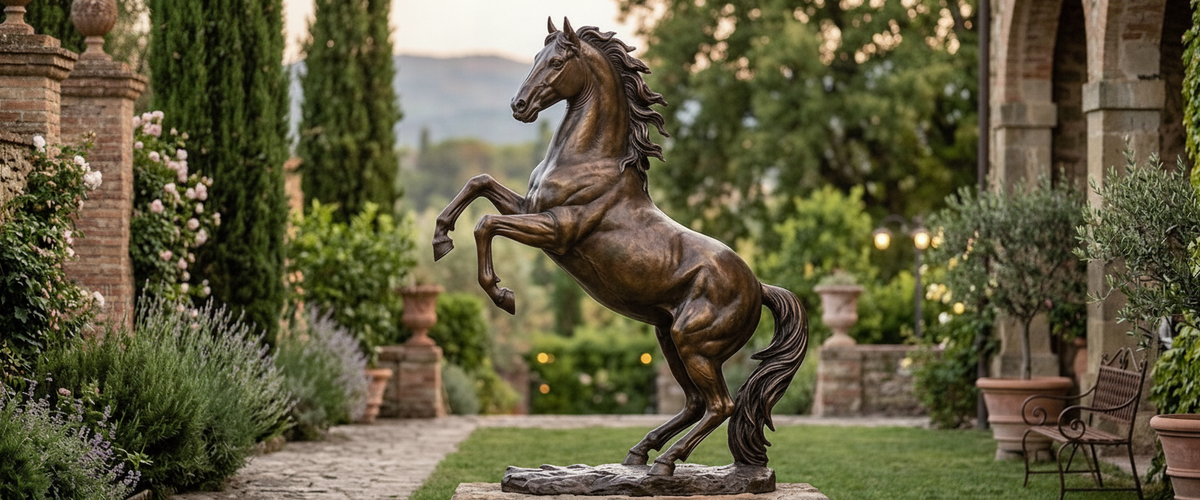
Rearing is the dramatic end of the scale and the hardest to hold up. Where the site can take a deeper footing and a heavier armature, a rearing figure such as the Life-Size Traditional Rearing Horse Bronze Sculpture, 210cm delivers that drama, but it balances its entire mass on two hind legs, with wind load pushing against a raised chest. Soil matters here too. On expansive clay that swells after rain, a local engineer may specify a pad poured deeper than the first drawing shows, and that consultation is money well spent before a rearing horse goes in the ground.
A rearing pose puts the whole mass on two hind legs, so the armature and footing have to do far more work.
Section Seams at the Shoulder and Flank
No foundry casts a life size horse in one pour. The figure is cast in sections, then welded together, and the classic joins sit at the shoulder, flank and neck. A well-chased weld disappears: the metal is ground, re-textured to match the modeled surface and patinated so the color flows across the seam.
Here is a studio habit worth copying. Hold a flashlight low across the flank at dusk. Raking light exposes a lazy seam instantly, and it will look the same way when the evening sun hits your garden. The Tate's note on patina explains why a consistent chemical finish is what finally hides the joins.
Threaded Rods, Concrete Pads and Frost Depth
The armature ends in threaded stainless rods that pass through the hooves and are set into a reinforced concrete pad. Below ground, frost is the quiet enemy. If the pad sits above the local frost line, freezing soil lifts it unevenly and the horse slowly tilts.
Frost depth varies enormously. A garden in Napa may barely freeze, while a property in Aspen or the Hudson Valley needs footings set well below a deep frost line; UK lawns are milder but clay soils still heave. Local building codes set the figure, and your installer or structural engineer should design to it.

Buyer Checklist Before You Commission a Bronze Horse Statue
Armature: stainless steel, running through every load-bearing leg into the footing.
Wall thickness: stated in writing, with reinforcement at the legs.
Pose versus site: check wind exposure and soil type before choosing a rearing figure.
Seams: ask for close-up photos of welded joins after chasing and patina.
Footing drawing: pad size, rod length and depth relative to your local frost line.
Access: confirm crane or lifting routes to the final position.
Choosing a Life Size Bronze Horse With Long Ownership in Mind
Start with the full bronze horse statues collection to narrow down pose and breed, then treat the shortlist as a conversation starter. At Giant Sculptures, most of our horse projects involve some bespoke element: a modified pose, a custom patina, a scaled figure for a courtyard, or an engineered base for a difficult site. Share your location, soil conditions and preferred pose, and we will quote the sculpture and the engineering together, because one without the other is only half an answer.
For wider placement ideas, Bronze Angel Statues for Sale: How to Read a Cast Before You Buy is useful companion reading before finalizing the setting and sightlines.