






































































































The wrong question is "what does it cost?" The right one, at least at the start, is "will this piece still look right in ten years, at the size and site I actually have?" Contemporary outdoor metal work lives or dies on decisions made long before anyone quotes a number, and most of those decisions happen at the maquette stage while the buyer is still thinking about the finished photograph. We spend a lot of time at Giant Sculptures talking clients back from the render and into the reality of weight, weld lines, and weather. A contemporary outdoor metal piece rewards planning far more than it rewards optimism.
This is a look from the studio side. What a maker weighs before agreeing to a contemporary outdoor metal commission, why some pieces read beautifully at 10 ft and fall apart at 30, and the questions that separate a confident workshop from one that will disappoint you two summers later.

Key Takeaways
- Material choice (bronze, stainless steel, Corten) sets the mood, the maintenance, and most of the budget.
- Scale is not a slider. A form that works small often needs re-engineering, not just enlarging, to work large.
- Budget depends on material, scale, complexity, engineering, finishing, and installation. Ask for a tailored quote rather than trusting a headline figure.
- A good studio shows you a maquette and a finish sample before cutting full-size metal.
- Ask about internal armature, drainage, fixings, and site access early. Silence on those points is a red flag.

What Sculptors Actually Think About Before Taking the Commission
Before we agree to a contemporary outdoor metal piece, the studio runs a quiet checklist that has nothing to do with the drawing and everything to do with physics. Where is it going? A rooftop terrace and a lawn put completely different loads on a structure. What is the wind exposure, the freeze-thaw cycle, the salt air? A coastal garden will eat the wrong alloy alive.
Then there is the honest conversation about the form itself. Some ideas that look decisive on paper become fussy in metal, with joins that trap water or thin sections that flex in a gale. A responsible maker will flag that before you fall in love with the sketch. We would rather adjust a curve at the maquette stage than argue with corrosion later. Every contemporary outdoor metal form gets tested against that risk first.
Weight and access come next. Where a client wants a full-height figure to anchor a lawn or courtyard, a piece like the Large Contemporary Headless Figure Bronze Sculpture (220cm) reads as a clean, quiet silhouette, but at that height it needs a real foundation and a clear route in. If a crane cannot reach the spot, the elegant plan on screen is worthless.

Craft Decisions That Change the Result (and the Price)
Material is the first fork in the road for any contemporary outdoor metal project. Cast bronze gives you depth, patina, and a surface that ages with grace; conservation bodies note that a stable patina actually protects the metal beneath, which is why classical bronzes survive centuries outdoors. The Getty Conservation Institute has published extensively on how those surface layers behave over time. Stainless steel goes the other way: crisp, reflective, modern, and happy to hold a mirror polish or a brushed satin finish. Corten, the weathering steel, is chosen precisely for the rust that forms and then seals itself into a warm oxide skin.
Each of those choices carries a cost and a maintenance profile. A mirror-polished stainless piece shows every fingerprint and needs cleaning to stay sharp. Corten will stain a pale stone plinth in its first year, so you plan for run-off. Bronze is forgiving, but the casting and chasing work is labor-heavy, which is where the hours stack up.
Finish is the second fork. On the same bronze form you can push a dark near-black patina, a green verdigris, or a hand-polished highlight on the raised edges. On a form with real surface texture, such as the Large Contemporary Crab Bronze Sculpture (120cm), that treatment does half the design work; the shell catches light differently depending on how the patina is layered and waxed. That labor is real, and it is one reason two pieces of the same size can carry very different quotes.
People often ask for a firm number here. The truthful answer is that price on a contemporary outdoor metal commission tracks material, scale, structural engineering, finishing hours, and installation, so a small change in any of those moves the figure. We quote each commission on its own terms rather than pretending there is a standard rate.

Why Some Pieces Read Right at 10 ft and Wrong at 30
Scale is where good ideas go to die. A form drawn to sit at eye level has a rhythm of detail that suits a close look. Blow it up to double height and place it across a lawn, and that same detail either disappears or turns into visual noise. The silhouette carries a large piece; the surface detail carries a small one. Get those the wrong way round and the sculpture feels off even when nobody can say why.
Enlarging is not a slider you drag. Wall thickness, internal armature, and the ratio of mass to base all have to be recalculated. A leg that was fine at 4 ft (1.2 m) may need to become a hidden steel core at 12 ft (3.7 m) so the piece does not sway. This is why we build a maquette and, for larger commissions, a scale study before anyone commits to full-size fabrication.
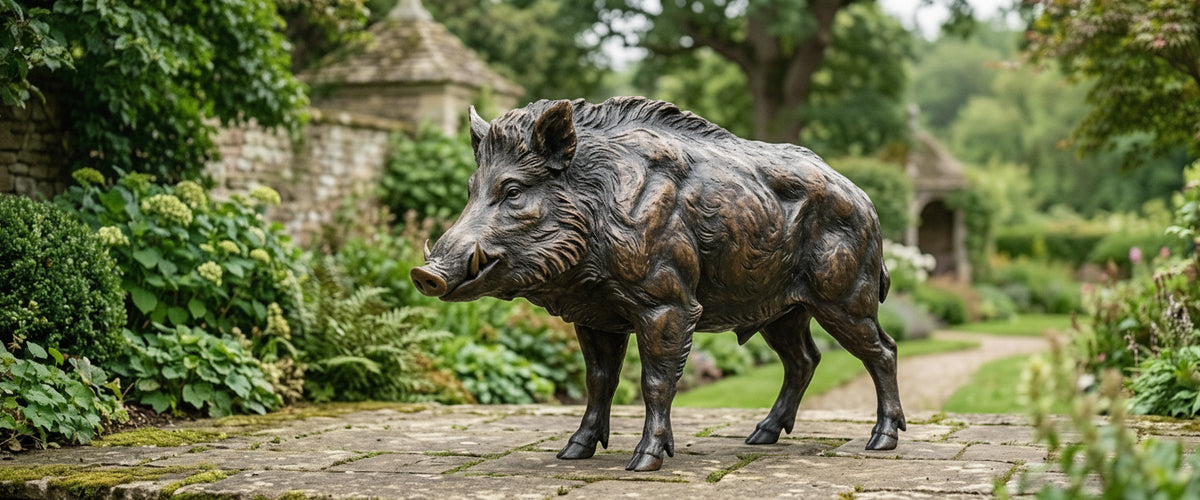
Animal forms show this vividly, and a contemporary outdoor metal animal is a good test case. Where the setting calls for a low, grounded presence, a piece like the Large Contemporary Wild Boar Bronze Sculpture (150cm) keeps weight low and forward, so it reads as powerful from across a courtyard. Take that same posture and stretch it tall and thin and the tension evaporates. The proportion that makes it work is deliberate, not incidental.
Studio Process: Maquette, Sample, Fabrication, Install
A trustworthy contemporary outdoor metal commission moves through clear stages, and each one gives you a decision point.
- Maquette. A small three-dimensional model, usually a fraction of the final height. This is where you approve the gesture and proportion. Changing your mind here is cheap; changing it in full-size metal is not.
- Sample. A physical finish sample in the actual material and patina. Screens lie about color and reflectivity, so we send or show a real swatch before committing the full surface.
- Fabrication. Casting or fabricating the piece, building the internal armature, welding, chasing, and finishing. For metalwork this is the longest stage and the one where craft hours accumulate.
- Install. Foundation, fixing, and placement. This is a site problem as much as a sculpture problem. Access, ground conditions, and lifting equipment all get planned before delivery day, not on it.
One lesson we learned the hard way on a rooftop commission: confirm the elevator dimensions and the loading dock height in writing before finalizing the base plate. A contemporary outdoor metal crate that fits the sculpture perfectly is no use if it cannot make the last 40 ft (12 m) of the trip.
Honest Red Flags Buyers Should Raise Before They Commit
Ask these questions early. The answers tell you whether you are dealing with a real workshop or a middleman.
- What is the internal structure? Any large outdoor piece needs an armature or engineered core, usually stainless steel so it does not corrode inside the metal skin. "We just make the outside" is not an answer.
- How does water drain? Hollow forms must shed water, not hold it. Trapped water freezes, expands, and splits welds.
- What are the fixings? Ask about the base plate, bolt specification, and foundation. A tall piece needs to resist wind uplift, not just sit on the grass.
- Can I see a maquette and a real finish sample? A studio confident in its process will offer both without being pushed.
- Who handles install and site survey? If nobody wants to talk about access and lifting, that risk is quietly being handed to you.
- What does long-term care look like? Bronze wants a periodic wax; stainless wants cleaning; Corten needs run-off planning. A vague answer here means someone has not thought past delivery.
If you want to see the range of surfaces and forms these decisions produce, our metal sculptures and metal wall art collections show how different alloys and finishes behave at scale. For interior or sheltered walls, contemporary outdoor metal wall art follows the same logic, just with less exposure to weather and slightly more freedom in the finish. The rules that govern a contemporary outdoor metal sculpture still apply, only softened.
The best contemporary outdoor metal commissions are the ones where the hard questions got asked first. Material, scale, structure, and site are settled on paper and in a sample before a single full-size cut is made. Get those right and the piece does exactly what a good sculpture should: it looks inevitable, as if the garden or courtyard was always waiting for it. Giant Sculptures builds bespoke contemporary outdoor metal pieces to that standard, and we are happy to talk through a specific site before you commit to anything.
For wider placement ideas, Outdoor Wall Sculpture for Gardens: What Sculptors Weigh Before They Say Yes is useful companion reading before finalising the setting and sightlines.