





































































































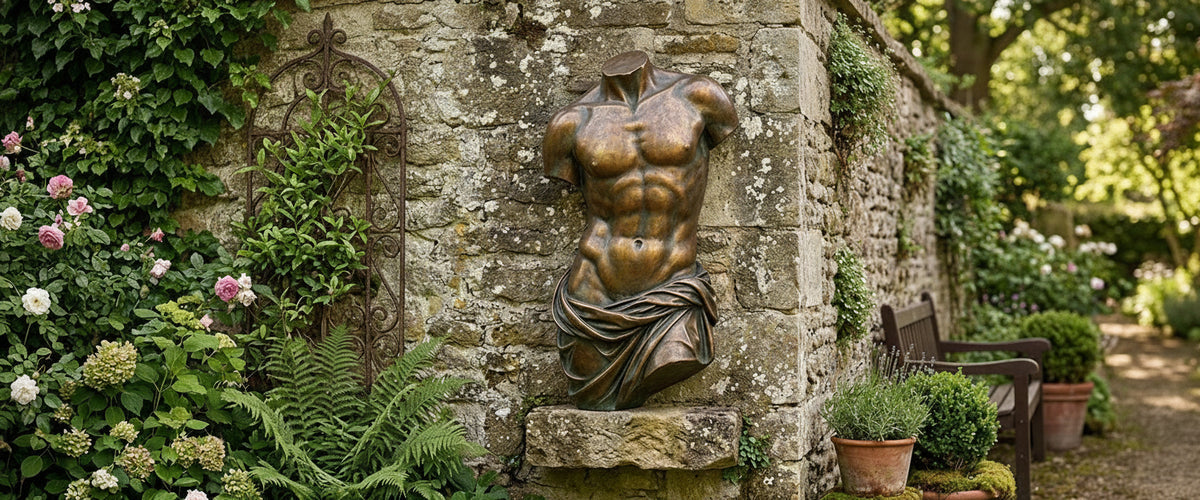

A blank garden wall is one of the hardest briefs a client ever hands us. A lawn forgives you; you can move a plinth six inches and nobody notices. A wall does not. It fixes the viewing angle, the light, the distance, and the moment someone rounds the corner and sees the piece for the first time. Get an outdoor wall sculpture for gardens right and it reads like it grew out of the masonry. Get it wrong and it looks like a picture hung too high in a hallway, except now it weighs 120 pounds (54 kg) and someone drilled into your retaining wall to do it.
So before we quote outdoor wall sculpture gardens work, we ask a lot of questions. Here is what actually goes through a sculptor's head, and what you should be asking us in return.

Key Takeaways
- The wall is the frame. Its material, height, and orientation shape the design as much as your taste does.
- Scale is read at distance, not on a screen. A relief that sings at 10 ft can look thin and fussy at 30.
- Material drives cost and lifespan. Bronze, Corten, and stainless behave very differently outdoors.
- Fixing is engineering, not an afterthought. Weight, wall build-up, and drainage decide the bracket long before anyone talks about looks.
- Budget depends on material, scale, complexity, and installation. Ask for a tailored quote on your outdoor wall sculpture gardens project rather than assuming a figure.

What Sculptors Think About Before Taking on a Garden Wall Commission
The first thing we want to know is what the wall is made of and how it was built. A solid brick or stone wall with a proper footing is a friend. A rendered blockwork screen, a rammed-earth garden divider, or a modern render-over-insulation system is a different conversation entirely, because you cannot simply hang serious weight off insulation board and hope. Any outdoor wall sculpture gardens plan starts with that build-up.
Next comes orientation. A south-facing wall in Napa bakes; a north-facing courtyard wall in the Hamptons stays damp and cool for months. Both facts change the material recommendation and the finish. We also ask about sightlines. Is this piece seen head-on from a terrace, glimpsed at an angle from a path, or lit at night from below? Outdoor wall sculpture for gardens that will mostly be viewed after dark needs relief depth that throws real shadow, not surface detail that vanishes the moment the sun drops.
Then there is the boring, essential stuff: drainage behind the piece, staining runoff onto pale stone or render, and whether the client plans to grow anything up the wall. Ivy and a bronze relief can coexist beautifully. Ivy and an untreated steel bracket cannot.

Craft Decisions That Change the Result (and the Price)
Material is the biggest fork in the road for outdoor wall sculpture gardens. Cast bronze is our default for figurative and classical work outdoors because it ages predictably and takes a patina you can actually specify. Where a large stone facade needs a piece with real mass and deep modeling, a bronze relief such as the Classical Figural Torso Wall Sconce Bronze Sculpture - 90cm holds its own where a lighter, flatter work would simply disappear against the stone.
Corten steel is the choice when a client wants something contemporary that talks to a planted garden. It develops a stable rust-toned oxide layer that seals itself over time, which is why it suits sculptural silhouettes and botanical forms. Stainless steel goes the other way, staying bright and reflective, and it works hardest near water features or where you want the garden wall sculpture to bounce light around a shaded courtyard.
Fabrication method matters too. A hand-modeled relief cast in bronze carries the sculptor's fingerprints and costs accordingly. Where the setting calls for contemporary color and open composition rather than classical weight, a cut-and-welded piece such as the Gold & Azure Landscape Mountain Metal Wall Sculpture - 120cm is closer to the right design language, and it opens up scale and color options that casting cannot match easily. Neither is better. They answer different briefs.
Finish is where budgets quietly climb. A specified patina, hand-applied gilding, a powder coat rated for coastal exposure, or a mirror polish on stainless all add studio hours to your outdoor wall sculpture gardens commission. We would rather tell you that upfront than surprise you.

Why Some Pieces Read Right at 10 ft and Wrong at 30
This is the mistake we see most often. A client falls for a relief in the studio, standing three feet away, admiring the fine detail. Installed on a garden wall viewed from a terrace 30 ft (9 m) away, that same detail collapses into visual noise and the piece looks weak.
Distance eats detail. The further away the main viewing point, the bolder the forms and the deeper the relief needs to be. A shallow, intricate design belongs on a courtyard wall you pass within arm's reach. For a large garden boundary wall seen across a lawn, something like the Copper-Gold Blossom Branch metal wall sculpture (500cm) makes more sense than a fine relief, because its branching form stays legible from a long way off and the composition does the talking before any detail registers. Scale is the quiet decider on outdoor wall sculpture gardens work.
We always ask for the primary viewing distance and, ideally, a photo taken from that exact spot. On a recent commission for a walled garden, the client's chosen wall turned out to sit behind a mature hedge that hid the lower third of the piece from the main terrace. We raised the whole composition 18 inches (46 cm) and redrew the base. Simple fix, but only because we asked before casting, not after.
Studio Process: Maquette, Sample, Fabrication, Install
A bespoke outdoor wall sculpture gardens commission at Giant Sculptures runs in stages, and each one exists to remove risk before it gets expensive.
- Brief and site review. Wall build-up, orientation, viewing distance, lighting, and mood. We flag anything structural early.
- Maquette. A scaled model, usually in clay or a working material, so you can judge proportion and depth in three dimensions rather than on a flat drawing. This is where most design changes should happen.
- Material sample. A patina swatch, a Corten test panel, or a polished stainless offcut so the finish is agreed against real light, not a screen.
- Fabrication. Casting or metalwork, then finishing. On larger pieces we build the fixing system in parallel so the sculpture and its brackets are designed as one object.
- Install. Delivery, wall preparation, and mounting. For heavy work we specify the fixings and coordinate with your builder or landscaper rather than leaving it to chance.
Because we ship worldwide, the install stage often means working with a local contractor to our drawings. Clear fixing specifications and a rated bracket system matter more when we are not the ones holding the drill, and that holds for every outdoor wall sculpture gardens install we ship.
A Quick Buyer's Checklist Before You Commit
- What is the wall actually built from, and can it carry the weight?
- What is the main viewing distance, and is the design bold enough for it?
- Which way does the wall face, and how does light hit it through the day?
- Is the piece lit at night, and does the relief depth suit that?
- Will runoff or patina staining affect pale stone or render below?
- Is the fixing system rated, corrosion-proof, and appropriate for the wall type?
- Does the material suit the climate, especially coastal salt or hard frost?
Honest Red Flags to Ask About Before You Commit
A good studio will welcome hard questions about your outdoor wall sculpture gardens plan. Here are the ones worth asking.
"How is this fixed, exactly?" If the answer is vague, walk carefully. Any exterior wall piece lives or dies on its brackets. For anything with real mass we use stainless fixings into structural substrate, spread the load across multiple points, and leave a ventilation gap so moisture does not sit trapped between metal and wall. The metal wall art collection includes plenty of pieces sized for exterior fixing, but sizing the mount to your specific wall is always a separate, deliberate step.
"What happens to the finish in five years?" Bronze patina evolves, and that is usually a feature; conservation guidance from bodies like the Getty Conservation Institute is clear that outdoor bronze benefits from periodic waxing and gentle cleaning rather than aggressive treatment. Corten's rust layer stabilizes but can stain adjacent surfaces during the first year or two. Ask what the garden wall sculpture will look like after it has weathered, not just on delivery day.
"Can I see a sample before you cast?" Any studio confident in its finish will say yes. If a supplier resists showing you a physical patina or material sample, that is a red flag.
"Who is liable if the fixing fails?" For premium and large-scale work this should be documented, not assumed.
None of this is meant to frighten you off. Well-chosen outdoor wall sculpture gardens can anchor an entire outdoor room and outlast the people who commissioned them. Browse the outdoor wall art and decor range to see the span of scale and material we work in, then tell us about your wall. The more we know before we start, the better the thing we hang on it.
For wider placement ideas, 3d Butterfly Wall Art: What Sculptors Weigh Before They Say Yes is useful companion reading before finalizing the setting and sightlines.