






































































































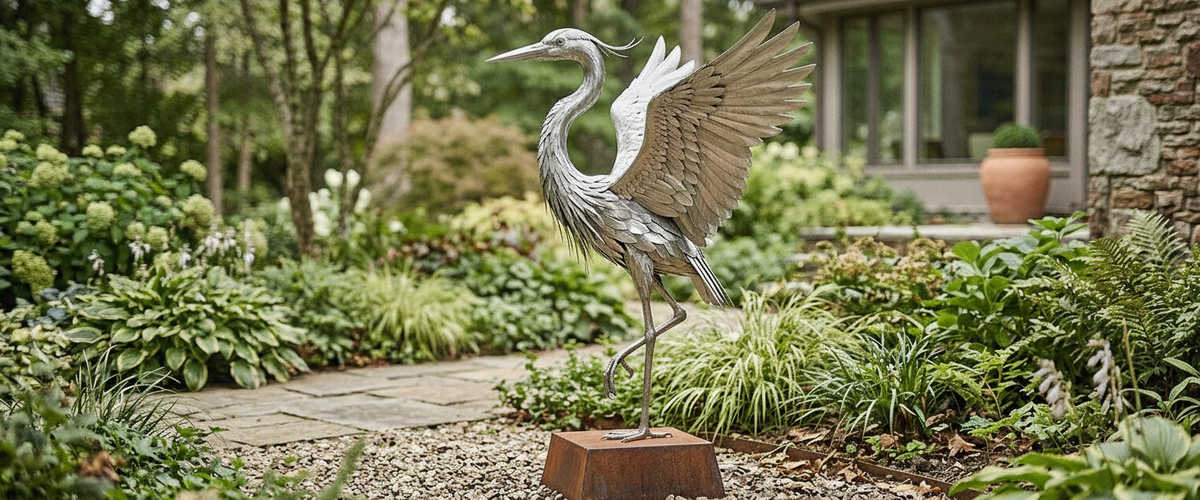

Most metal bird sculptures for sale look convincing in a product photo taken head-on. Turn them ninety degrees and the illusion often collapses. A heron becomes a cookie-cutter silhouette, and a crane becomes a weathervane with ambitions. The method used to make the feathers tells you more about a bird than any listing description. It also tells you how the piece will survive ten winters in Aspen or ten summers in Palm Springs.
At a Glance
Construction method (cut, forged, cast, or welded) decides how much depth and detail a bird can carry.
Flat laser-cut birds need layered sheet to read properly from the side.
Wing roots and necks are where weld shortcuts show first, so inspect them before anything else.
Corten, patinated bronze, and brushed stainless weather gracefully. Paint does not.
Commission when species accuracy, scale, or a difficult site matters more than speed.

Metal Bird Sculptures for Sale: Cut, Forged, Cast or Welded
Every metal bird starts as one of four processes, and each leaves fingerprints. Cut birds are profiled from sheet with a laser or plasma torch. They are crisp, repeatable, and essentially two-dimensional. Forged birds are hammered from hot bar, so feathers are drawn out one by one and no two match. That irregularity is the point.
Cast birds come from a mold, traditionally using the lost-wax process. Casting can carry the barbs of a single flight feather or the wet glint of an eye. Welded or fabricated birds are assembled from panels, rods, or hundreds of individually shaped feathers. Fabrication is how you get a bird with a wingspan larger than a car.
Laser-Cut Sheet Birds Look Flat Side-On, and Layering Is the Only Real Fix
In our studio, we judge a cut bird by walking around it before we look at its face. A single sheet reads well from one angle only. That is fine on a wall and disappointing in the middle of a lawn. The fix is layering: three or more offset plates for the body, primaries folded or rolled so they catch light, and a tail set on a different plane from the wings. If a listing of metal bird sculptures for sale only shows the front, ask for a side photo. Sellers of good layered work are usually happy to send one.
Seen side-on, offset plates and rolled primaries give a cut heron real depth.

Cast Bronze and Aluminum Against Fabricated Steel
Bronze is roughly three times as dense as aluminum, and you feel it. That weight is an asset outdoors, because a cast bronze owl is hard to steal and harder to topple. It also means footings and lifting equipment for anything life-size or larger. Bronze also takes fine cast detail better than most sculptural metals, which is why our bronze animal sculptures lean so heavily on texture.
Cast aluminum suits rooftops, balconies, and suspended pieces where load matters. Detail is softer, and uncoated aluminum near salt air can pit. Fabricated stainless or Corten steel wins on scale. A 10-foot (3 m) wingspan is realistic, and the open construction lets wind pass through instead of pushing against a solid mass.
Check the Wing Root and Neck First
A spread wing is a cantilever. All its weight, plus every gust, hangs off one joint at the shoulder. Long necks behave the same way, acting like a lever on the body. These are the first places a maker saves time, and the first places a buyer should look.
Good work shows a continuous weld that has been ground and blended into the form. Warning signs include tack welds left visible, hairline gaps, a sudden change in metal thickness, or a neck with no internal support. For a crane or heron on an exposed waterfront site, we specify a stainless armature running through each neck for exactly this reason. On that kind of site, the wind off the water never really stops.
A continuous, ground-smooth weld at the wing root is the clearest sign of careful fabrication.

Corten, Patinated Bronze and Brushed Stainless Age Into Plumage
The best outdoor finishes change slowly and look better for it. Corten forms a stable rust layer that deepens to a plumage-like russet. Patinated bronze shifts toward warmer browns and, near the coast, soft greens. Brushed stainless barely changes at all, provided the grade suits the site. For coastal gardens, ask whether the steel is a marine grade such as 316, which the World Stainless Association recommends for chloride-heavy environments.
Paint is the outlier, and it remains common among cheaper metal bird sculptures for sale. A painted metal bird looks cheerful on delivery, then starts to chip at every edge within a few seasons and exposes raw steel underneath. Applied decorative finishes sit somewhere in between. A black and gold surface like the one on the Black and Gold Abstract Scholar's Rock Metal Sculpture - 163cm is striking in a covered loggia or entrance hall, but any finish of that kind deserves a direct question before it goes outside: is it rated for exterior use, or is it happiest under a roof?
A Buyer's Checklist for Metal Bird Sculptures for Sale
Viewing angles: Will the bird be seen from one side or walked around? Walked-around birds need layering, casting, or full fabrication.
Site exposure: Coastal, high desert, or sheltered courtyard? Match the metal and grade to the air.
Joint quality: Ask for close-ups of the wing root, neck, and leg-to-base connection.
Fixing method: Look for a baseplate or threaded studs designed for anchoring, not a bird simply resting on a rock.
Finish honesty: Choose a weathering surface for outdoors, and save painted or decorative finishes for interiors.
Weight and access: Check whether a crane, forklift, or two strong people will be needed on delivery day.

When a Catalog Bird Is Enough, and When a Commission Justifies the Wait
Plenty of metal bird sculptures for sale are exactly right off the shelf, especially indoors. On a console table or bookshelf, the scale is small and nothing has to withstand weather. At that size, mixed materials work well. Brass birds set against a jade-effect resin disc, as in the Amber Jade Effect Pierced Disc & Brass Birds Resin Sculpture - 40cm at about 16 inches (40 cm), bring metal detail into a room without any engineering decisions. In a stairwell or breakfast nook, where the bird is seen from below as often as from the side, a hanging form such as the Yellow Birdcage with Black Bird Hanging Sculpture - 58cm at about 23 inches (58 cm) suits the space better than anything on a plinth.
Commission when the bird has to be a particular bird. A great blue heron for a Texas lake house, a pair of roseate spoonbills for a Florida estate, or a raptor sized to a specific entrance wall all justify the extra weeks of maquettes, approvals, and fabrication. Giant Sculptures handles these bespoke commissions with the species, scale, metal, and anchoring designed around the site. Budget depends on material, size, feather complexity, engineering, installation, and finishing, so the honest route is a tailored quote.
Start by browsing our bird sculptures and wider metal sculptures to see which construction styles appeal to you. When a catalog piece is close but not quite right, that gap is usually the brief for a commission.
For wider placement ideas, Bronze Garden Bird Sculpture: When Verdigris Reads as Plumage and When It Reads as Neglect is useful companion reading before finalising the setting and sightlines.