





































































































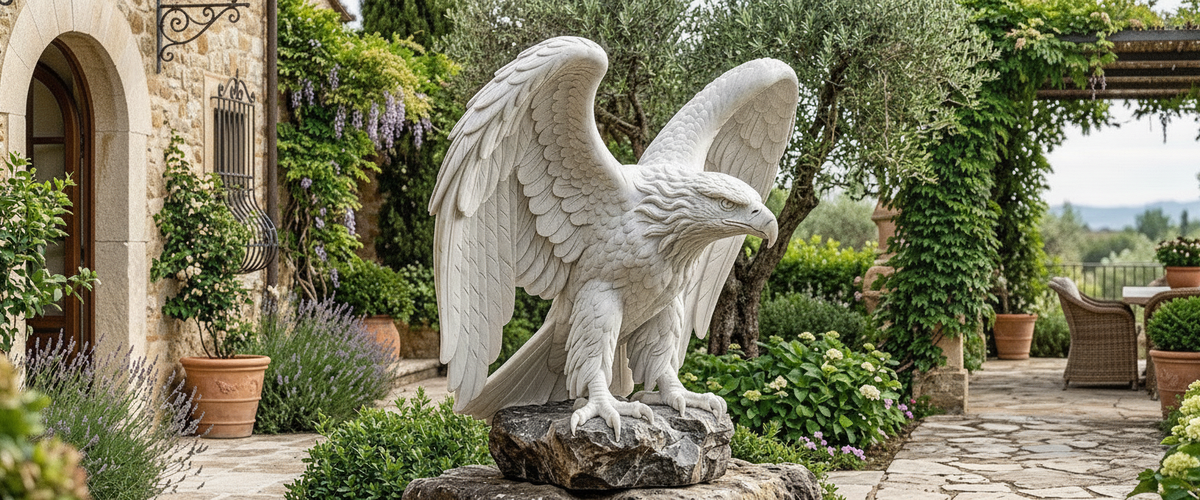

Most marble eagles fail at the feathers. From twenty feet the silhouette reads beautifully, wings cocked, head turned, talons locked onto a rock. Walk up to it and the plumage collapses into a field of shallow scratches with no depth behind them. That gap between distance impression and close inspection is the single biggest quality divide in the category, and it is why choosing a marble eagle statue takes more scrutiny than choosing almost any other animal subject in stone. Feathers punish lazy carving in a way that fur and drapery never do.

Key Takeaways
Judge feathers by shadow, not by line count. Deep undercutting throws a shadow; surface scoring does not.
The marble block size sets the pose. Fully outstretched wings are a bronze idea, not a marble one.
An eagle head bust delivers more drama per cubic foot of stone than a small full figure.
Weather-facing piers in freezing climates want a dense, tight-grained stone, not soft white statuary marble.
Ankles, beak tips and trailing wing edges are the failure points. Ask how each one is supported.
Budget follows stone grade, scale, undercutting complexity, base engineering and crating. Ask for a tailored quote.
The Shadow Test: Reading Feathers on a Marble Eagle Statue
Stand at arm's length and look at where the shadows fall. On a properly carved marble eagle statue, each covert feather has a lifted edge with air behind it, so the stone reads as layered plates rather than an engraved pattern. Tilt your head or move a light source and the shadows shift. On a rushed carve, the feathers are cut with a flat rotary line, all at the same depth, all at the same angle, and the shadow never changes because there is nothing underneath to catch it.
The tell is usually at the shoulder, where the scapular feathers overlap the wing coverts. That is the fiddliest transition on the whole bird, and it is where a carver in a hurry flattens everything into one plane. Check the back of the neck too. Eagle hackles are long and pointed, and they should break the outline of the neck slightly. If the neck is a smooth column with lines drawn on it, keep looking.
Undercut coverts on a marble eagle statue lift clear of the layer beneath and throw a shadow that moves with the light.

Block Size Dictates the Pose
Marble comes out of the quarry as a rectangular block, and everything you carve has to fit inside it. That single fact governs the pose of a marble eagle statue more than any artistic decision. A bird with wings thrown wide in a full raptor spread needs a block wider than it is tall, which is expensive, wasteful and structurally unwise, because those wing tips end up as long unsupported cantilevers of brittle stone. Bronze does that pose happily. Marble refuses.
What marble does superbly is the alighting or mantling pose, where the wings are raised and partly folded, tucked back toward the body so the mass stays inside the cone of the block. At monumental scale that logic is easy to read in a piece like the Alighting Eagle Grey Marble Garden Statue, 220cm (roughly 7 ft 3 in), where the drama sits in the raised wings and forward head while the stone stays connected to itself. Ask any studio for a profile drawing of the block outline over the finished form. If the design pokes outside it in three places, you are looking at a piece that will be joined, and joints need to be declared upfront.
The alighting pose keeps a marble eagle statue inside the cone of the quarry block, with no unsupported wing tips.
Eagle Head or Full Figure: How the Crop Changes Everything
A marble eagle head statue is a different animal from a full-figure bird, and often the smarter buy. Cropping a marble eagle statue to the head and upper breast puts all the carving budget into the features that carry the character: the hooded brow, the cere, the hook of the beak, the hackle feathers breaking over the shoulder. At close range in an entry hall or on a low plinth, a head bust reads as sculpture; a three-foot full-figure eagle usually reads as an ornament.
That trade comes up often. One client planning a nine-foot bird over a vineyard gate settled on a monumental head bust on the pier instead, because the head at that scale hit harder than a full figure would have at the same cost. Where the crop itself becomes the composition, the Horse Head from the Block Marble Statue, 250cm shows how far the idea travels, with the uncut block left visible behind the finished head. If you want the outstretched wings, though, look seriously at cast metal: our bronze eagle statues hold poses that stone cannot.

What the Penn Station Eagles Teach About Stone Choice
People search for marble eagle Penn statues, and the correction is worth making. The famous eagles from the original Pennsylvania Station in New York, designed by Adolph Weinman and installed around 1910, were carved in granite rather than marble. That was a deliberate call for a soot-heavy, freeze-thaw city facade. Weinman's work is well documented through the Smithsonian American Art Museum, and the survivors scattered across campuses and naval sites still show crisp plumage a century on. Granite gave up some carving finesse and bought decades of weather resistance.
Take the same decision seriously before you commit a marble eagle statue to an exposed facade. Classic white Carrara is forgiving to carve and beautiful under soft light, and statuario, with its brighter ground and finer crystal, is the traditional choice for close-viewed figurative work. Both are calcite marbles, which means they are chemically vulnerable to acid rain and mechanically vulnerable to frost. For an exposed pier in Aspen, Chicago or the Hamptons, a denser gray or a harder stone will hold detail far longer. Interior atriums and covered loggias are where the white statuary marbles earn their keep. Where the site is punishing and the feather edges still have to stay razor-sharp, cast metal sidesteps the argument: a bust on the scale of the Large Traditional Eagle Head Bronze Bust, 150cm keeps detail that no calcite marble will hold on an open pier, and that is worth weighing before you settle on stone.
Frost, Spalling and Where Marble Eagles Break
Water gets into the stone, freezes, expands, and lifts the surface off in flakes. Conservation guidance on stone decay, including technical advice published by Historic Environment Scotland, consistently identifies trapped moisture and freeze-thaw cycling as the main driver of surface loss on exposed carved stone. On an eagle, the flat upper wing surfaces and the shallow bowl between the shoulders are exactly where water sits. A marble eagle statue intended for outdoors should shed water: sloped wing tops, no dead-flat ledges, no cupped talon hollows without a drainage path.
Three places fail. The ankles carry a heavy body on thin scaled legs, which is why good outdoor eagles keep a rock, stump or drapery mass connecting body to base. The beak tip is the most exposed projection on the piece and the first casualty of a careless forklift. The trailing wing edge is thin by design and chips easily in handling. Ask where the stone is thinnest and what supports it. A studio that answers precisely is a studio that has carved eagles before.

Commissioning Checklist
Approve a maquette. A scaled model in clay or resin settles head angle and wing height before anyone cuts stone. Head turn is the detail clients change most often.
Confirm the block. Get the quarry stone type, grade and finished orientation in writing, plus a note on any veining that will run through the piece.
Specify the finish. Honed, polished or lightly tooled changes how feathers read. Polished marble outdoors loses its shine unevenly; honed ages more gracefully.
Engineer the base. Marble is heavy. You need a reinforced pad or pier footing, plus stainless dowels and a non-staining setting mortar.
Plan the crate. Custom bracing under the wings, foam contact points at the beak, and a lifting plan agreed before the truck arrives.
Agree access. Crane, gantry or forklift, and whether the route to the pier can carry the load.
Cost for a marble eagle statue tracks stone grade, finished size, how much undercutting the design demands, base engineering, finishing hours and crating for the destination. A gate-pier commission in Texas and an interior bust in a Manhattan lobby can differ enormously even at similar heights, so ask for a tailored quote rather than working from a category average. Look through the wider marble sculptures range and the eagle statues collection to fix your scale first, then talk to us at Giant Sculptures about carving a bespoke bird to the site.
For wider placement ideas, How to Judge a Hermes Marble Sculpture Bust Before You Buy is useful companion reading before finalising the setting and sightlines.