





































































































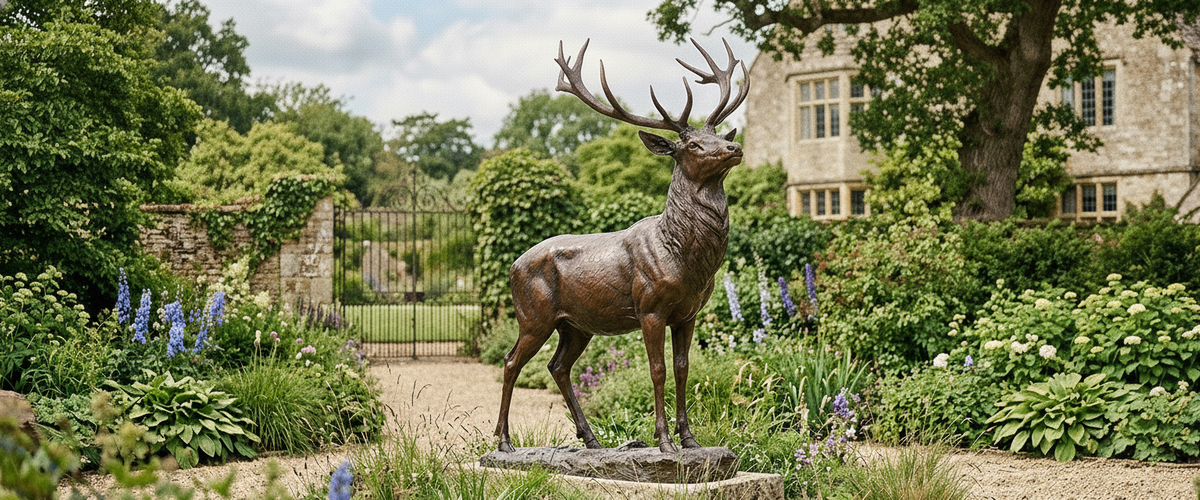

A life size stag sculpture that fills a workshop floor can look like a garden ornament from fifty yards down a lawn. Same casting, same 8 ft 10 in (270 cm) from hoof to antler tip, completely different animal. Interior walls flatter sculpture; open ground eats it. That one fact explains most of the disappointment we hear about after a stag lands somewhere it was never sized for, and it is fixable at the specification stage rather than after delivery.
A standing, head-up figure holds the far end of a long lawn better than any other deer pose.

Key Takeaways Before You Buy
Sight distance sets scale. Under 30 ft (9 m), life size works. Past 100 ft (30 m), you want a stag on a plinth or a larger-than-life casting.
Antlers are a sail. A wide rack catches wind and transfers that load straight down through slim cast legs into the base.
Cast bronze outlasts everything else outdoors. Fabricated stainless and Corten are strong alternatives; resin is not a long-term outdoor answer at this size.
Pose changes the read. Head-up alert holds a long axis; grazing and recumbent poses reward close, intimate placement.
The footing matters more than the finish. A proper concrete pad and stainless fixings keep the hind legs from becoming the failure point.
Why a Life Size Stag Sculpture Shrinks the Moment It Hits the Lawn
Human eyes judge size against nearby reference points. Inside a studio, the reference is a doorway, a workbench, a person. On two acres of mown grass with mature oaks behind it, the reference is a 60 ft tree line, and a real red deer stag is a modest thing by comparison. We have had clients stand next to a 250 cm (8 ft 2 in) casting in our workshop, call it enormous, then ask three weeks later why the same life size stag sculpture looks small at the end of a drive.
The fix is either distance or elevation. Bring the viewing position closer, or lift the piece. A stone or bronze plinth of 18 to 24 in (45 to 60 cm) restores presence without pushing you into a larger-than-life commission. For genuinely long approaches, a grouping does what a single figure cannot. Two animals set at a slight angle to each other, in the manner of the Life-Size Pair of Stags Bronze Sculpture - 240cm, occupy a wider footprint and build their own internal scale, because each animal measures the other.

Antler Spread Is a Wind Load, and It Never Appears on a Quote
Nobody puts "antler sail area" on a specification sheet, but it is the number that decides how a life size stag sculpture is engineered. A mature red deer carries a spread that can approach 3 ft (about 90 cm) across, and the British Deer Society notes that older stags develop increasingly complex tops. Sculpture exaggerates that silhouette because it is the most recognizable part of the animal. Multiply the surface area, add a gale, and you have a lever arm working against four slender legs.
Ask any supplier three things: whether an internal armature runs through the neck and legs, how the antler tines are supported, and what the fixing pattern at the hooves looks like. Our own castings for exposed sites carry heavier wall thickness through the load path and stainless steel threaded rod set into the base. On a Texas ranch commission we specified deeper anchoring than the site plan called for, purely because the piece sat on a rise with nothing upwind of it for half a mile.
Cast Bronze, Resin and Fabricated Steel Measured Against One Hard Winter
Cast bronze is the default for good reason. It develops a stable patina, tolerates freeze-thaw cycles, and can be repaired decades later. The National Park Service guidance on outdoor sculpture is blunt about the real enemy: not weather itself, but neglected surfaces where water sits and salts accumulate. An annual wash and wax is genuinely all most bronze stags need.
Fabricated stainless steel gives you a contemporary, faceted or mirror-finish stag that reads as sculpture rather than taxidermy, and it suits modern architecture where a traditional brown patina can look borrowed from another century. Corten weathers to a rust-orange that sits beautifully against birch and grasses, though it stains anything porous beneath it, so keep it off limestone paving.
Resin and composite are where buyers get burned. They photograph well and ship cheaply, and they are fine under cover. Left outside through a winter of UV, frost and driven rain, thin-walled resin embrittles, and antler tips are the first casualty. If a life size stag sculpture is going outdoors permanently, buy metal. The bronze deer statues range is the clearest place to see why the material carries the subject.

Head-Up Alert or Grazing: What Each Pose Does to a Long Sightline
Pose is a placement decision disguised as a taste decision. A head-up alert life size stag sculpture reads at distance because the antlers break the horizon and the neck line gives you a strong vertical. Where the sightline runs the length of a lawn or across water, a full-height figure such as the Life-Size Standing Stag Bronze Sculpture - 270cm anchors the far end better than anything else in the deer family. A bugling or roaring pose adds narrative energy and works when viewers arrive from the side, since the open mouth and thrown-back head only register in profile.
Grazing and recumbent poses do the opposite. They lose their silhouette at distance but gain enormously up close, where you can read the modeling of the shoulder and the set of the ears. For a terrace, a walled courtyard or a bend in a woodland path where you meet the animal at ten paces, a lower, settled figure like the Life-Size Classical Recumbent Stag at 210cm is the more considered choice. Put the same piece at the end of a 200 ft avenue and it disappears into the mowing stripes.
Plinth and Footing: Stop the Hind Legs Becoming the Weak Point
Deer sculptures fail at the hocks. The rear legs carry the mass, the pose usually loads them asymmetrically, and the ground beneath them moves. A reinforced concrete pad below frost depth, sized to the footprint and cured before installation, solves most of it. Bed the base on non-shrink grout rather than mortar, use stainless fixings so nothing bleeds rust down the plinth, and leave a drainage fall so meltwater runs away from the hooves.
Turf installations need a hidden pad set flush, or mowers will clip the base for the next twenty years. That was a lesson from a Hamptons garden where the maintenance crew shaved the same corner of a bronze plinth three seasons running.
On a ridge line, the antlers do their work against open sky rather than competing foliage.
Backdrops That Give the Antlers Something to Cut Against
The antlers are the whole point, so give them contrast. Dark evergreen hedging, a pale render wall, open sky on a ridge line, or a still water surface will all hold the shape. Dappled woodland at the same tonal value as a mid-brown patina swallows it entirely. Test with a stake and a cardboard silhouette before you pour concrete; it takes an afternoon and saves a relocation.
Buyer's Checklist for a Life Size Bronze Stag Sculpture in the UK or US
Measure your primary viewing distance and the width of the backdrop behind the piece.
Confirm alloy, wall thickness, armature and fixing detail in writing.
Check exposure: coastal salt, prevailing wind direction, frost depth.
Plan access for a crane or telehandler; these are machine-lift pieces.
Agree patina color against your architecture, not against a photograph.
Book an annual wash and wax into the estate maintenance calendar.
Budget depends on scale, alloy, complexity of the antlers, engineering, finishing and installation, so ask for a tailored quote rather than working from a headline figure.

Field Notes from Stag Commissions on Estates and Hotel Grounds
Demand for a life size bronze stag sculpture in the UK tends to come from estates and country hotels wanting a piece that works year-round, usually in a mid-brown or green patina that sits with existing stonework. American buyers more often want a stag as a focal point at the head of a drive or in a sculpture walk. Both groups underestimate the same thing: how much a life size stag sculpture changes across a day. Morning backlight turns it into pure silhouette; flat noon light kills the modeling; late sun rakes the shoulder and brings the whole animal alive. Site it for the hour you actually use the garden.
Giant Sculptures works on both catalog castings and fully bespoke stags, scaling a pose, adjusting antler configuration or matching a patina to existing metalwork, and we ship a life size bronze stag sculpture to UK estates and US properties alike. If you are still comparing options, the wider wildlife sculptures collection is a useful way to see how different animals hold different distances before you settle on a stag.
For wider placement ideas, Pounds Before Inches: Buying a Life Size Bronze Statue Without Surprises is useful companion reading before finalising the setting and sightlines.