






































































































Most first-time buyers measure the space before they buy a life size bronze statue. Height clears the pergola, width clears the path, done. Then the crate lands and the questions start: can the terrace take it, where do the bolts go, why is there a faint line running down the shoulder. Bronze is unforgiving of guesswork, so we front-load the awkward questions long before a life size bronze statue is cast.

Quick Answer: What Matters Most
Weight beats height. A hollow-cast standing figure typically lands in the hundreds of pounds, not the tons people imagine. Multi-figure groups and animals change that fast.
Wall thickness is a craft decision. Roughly an eighth to a quarter inch (about 3 to 6 mm) of bronze, thicker where load gathers.
Seams are unavoidable on large casts. Good foundries hide them; poor ones leave them across a face.
The anchor usually fails before the bronze does. Specify the fixings and the pad, not just the statue.
Access is the real constraint. Gate piers, turning circles, elevator depth and soft ground for crane outriggers all shape how a life size bronze statue reaches its final position.
Pounds Before Inches: What Life Size Really Asks of Your Floor or Lawn
Bronze is dense, close to three times the weight of the same volume of concrete. That is why nobody sane casts a life size bronze statue solid. Hollow casting keeps a full-height figure in a range two riggers and a stair-climbing dolly can handle on a good day, while a rearing horse or a two-figure group moves into machine territory.
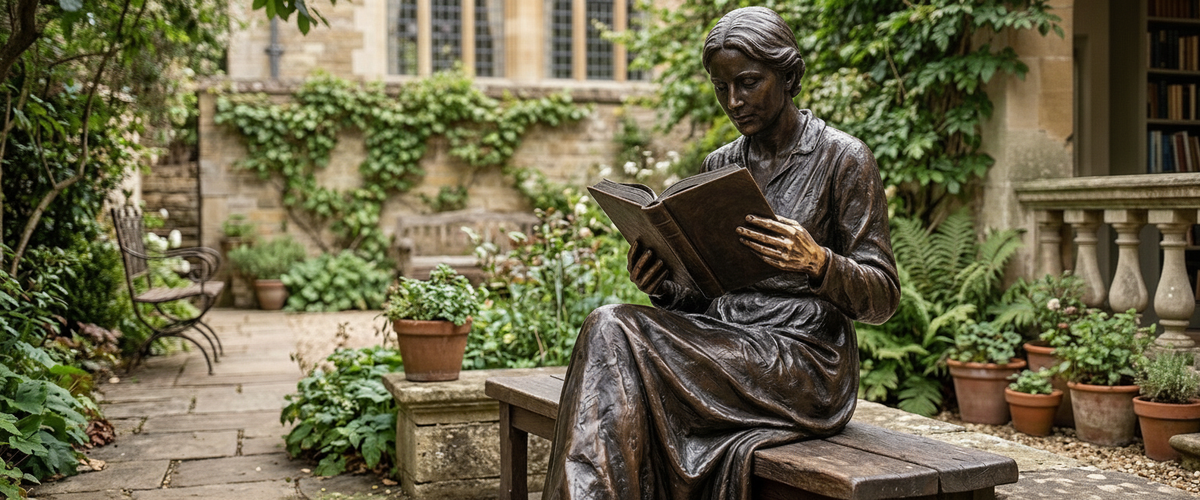
The number that matters is not total weight but pressure per square inch at the base. A seated figure spreads its load over a broad seat and thigh contact; a standing figure on two narrow feet concentrates it. Where a terrace has limited capacity, a seated composition such as the Life-Size Modern Seated Reader Bronze Sculpture - 170cm is a far easier structural proposition than the same mass balanced on two ankles. On a timber roof terrace in NYC, that difference decides whether a life size bronze statue needs a structural engineer's sign-off. On a lawn, it decides whether the piece slowly tilts over two wet winters. We set one seated figure straight onto gravel in a Napa courtyard because the client wanted it that way, and still poured a hidden concrete pad underneath, because gravel moves and bronze remembers.
A seated composition spreads its load across a broad base, which is far kinder to terraces and timber decks than two narrow feet.

Hollow Casting and the Internal Armature
Lost-wax casting has barely changed in principle for three thousand years: a wax version of the sculpture is invested in a ceramic shell, the wax is burned out, and molten bronze fills the void. The modern skill is in control. Wall thickness is tuned across the form, thinner in broad sheltered areas, thickened at ankles, wrists, tails and any point carrying the piece's weight or catching wind.
Inside, a slender life size bronze statue needs an armature. We specify stainless steel, and we ask about it every time we assess a foundry, because mild steel armatures are the quiet killer of older outdoor bronzes. Steel rusts, rust expands, and the expansion splits the bronze skin from the inside. Mounting studs should be welded to that internal structure, not just tacked to the shell, so the load path runs from the bolt into the frame rather than through a quarter inch of skin.
Where the Seams Land on a Sectional Cast
Every life size bronze statue at full human scale or larger is cast in sections and joined. Arms, tails, wings and outstretched limbs come off the main body, get welded with rods of matching alloy, then chased, textured and patinated so the join disappears into the surface. The tell of a careful foundry is seam placement: along a hairline, inside a garment fold, under a jaw, behind a haunch. The tell of a careless one is a weld line crossing a cheekbone or the flat of a chest, where light rakes across it and shows a slight ridge forever.
Extended forms make this obvious. On a piece like the Life-Size Classical Walking Unicorn Bronze Sculpture - 240cm, the legs, tail and horn have to be separate casts, so the quality of the chasing decides whether you read a single animal or a kit of parts. Ask to see photos of the piece mid-assembly. Foundries proud of their chasing are happy to send them, and the National Sculpture Society is a good starting point for understanding the standards professional sculptors expect from their casters.
Legs, tail and horn arrive as separate casts; chasing and re-texturing the welds is what makes the animal read as one piece.

Ground Bearing, Plinth Depth and the Anchor Bolt That Fails First
Bronze outlives almost everything around it. The failure point is nearly always the connection. Outdoors, a life size bronze statue needs a reinforced concrete pad taken below the local frost line, sized to the footprint rather than the figure, with the anchors cast or resin-set into it. Use stainless steel or silicon bronze fixings; plain galvanized steel bolted into a bronze base plate sets up a galvanic couple that eats the fastener from the inside out.
Height adds wind load, and a taller piece on a raised plinth acts like a sail with a lever arm. An upward-reaching composition such as the Life-Size Contemporary Man and Eagle Bronze Sculpture - 200cm reads best lifted on stone, but the plinth then becomes structural and needs its own reinforcement and dowelling into the pad. Where a piece will sit in a lawn or Aspen-style graded slope, we also plan drainage so water never pools at the base plate.
Doorways, Crane Lines and Turning Circles
Before we quote installation on a bespoke commission, we run a site survey, and it is deliberately dull. Narrowest pinch point on the route. Gate pier spacing. Overhead cables and low branches on the crane line. Driveway turning circle for a flatbed. Ground firmness where the outriggers will sit. For interiors, elevator car depth and door swing, plus the diagonal on any stair turn.
We learned this properly on a Hamptons delivery years ago where the drive was generous and the gate piers were not, which cost half a day and a rented telehandler. Now we ask for photos and a measurement of the tightest point on every job. It takes ten minutes and saves a fortune.
Patina for a Piece People Will Touch
A chemical patina is a controlled surface reaction, sealed with wax or lacquer. Put a life size bronze statue where people pass within arm's reach and they will touch it, always in the same places: a hand, a hip, a nose, a knee. Those spots polish back to raw gold. You can fight that with barriers, or design for it by asking the studio to rub highlights into those areas from the start so the wear reads as intention.
Long-term care is simple and non-negotiable: rinse, dry, and re-wax exterior work at least annually, more often in coastal salt air. Conservation guidance from the American Institute for Conservation is worth reading before anyone reaches for an abrasive pad or a pressure washer.

Checklist Before You Commission a Life Size Bronze Statue
Confirm approximate crated and uncrated weight, plus base footprint dimensions.
Ask about wall thickness and armature material.
Request seam locations and in-progress assembly photos.
Check floor or ground bearing capacity with an engineer for terraces, decks and roofs.
Specify pad depth, reinforcement and stainless or silicon bronze anchors.
Measure the tightest point on the delivery route, including height.
Agree the patina recipe and where highlights will sit.
Book the first wax service into the calendar at handover.
On budget: cost tracks alloy volume, scale, complexity of the pose, the amount of hand chasing, engineering and structural work, patina, crating and installation. Two pieces of identical height can differ substantially once one has outstretched limbs and a second figure. We quote each life size bronze statue individually, and we would rather price the pad and the rigging honestly than leave you to discover them later. Browse the life size and large statues range or the bronze horse statues for a sense of scale, then send us the site photos and we will work backwards from there.
For wider placement ideas, Life Size Greek Statues: Read the Knees Before You Read the Price is useful companion reading before finalising the setting and sightlines.